 Add to Chrome
 Add to Firefox
 Add to Edge
Grounding Hierarchical Vision-Language-Action Models Through Explicit Language-Action Alignment
Apr 07, 2026
Achieving robot transparency is a critical step toward effective human-robot collaboration. To be transparent, a robot's natural language communication must be consistent with its actions and explicitly grounded in the task and environment. Existing hierarchical Vision-Language-Action (VLA) models can generate language (e.g., through chain-of-thought) and low-level actions. However, current work does not consider explicit alignment between these modalities during training. To address this crucial gap, we propose a novel training framework that explicitly grounds hierarchical VLA sub-task descriptions with respect to the visual observation and action space. Our framework uses a contrastive model to assess the alignment between generated language and corresponding action trajectories. This contrastive model enables direct ranking of different language-trajectory pairs based on their alignment, allowing us to refine the grounding of our hierarchical VLA through offline preference learning. We apply our framework to the LanguageTable dataset, a benchmark dataset of human language-annotated trajectories, and provide critical insights into multimodal grounding representations, all while establishing a strong baseline that achieves performance comparable to fully supervised fine-tuning and minimizing the need for costly data annotations.

Hierarchical, Interpretable, Label-Free Concept Bottleneck Model
Apr 02, 2026Concept Bottleneck Models (CBMs) introduce interpretability to black-box deep learning models by predicting labels through human-understandable concepts. However, unlike humans, who identify objects at different levels of abstraction using both general and specific features, existing CBMs operate at a single semantic level in both concept and label space. We propose HIL-CBM, a Hierarchical Interpretable Label-Free Concept Bottleneck Model that extends CBMs into a hierarchical framework to enhance interpretability by more closely mirroring the human cognitive process. HIL-CBM enables classification and explanation across multiple semantic levels without requiring relational concept annotations. HIL-CBM aligns the abstraction level of concept-based explanations with that of model predictions, progressing from abstract to concrete. This is achieved by (i) introducing a gradient-based visual consistency loss that encourages abstraction layers to focus on similar spatial regions, and (ii) training dual classification heads, each operating on feature concepts at different abstraction levels. Experiments on benchmark datasets demonstrate that HIL-CBM outperforms state-of-the-art sparse CBMs in classification accuracy. Human evaluations further show that HIL-CBM provides more interpretable and accurate explanations, while maintaining a hierarchical and label-free approach to feature concepts.
Joint Action Language Modelling for Transparent Policy Execution
Apr 14, 2025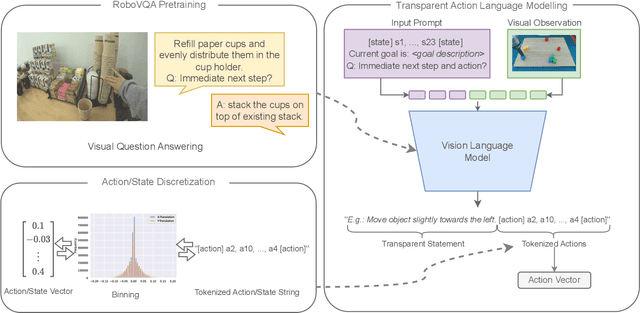
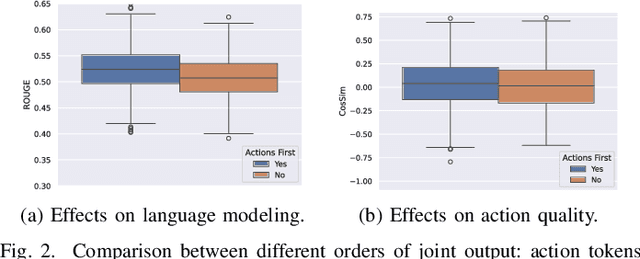
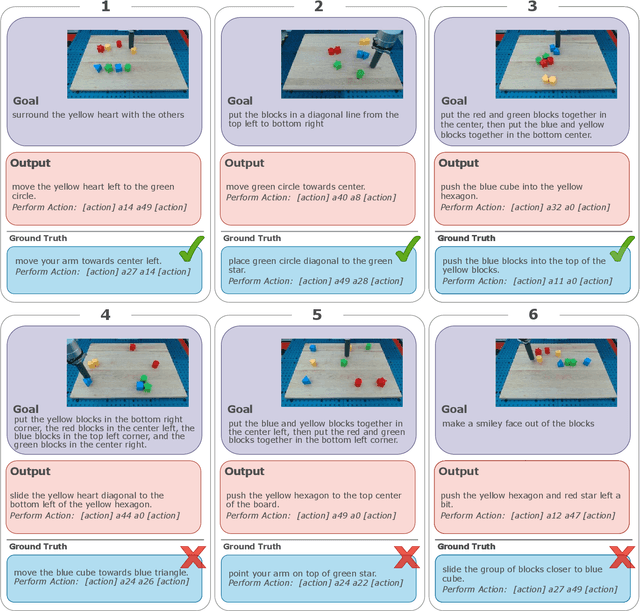
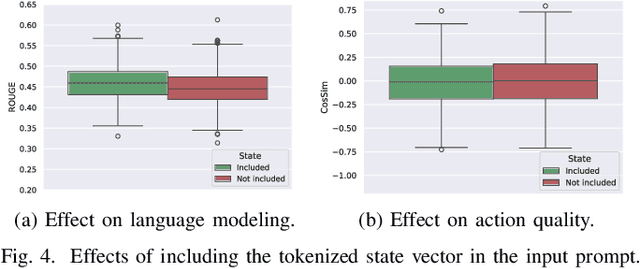
An agent's intention often remains hidden behind the black-box nature of embodied policies. Communication using natural language statements that describe the next action can provide transparency towards the agent's behavior. We aim to insert transparent behavior directly into the learning process, by transforming the problem of policy learning into a language generation problem and combining it with traditional autoregressive modelling. The resulting model produces transparent natural language statements followed by tokens representing the specific actions to solve long-horizon tasks in the Language-Table environment. Following previous work, the model is able to learn to produce a policy represented by special discretized tokens in an autoregressive manner. We place special emphasis on investigating the relationship between predicting actions and producing high-quality language for a transparent agent. We find that in many cases both the quality of the action trajectory and the transparent statement increase when they are generated simultaneously.
Attributes-aware Visual Emotion Representation Learning
Apr 09, 2025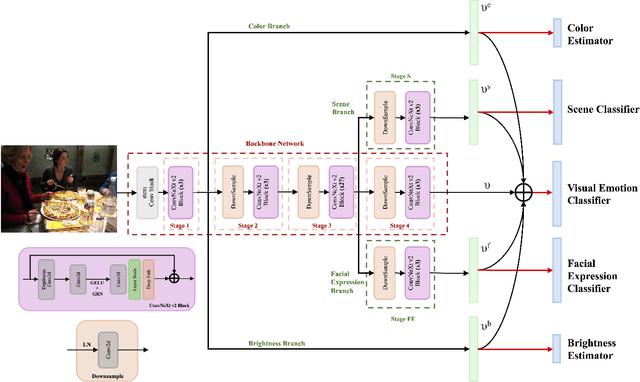


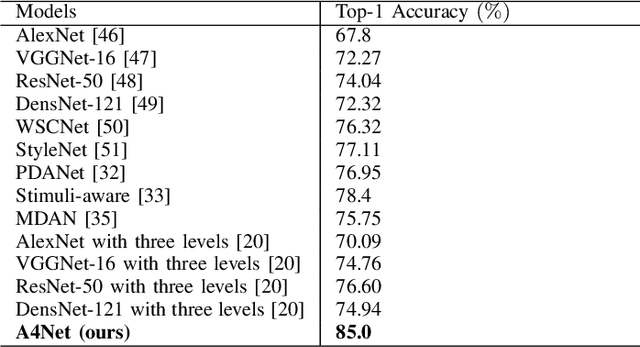
Visual emotion analysis or recognition has gained considerable attention due to the growing interest in understanding how images can convey rich semantics and evoke emotions in human perception. However, visual emotion analysis poses distinctive challenges compared to traditional vision tasks, especially due to the intricate relationship between general visual features and the different affective states they evoke, known as the affective gap. Researchers have used deep representation learning methods to address this challenge of extracting generalized features from entire images. However, most existing methods overlook the importance of specific emotional attributes such as brightness, colorfulness, scene understanding, and facial expressions. Through this paper, we introduce A4Net, a deep representation network to bridge the affective gap by leveraging four key attributes: brightness (Attribute 1), colorfulness (Attribute 2), scene context (Attribute 3), and facial expressions (Attribute 4). By fusing and jointly training all aspects of attribute recognition and visual emotion analysis, A4Net aims to provide a better insight into emotional content in images. Experimental results show the effectiveness of A4Net, showcasing competitive performance compared to state-of-the-art methods across diverse visual emotion datasets. Furthermore, visualizations of activation maps generated by A4Net offer insights into its ability to generalize across different visual emotion datasets.
From Concrete to Abstract: A Multimodal Generative Approach to Abstract Concept Learning
Oct 03, 2024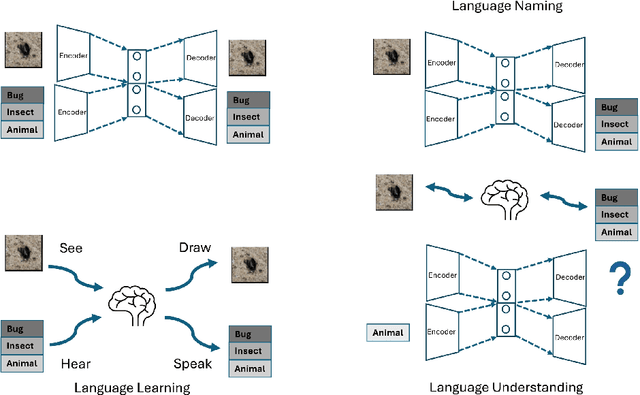
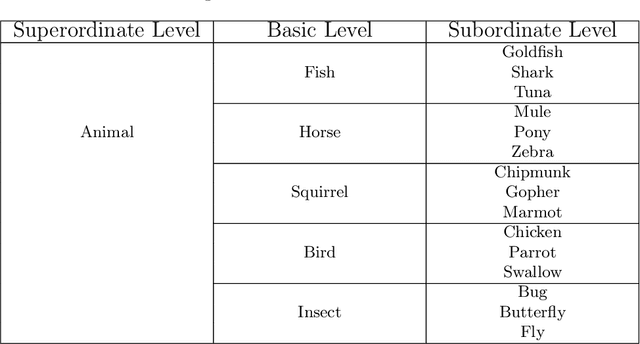
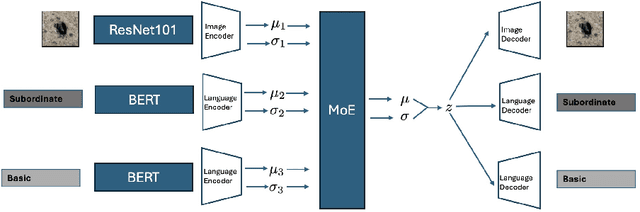
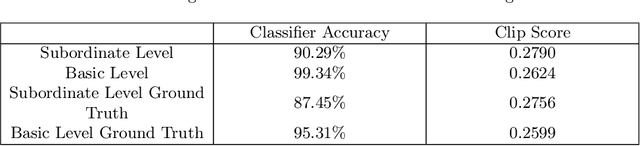
Understanding and manipulating concrete and abstract concepts is fundamental to human intelligence. Yet, they remain challenging for artificial agents. This paper introduces a multimodal generative approach to high order abstract concept learning, which integrates visual and categorical linguistic information from concrete ones. Our model initially grounds subordinate level concrete concepts, combines them to form basic level concepts, and finally abstracts to superordinate level concepts via the grounding of basic-level concepts. We evaluate the model language learning ability through language-to-visual and visual-to-language tests with high order abstract concepts. Experimental results demonstrate the proficiency of the model in both language understanding and language naming tasks.
Noise-Free Explanation for Driving Action Prediction
Jul 08, 2024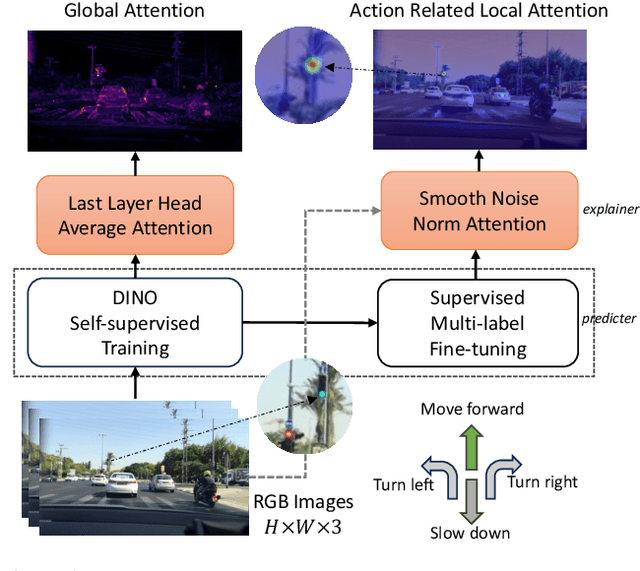

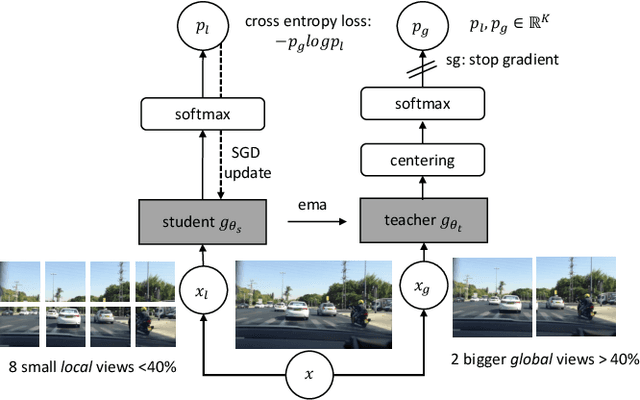
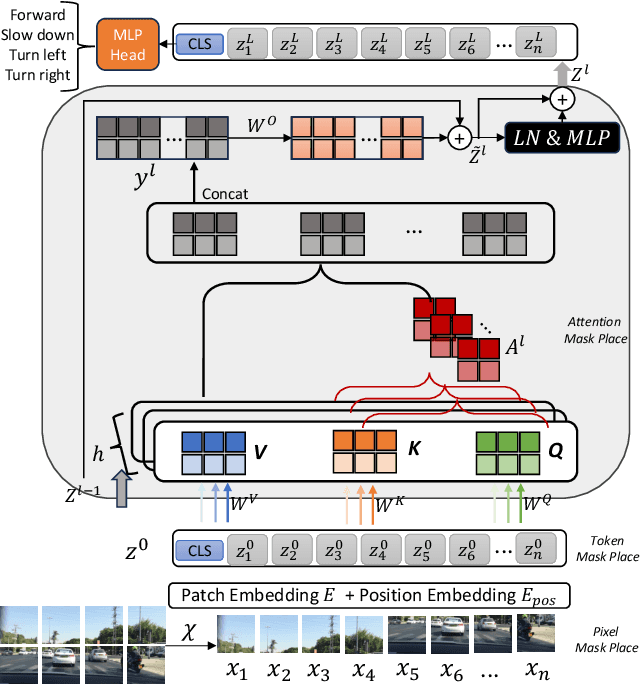
Although attention mechanisms have achieved considerable progress in Transformer-based architectures across various Artificial Intelligence (AI) domains, their inner workings remain to be explored. Existing explainable methods have different emphases but are rather one-sided. They primarily analyse the attention mechanisms or gradient-based attribution while neglecting the magnitudes of input feature values or the skip-connection module. Moreover, they inevitably bring spurious noisy pixel attributions unrelated to the model's decision, hindering humans' trust in the spotted visualization result. Hence, we propose an easy-to-implement but effective way to remedy this flaw: Smooth Noise Norm Attention (SNNA). We weigh the attention by the norm of the transformed value vector and guide the label-specific signal with the attention gradient, then randomly sample the input perturbations and average the corresponding gradients to produce noise-free attribution. Instead of evaluating the explanation method on the binary or multi-class classification tasks like in previous works, we explore the more complex multi-label classification scenario in this work, i.e., the driving action prediction task, and trained a model for it specifically. Both qualitative and quantitative evaluation results show the superiority of SNNA compared to other SOTA attention-based explainable methods in generating a clearer visual explanation map and ranking the input pixel importance.