 Add to Chrome
 Add to Firefox
 Add to Edge
Hierarchical, Interpretable, Label-Free Concept Bottleneck Model
Apr 02, 2026
Concept Bottleneck Models (CBMs) introduce interpretability to black-box deep learning models by predicting labels through human-understandable concepts. However, unlike humans, who identify objects at different levels of abstraction using both general and specific features, existing CBMs operate at a single semantic level in both concept and label space. We propose HIL-CBM, a Hierarchical Interpretable Label-Free Concept Bottleneck Model that extends CBMs into a hierarchical framework to enhance interpretability by more closely mirroring the human cognitive process. HIL-CBM enables classification and explanation across multiple semantic levels without requiring relational concept annotations. HIL-CBM aligns the abstraction level of concept-based explanations with that of model predictions, progressing from abstract to concrete. This is achieved by (i) introducing a gradient-based visual consistency loss that encourages abstraction layers to focus on similar spatial regions, and (ii) training dual classification heads, each operating on feature concepts at different abstraction levels. Experiments on benchmark datasets demonstrate that HIL-CBM outperforms state-of-the-art sparse CBMs in classification accuracy. Human evaluations further show that HIL-CBM provides more interpretable and accurate explanations, while maintaining a hierarchical and label-free approach to feature concepts.

From Concrete to Abstract: A Multimodal Generative Approach to Abstract Concept Learning
Oct 03, 2024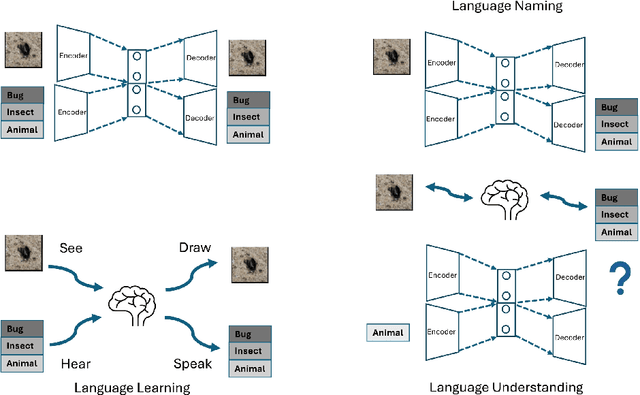
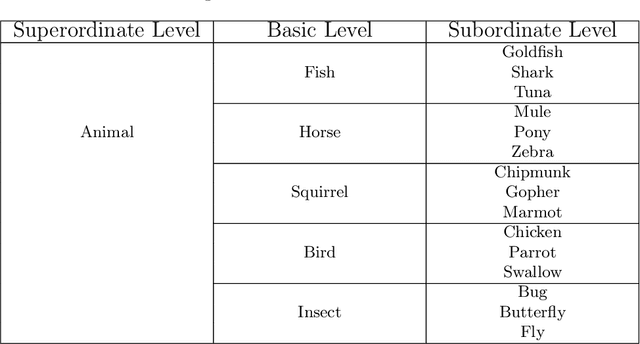
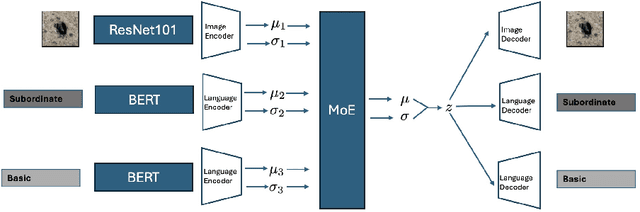
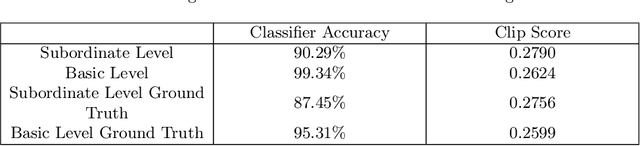
Understanding and manipulating concrete and abstract concepts is fundamental to human intelligence. Yet, they remain challenging for artificial agents. This paper introduces a multimodal generative approach to high order abstract concept learning, which integrates visual and categorical linguistic information from concrete ones. Our model initially grounds subordinate level concrete concepts, combines them to form basic level concepts, and finally abstracts to superordinate level concepts via the grounding of basic-level concepts. We evaluate the model language learning ability through language-to-visual and visual-to-language tests with high order abstract concepts. Experimental results demonstrate the proficiency of the model in both language understanding and language naming tasks.