 Add to Chrome
 Add to Firefox
 Add to Edge
Density-Ratio Losses for Post-Hoc Learning to Defer
May 19, 2026
We study post-hoc Learning to Defer (L2D) through the lens of ideal distributions: divergence-regularized reweightings of the data distribution under which a model attains low loss. We define deferral via the density-ratio between a model's and an expert's ideals. Using the reduction from density-ratio estimation to class-probability estimation, we derive the DR CPE losses for post-hoc L2D scorers. Deferral decisions are then made by thresholding the scorer, allowing deferral rates to be adjusted without retraining. For KL-based ideal distributions, our deferral rules recovers Chow's rule under the original distribution and a connection to an expert-tilted Bayes posterior -- which incorporates the expert's performance -- depending on if the ideal distributions are joint or marginal distributions. Experimentally, our approach is competitive compared to common baselines and more robust across dataset settings. More broadly, our results cast post-hoc L2D as density-ratio learning between ideal distributions, bridging Chow-style rules, expert comparison, and elucidating connections to related learning settings including anomaly detection.

A Hierarchical Sampling Framework for bounding the Generalization Error of Federated Learning
May 05, 2026We study expected generalization bounds for the Hierarchical Federated Learning (HFL) setup using Wasserstein distance. We introduce a generalized framework in which data is sampled hierarchically, and we model it with a multi-layered tree structure that induces dependencies among the clients' datasets. We derive generalization bounds in terms of Wasserstein distance under the Lipschitz assumption on the loss function, by applying a supersample construction that allows us to measure the sensitivity of the algorithm to the change of a single node in the sampling tree. By leveraging the FL structure, we recover and strictly imply existing state-of-the-art conditional mutual information (CMI) bounds in the case of bounded losses. We also show that our bound can be applied together with Differential Privacy assumptions, to recover generalization bounds based on algorithmic privacy. To assess the tightness of our bounds, we study the Gaussian Location Model (GLM) and show that we recover the actual asymptotic rate of the generalization error.
A Coding-Theoretic Analysis of Hyperspherical Prototypical Learning Geometry
Jul 10, 2024Hyperspherical Prototypical Learning (HPL) is a supervised approach to representation learning that designs class prototypes on the unit hypersphere. The prototypes bias the representations to class separation in a scale invariant and known geometry. Previous approaches to HPL have either of the following shortcomings: (i) they follow an unprincipled optimisation procedure; or (ii) they are theoretically sound, but are constrained to only one possible latent dimension. In this paper, we address both shortcomings. To address (i), we present a principled optimisation procedure whose solution we show is optimal. To address (ii), we construct well-separated prototypes in a wide range of dimensions using linear block codes. Additionally, we give a full characterisation of the optimal prototype placement in terms of achievable and converse bounds, showing that our proposed methods are near-optimal.
A note on generalization bounds for losses with finite moments
Mar 25, 2024
This paper studies the truncation method from Alquier [1] to derive high-probability PAC-Bayes bounds for unbounded losses with heavy tails. Assuming that the $p$-th moment is bounded, the resulting bounds interpolate between a slow rate $1 / \sqrt{n}$ when $p=2$, and a fast rate $1 / n$ when $p \to \infty$ and the loss is essentially bounded. Moreover, the paper derives a high-probability PAC-Bayes bound for losses with a bounded variance. This bound has an exponentially better dependence on the confidence parameter and the dependency measure than previous bounds in the literature. Finally, the paper extends all results to guarantees in expectation and single-draw PAC-Bayes. In order to so, it obtains analogues of the PAC-Bayes fast rate bound for bounded losses from [2] in these settings.
More PAC-Bayes bounds: From bounded losses, to losses with general tail behaviors, to anytime-validity
Jun 21, 2023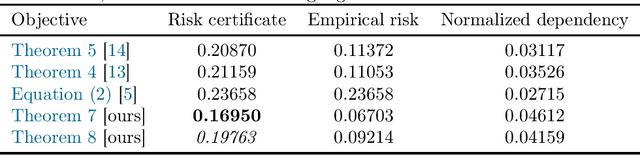
In this paper, we present new high-probability PAC-Bayes bounds for different types of losses. Firstly, for losses with a bounded range, we present a strengthened version of Catoni's bound that holds uniformly for all parameter values. This leads to new fast rate and mixed rate bounds that are interpretable and tighter than previous bounds in the literature. Secondly, for losses with more general tail behaviors, we introduce two new parameter-free bounds: a PAC-Bayes Chernoff analogue when the loss' cumulative generating function is bounded, and a bound when the loss' second moment is bounded. These two bounds are obtained using a new technique based on a discretization of the space of possible events for the "in probability" parameter optimization problem. Finally, we extend all previous results to anytime-valid bounds using a simple technique applicable to any existing bound.
Limitations of Information-Theoretic Generalization Bounds for Gradient Descent Methods in Stochastic Convex Optimization
Dec 27, 2022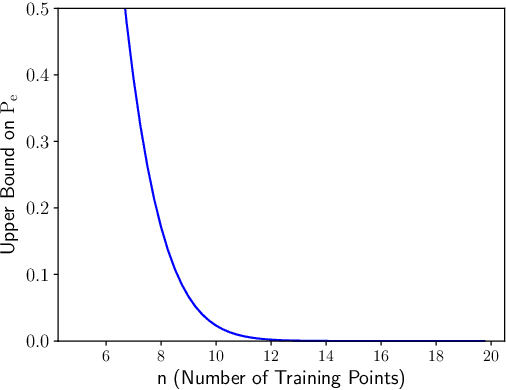
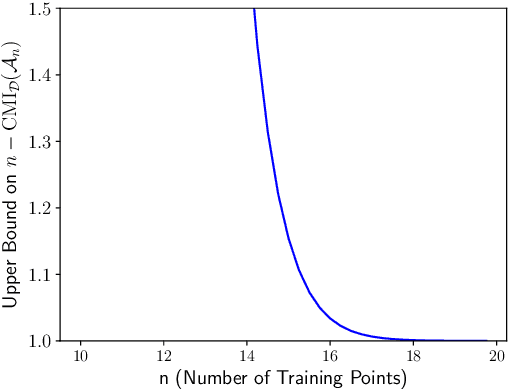
To date, no "information-theoretic" frameworks for reasoning about generalization error have been shown to establish minimax rates for gradient descent in the setting of stochastic convex optimization. In this work, we consider the prospect of establishing such rates via several existing information-theoretic frameworks: input-output mutual information bounds, conditional mutual information bounds and variants, PAC-Bayes bounds, and recent conditional variants thereof. We prove that none of these bounds are able to establish minimax rates. We then consider a common tactic employed in studying gradient methods, whereby the final iterate is corrupted by Gaussian noise, producing a noisy "surrogate" algorithm. We prove that minimax rates cannot be established via the analysis of such surrogates. Our results suggest that new ideas are required to analyze gradient descent using information-theoretic techniques.
Tighter expected generalization error bounds via Wasserstein distance
Jan 22, 2021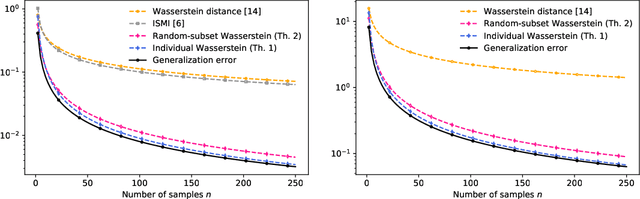
In this work, we introduce several expected generalization error bounds based on the Wasserstein distance. More precisely, we present full-dataset, single-letter, and random-subset bounds on both the standard setting and the randomized-subsample setting from Steinke and Zakynthinou [2020]. Moreover, we show that, when the loss function is bounded, these bounds recover from below (and thus are tighter than) current bounds based on the relative entropy and, for the standard setting, generate new, non-vacuous bounds also based on the relative entropy. Then, we show how similar bounds featuring the backward channel can be derived with the proposed proof techniques. Finally, we show how various new bounds based on different information measures (e.g., the lautum information or several $f$-divergences) can be derived from the presented bounds.
On Random Subset Generalization Error Bounds and the Stochastic Gradient Langevin Dynamics Algorithm
Oct 21, 2020In this work, we unify several expected generalization error bounds based on random subsets using the framework developed by Hellstr\"om and Durisi [1]. First, we recover the bounds based on the individual sample mutual information from Bu et al. [2] and on a random subset of the dataset from Negrea et al. [3]. Then, we introduce their new, analogous bounds in the randomized subsample setting from Steinke and Zakynthinou [4], and we identify some limitations of the framework. Finally, we extend the bounds from Haghifam et al. [5] for Langevin dynamics to stochastic gradient Langevin dynamics and we refine them for loss functions with potentially large gradient norms.
Region-based Energy Neural Network for Approximate Inference
Jun 17, 2020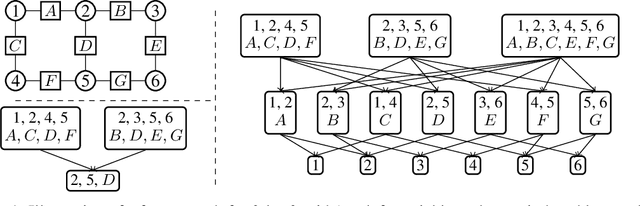
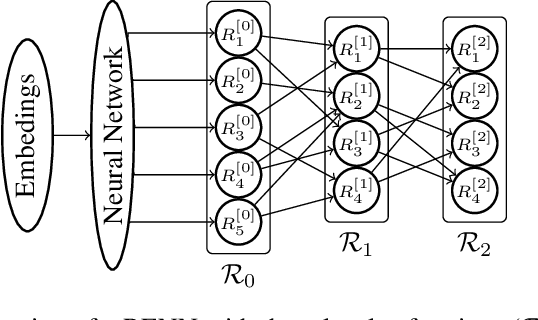
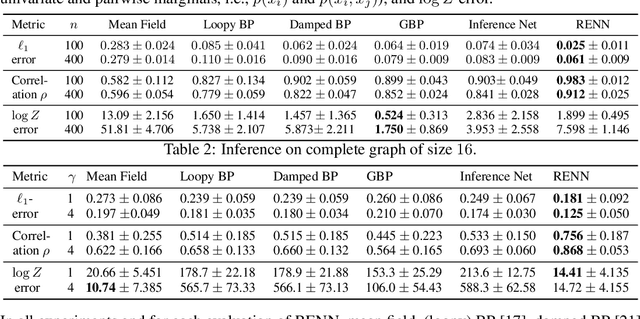
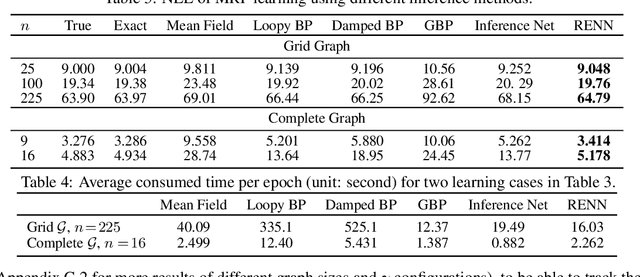
Region-based free energy was originally proposed for generalized belief propagation (GBP) to improve loopy belief propagation (loopy BP). In this paper, we propose a neural network based energy model for inference in general Markov random fields (MRFs), which directly minimizes the region-based free energy defined on region graphs. We term our model Region-based Energy Neural Network (RENN). Unlike message-passing algorithms, RENN avoids iterative message propagation and is faster. Also different from recent deep neural network based models, inference by RENN does not require sampling, and RENN works on general MRFs. RENN can also be employed for MRF learning. Our experiments on marginal distribution estimation, partition function estimation, and learning of MRFs show that RENN outperforms the mean field method, loopy BP, GBP, and the state-of-the-art neural network based model.
A Variational Approach to Privacy and Fairness
Jun 11, 2020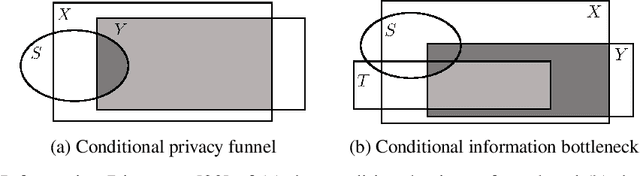
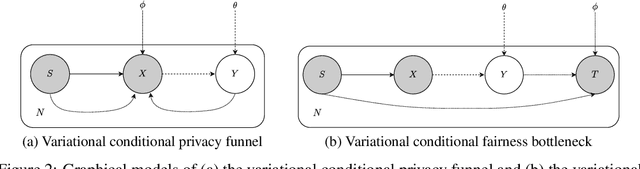
In this article, we propose a new variational approach to learn private and/or fair representations. This approach is based on the Lagrangians of a new formulation of the privacy and fairness optimization problems that we propose. In this formulation, we aim at generating representations of the data that keep a prescribed level of the relevant information that is not shared by the private or sensitive data, while minimizing the remaining information they keep. The proposed approach (i) exhibits the similarities of the privacy and fairness problems, (ii) allows us to control the trade-off between utility and privacy or fairness through the Lagrange multiplier parameter, and (iii) can be comfortably incorporated to common representation learning algorithms such as the VAE, the $\beta$-VAE, the VIB, or the nonlinear IB.