 Add to Chrome
 Add to Firefox
 Add to Edge
Personalized Turn-Level User Conversation Satisfaction Benchmark
May 28, 2026
User satisfaction with AI assistants is highly personalized: the same response may satisfy one user but disappoint another depending on what each user expects and what they have asked for before. Existing automatic evaluation methods mostly measure generic response quality, making it difficult to judge whether a response satisfies a user at a specific turn. We study this problem as personalized turn-level user conversation satisfaction evaluation. We build a conversation satisfaction evaluator that combines compact user memories with target-turn context to produce satisfaction scores and dissatisfaction-oriented rationales. Meta-evaluation against human satisfaction annotations shows that personalized memory and post-hoc score calibration improve ordinal agreement and dissatisfied-turn detection over supervised, retrieval-based, and generic LLM-as-a-judge baselines. We further introduce PersTurnBench, a personalized turn-level user conversation satisfaction benchmark that uses the verified evaluator to assess generation models via replay. By holding the replay state fixed, PersTurnBench enables controlled comparison of generic generation models and memory-augmented personalized systems without new human labels for every candidate model. The evaluator and benchmark let researchers compare candidate generation models on personalized satisfaction without collecting new user feedback for every model.

NeuronBlocks -- Building Your NLP DNN Models Like Playing Lego
Apr 21, 2019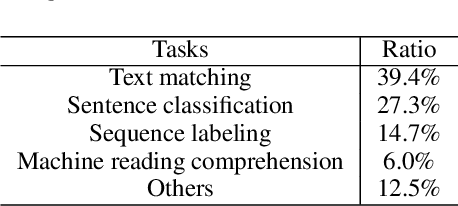
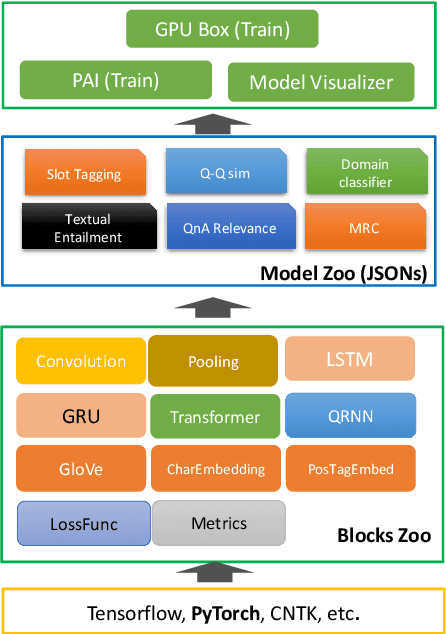
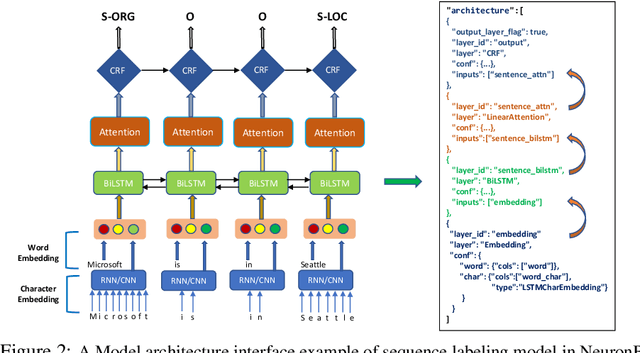
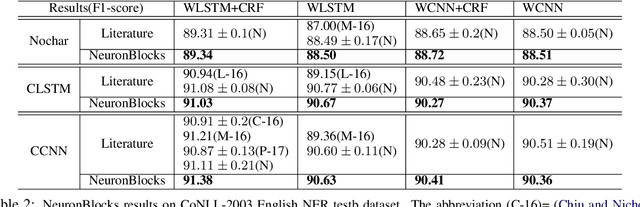
When building deep neural network models for natural language processing tasks, engineers often spend a lot of efforts on coding details and debugging, instead of focusing on model architecture design and hyper-parameter tuning. In this paper, we introduce NeuronBlocks, a deep neural network toolkit for natural language processing tasks. In NeuronBlocks, a suite of neural network layers are encapsulated as building blocks, which can easily be used to build complicated deep neural network models by configuring a simple JSON file. NeuronBlocks empowers engineers to build and train various NLP models in seconds even without a single line of code. A series of experiments on real NLP datasets such as GLUE and WikiQA have been conducted, which demonstrates the effectiveness of NeuronBlocks.