 Add to Chrome
 Add to Firefox
 Add to Edge
Identity as Presence: Towards Appearance and Voice Personalized Joint Audio-Video Generation
Mar 18, 2026
Recent advances have demonstrated compelling capabilities in synthesizing real individuals into generated videos, reflecting the growing demand for identity-aware content creation. Nevertheless, an openly accessible framework enabling fine-grained control over facial appearance and voice timbre across multiple identities remains unavailable. In this work, we present a unified and scalable framework for identity-aware joint audio-video generation, enabling high-fidelity and consistent personalization. Specifically, we introduce a data curation pipeline that automatically extracts identity-bearing information with paired annotations across audio and visual modalities, covering diverse scenarios from single-subject to multi-subject interactions. We further propose a flexible and scalable identity injection mechanism for single- and multi-subject scenarios, in which both facial appearance and vocal timbre act as identity-bearing control signals. Moreover, in light of modality disparity, we design a multi-stage training strategy to accelerate convergence and enforce cross-modal coherence. Experiments demonstrate the superiority of the proposed framework. For more details and qualitative results, please refer to our webpage: \href{https://chen-yingjie.github.io/projects/Identity-as-Presence}{Identity-as-Presence}.

Improving Reconstruction of Representation Autoencoder
Feb 09, 2026Recent work leverages Vision Foundation Models as image encoders to boost the generative performance of latent diffusion models (LDMs), as their semantic feature distributions are easy to learn. However, such semantic features often lack low-level information (\eg, color and texture), leading to degraded reconstruction fidelity, which has emerged as a primary bottleneck in further scaling LDMs. To address this limitation, we propose LV-RAE, a representation autoencoder that augments semantic features with missing low-level information, enabling high-fidelity reconstruction while remaining highly aligned with the semantic distribution. We further observe that the resulting high-dimensional, information-rich latent make decoders sensitive to latent perturbations, causing severe artifacts when decoding generated latent and consequently degrading generation quality. Our analysis suggests that this sensitivity primarily stems from excessive decoder responses along directions off the data manifold. Building on these insights, we propose fine-tuning the decoder to increase its robustness and smoothing the generated latent via controlled noise injection, thereby enhancing generation quality. Experiments demonstrate that LV-RAE significantly improves reconstruction fidelity while preserving the semantic abstraction and achieving strong generative quality. Our code is available at https://github.com/modyu-liu/LVRAE.
Stand-In: A Lightweight and Plug-and-Play Identity Control for Video Generation
Aug 12, 2025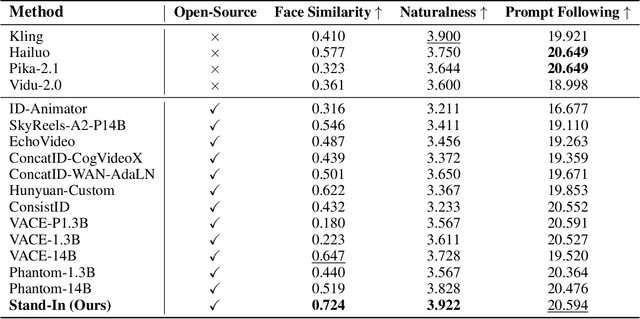
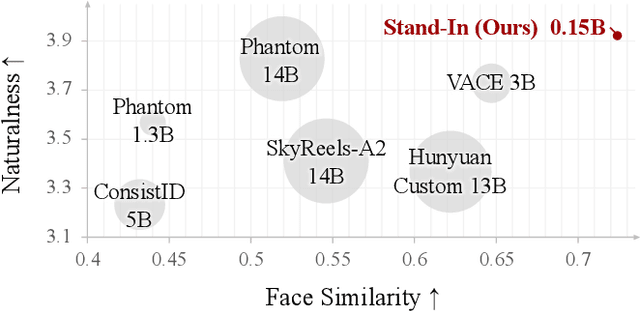
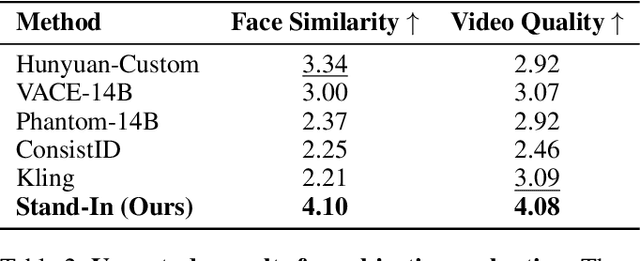
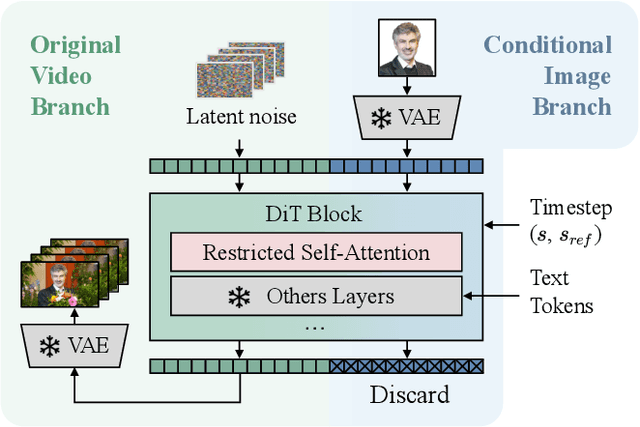
Generating high-fidelity human videos that match user-specified identities is important yet challenging in the field of generative AI. Existing methods often rely on an excessive number of training parameters and lack compatibility with other AIGC tools. In this paper, we propose Stand-In, a lightweight and plug-and-play framework for identity preservation in video generation. Specifically, we introduce a conditional image branch into the pre-trained video generation model. Identity control is achieved through restricted self-attentions with conditional position mapping, and can be learned quickly with only 2000 pairs. Despite incorporating and training just $\sim$1% additional parameters, our framework achieves excellent results in video quality and identity preservation, outperforming other full-parameter training methods. Moreover, our framework can be seamlessly integrated for other tasks, such as subject-driven video generation, pose-referenced video generation, stylization, and face swapping.
BeautyREC: Robust, Efficient, and Content-preserving Makeup Transfer
Dec 12, 2022In this work, we propose a Robust, Efficient, and Component-specific makeup transfer method (abbreviated as BeautyREC). A unique departure from prior methods that leverage global attention, simply concatenate features, or implicitly manipulate features in latent space, we propose a component-specific correspondence to directly transfer the makeup style of a reference image to the corresponding components (e.g., skin, lips, eyes) of a source image, making elaborate and accurate local makeup transfer. As an auxiliary, the long-range visual dependencies of Transformer are introduced for effective global makeup transfer. Instead of the commonly used cycle structure that is complex and unstable, we employ a content consistency loss coupled with a content encoder to implement efficient single-path makeup transfer. The key insights of this study are modeling component-specific correspondence for local makeup transfer, capturing long-range dependencies for global makeup transfer, and enabling efficient makeup transfer via a single-path structure. We also contribute BeautyFace, a makeup transfer dataset to supplement existing datasets. This dataset contains 3,000 faces, covering more diverse makeup styles, face poses, and races. Each face has annotated parsing map. Extensive experiments demonstrate the effectiveness of our method against state-of-the-art methods. Besides, our method is appealing as it is with only 1M parameters, outperforming the state-of-the-art methods (BeautyGAN: 8.43M, PSGAN: 12.62M, SCGAN: 15.30M, CPM: 9.24M, SSAT: 10.48M).