 Add to Chrome
 Add to Firefox
 Add to Edge
LoopVLA: Learning Sufficiency in Recurrent Refinement for Vision-Language-Action Models
May 11, 2026
Current Vision-Language-Action (VLA) models typically treat the deepest representation of a vision-language backbone as universally optimal for action prediction. However, robotic manipulation is composed of many frequent closed-loop spatial adjustments, for which excessive abstraction may waste computation and weaken low-level geometric cues essential for precise control. Existing early-exit strategies attempt to reduce computation by stopping at predefined layers or applying heuristic rules such as action consistency, but they do not directly answer when a representation is actually sufficient for action. In this paper, we present LoopVLA, a recurrent VLA architecture that jointly learns representation refinement, action prediction, and sufficiency estimation. LoopVLA iteratively applies a shared Transformer block to refine multimodal tokens, and at each iteration produces both a candidate action and a sufficiency score that estimates whether further refinement is necessary. By sharing parameters across iterations, LoopVLA decouples refinement from absolute layer indices and grounds sufficiency estimation in the evolving representation itself. Since sufficiency has no direct supervision, we introduce a self-supervised distribution alignment objective, where intermediate confidence scores are trained to match the relative action quality across refinement steps, thereby linking sufficiency learning to policy optimization signals. Experiments on LIBERO, LIBERO-Plus, and VLA-Arena show that LoopVLA pushes the efficiency-performance frontier of VLA policies, reducing parameters by 45% and improving inference throughput by up to 1.7 times while matching or outperforming strong baselines in task success.

Model Predictive Spherical Image-Based Visual Servoing On $SO(3)$ for Aggressive Aerial Tracking
Dec 19, 2022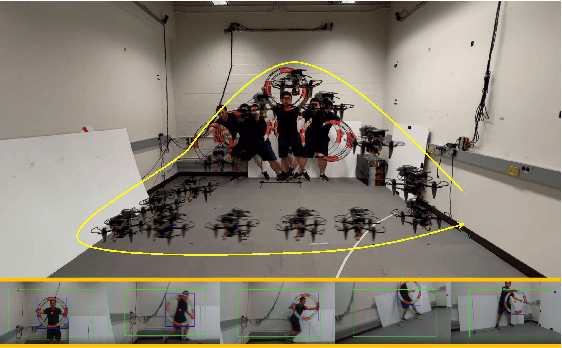
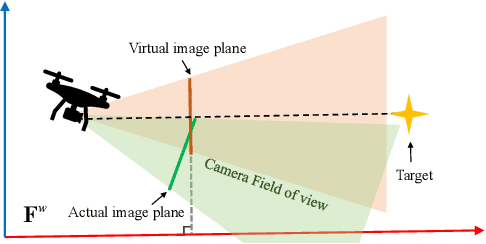
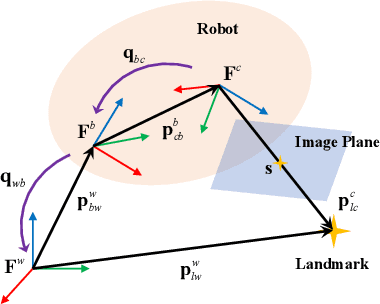
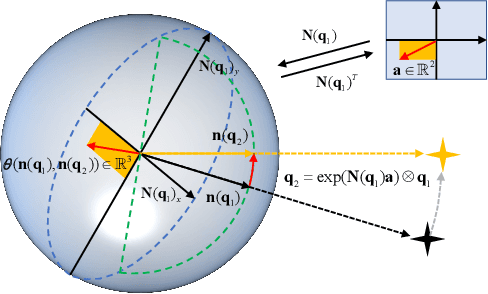
This paper presents an image-based visual servo control (IBVS) method for a first-person-view (FPV) quadrotor to conduct aggressive aerial tracking. There are three major challenges to maneuvering an underactuated vehicle using IBVS: (i) finding a visual feature representation that is robust to large rotations and is suited to be an optimization variable; (ii) keeping the target visible without sacrificing the robot's agility; and (iii) compensating for the rotational effects in the detected features. We propose a complete design framework to address these problems. First, we employ a rotation on $SO(3)$ to represent a spherical image feature on $S^{2}$ to gain singularity-free and second-order differentiable properties. To ensure target visibility, we formulate the IBVS as a nonlinear model predictive control (NMPC) problem with three constraints taken into account: the robot's physical limits, target visibility, and time-to-collision (TTC). Furthermore, we propose a novel attitude-compensation scheme to enable formulating the visibility constraint in the actual image plane instead of a virtual fix-orientation image plane. It guarantees that the visibility constraint is valid under large rotations. Extensive experimental results show that our method can track a fast-moving target stably and aggressively without the aid of a localization system.