 Add to Chrome
 Add to Firefox
 Add to Edge
HG-Lane: High-Fidelity Generation of Lane Scenes under Adverse Weather and Lighting Conditions without Re-annotation
Mar 10, 2026
Lane detection is a crucial task in autonomous driving, as it helps ensure the safe operation of vehicles. However, existing datasets such as CULane and TuSimple contain relatively limited data under extreme weather conditions, including rain, snow, and fog. As a result, detection models trained on these datasets often become unreliable in such environments, which may lead to serious safety-critical failures on the road. To address this issue, we propose HG-Lane, a High-fidelity Generation framework for Lane Scenes under adverse weather and lighting conditions without requiring re-annotation. Based on this framework, we further construct a benchmark that includes adverse weather and lighting scenarios, containing 30,000 images. Experimental results demonstrate that our method consistently and significantly improves the performance of existing lane detection networks. For example, using the state-of-the-art CLRNet, the overall mF1 score on our benchmark increases by 20.87 percent. The F1@50 score for the overall, normal, snow, rain, fog, night, and dusk categories increases by 19.75 percent, 8.63 percent, 38.8 percent, 14.96 percent, 26.84 percent, 21.5 percent, and 12.04 percent, respectively. The code and dataset are available at: https://github.com/zdc233/HG-Lane.

STS MICCAI 2023 Challenge: Grand challenge on 2D and 3D semi-supervised tooth segmentation
Jul 18, 2024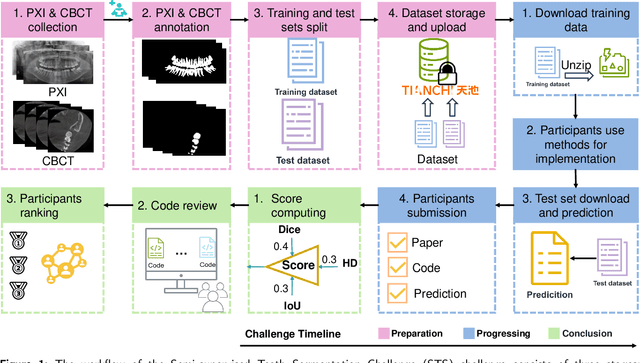



Computer-aided design (CAD) tools are increasingly popular in modern dental practice, particularly for treatment planning or comprehensive prognosis evaluation. In particular, the 2D panoramic X-ray image efficiently detects invisible caries, impacted teeth and supernumerary teeth in children, while the 3D dental cone beam computed tomography (CBCT) is widely used in orthodontics and endodontics due to its low radiation dose. However, there is no open-access 2D public dataset for children's teeth and no open 3D dental CBCT dataset, which limits the development of automatic algorithms for segmenting teeth and analyzing diseases. The Semi-supervised Teeth Segmentation (STS) Challenge, a pioneering event in tooth segmentation, was held as a part of the MICCAI 2023 ToothFairy Workshop on the Alibaba Tianchi platform. This challenge aims to investigate effective semi-supervised tooth segmentation algorithms to advance the field of dentistry. In this challenge, we provide two modalities including the 2D panoramic X-ray images and the 3D CBCT tooth volumes. In Task 1, the goal was to segment tooth regions in panoramic X-ray images of both adult and pediatric teeth. Task 2 involved segmenting tooth sections using CBCT volumes. Limited labelled images with mostly unlabelled ones were provided in this challenge prompt using semi-supervised algorithms for training. In the preliminary round, the challenge received registration and result submission by 434 teams, with 64 advancing to the final round. This paper summarizes the diverse methods employed by the top-ranking teams in the STS MICCAI 2023 Challenge.