 Add to Chrome
 Add to Firefox
 Add to Edge
CodeTeam: An LLM-Powered Multi-Agent Framework for Repository-Level Code Generation
Jun 20, 2026
Natural language to repository generation (NL2Repo) requires a system to construct an entire software repository from a natural-language requirements document. Compared with function-level code generation, this task demands longer planning horizons, stable interfaces across files, and iterative debugging of cross-file inconsistencies. To address these challenges, we propose CodeTeam, an LLM-based multi-agent framework that separates planning, decision making, and implementation into distinct, coordinated stages. In the planning stage, multiple Architect agents draft competing software design sketches (SDS), optionally grounded by retrieved design references. A CTO agent then evaluates, selects, and normalizes the most promising SDS into a machine-checkable contract that specifies file ownership, public interfaces, and dependency constraints. In the implementation stage, Developer agents generate code under a dependency-aware scheduler with bounded context and lightweight Git-based coordination, while a QA agent runs tests and drives iterative repairs. On the synthesis-based SketchEval benchmark, we explicitly compare CodeTeam's prompt-engineering (PE) and supervised fine-tuning (SFT) variants with the corresponding CodeS variants, where CodeTeam improves the overall SketchBLEU by 4.1 and 2.9 absolute points, respectively. On the execution-based NL2Repo-Bench benchmark, used as an external validation protocol, CodeTeam achieves the highest average test pass rate in both settings (34.6% PE, 42.3% SFT), confirming that the sketch-improvements extend to functional correctness under upstream test suites. Ablation results show that project-specific developer allocation and retrieval-augmented planning each contribute substantially to the SketchBLEU improvement (9.9% and 8.1% relative, respectively). CodeTeam and the experimental results are available at https://github.com/WhitenWhiten/CodeTeam

Beyond Functional Correctness: Design Issues in AI IDE-Generated Large-Scale Projects
Apr 07, 2026New generation of AI coding tools, including AI-powered IDEs equipped with agentic capabilities, can generate code within the context of the project. These AI IDEs are increasingly perceived as capable of producing project-level code at scale. However, there is limited empirical evidence on the extent to which they can generate large-scale software systems and what design issues such systems may exhibit. To address this gap, we conducted a study to explore the capability of Cursor in generating large-scale projects and to evaluate the design quality of projects generated by Cursor. First, we propose a Feature-Driven Human-In-The-Loop (FD-HITL) framework that systematically guides project generation from curated project descriptions. We generated 10 projects using Cursor with the FD-HITL framework across three application domains and multiple technologies. We assessed the functional correctness of these projects through manual evaluation, obtaining an average functional correctness score of 91%. Next, we analyzed the generated projects using two static analysis tools, CodeScene and SonarQube, to detect design issues. We identified 1,305 design issues categorized into 9 categories by CodeScene and 3,193 issues in 11 categories by SonarQube. Our findings show that (1) when used with the FD-HITL framework, Cursor can generate functional large-scale projects averaging 16,965 LoC and 114 files; (2) the generated projects nevertheless contain design issues that may pose long-term maintainability and evolvability risks, requiring careful review by experienced developers; (3) the most prevalent issues include Code Duplication, high Code Complexity, Large Methods, Framework Best-Practice Violations, Exception-Handling Issues and Accessibility Issues; (4) these design issues violate design principles such as SRP, SoC, and DRY. The replication package is at https://github.com/Kashifraz/DIinAGP
FasterPy: An LLM-based Code Execution Efficiency Optimization Framework
Dec 28, 2025Code often suffers from performance bugs. These bugs necessitate the research and practice of code optimization. Traditional rule-based methods rely on manually designing and maintaining rules for specific performance bugs (e.g., redundant loops, repeated computations), making them labor-intensive and limited in applicability. In recent years, machine learning and deep learning-based methods have emerged as promising alternatives by learning optimization heuristics from annotated code corpora and performance measurements. However, these approaches usually depend on specific program representations and meticulously crafted training datasets, making them costly to develop and difficult to scale. With the booming of Large Language Models (LLMs), their remarkable capabilities in code generation have opened new avenues for automated code optimization. In this work, we proposed FasterPy, a low-cost and efficient framework that adapts LLMs to optimize the execution efficiency of Python code. FasterPy combines Retrieval-Augmented Generation (RAG), supported by a knowledge base constructed from existing performance-improving code pairs and corresponding performance measurements, with Low-Rank Adaptation (LoRA) to enhance code optimization performance. Our experimental results on the Performance Improving Code Edits (PIE) benchmark demonstrate that our method outperforms existing models on multiple metrics. The FasterPy tool and the experimental results are available at https://github.com/WuYue22/fasterpy.
Integrating Various Software Artifacts for Better LLM-based Bug Localization and Program Repair
Dec 05, 2024
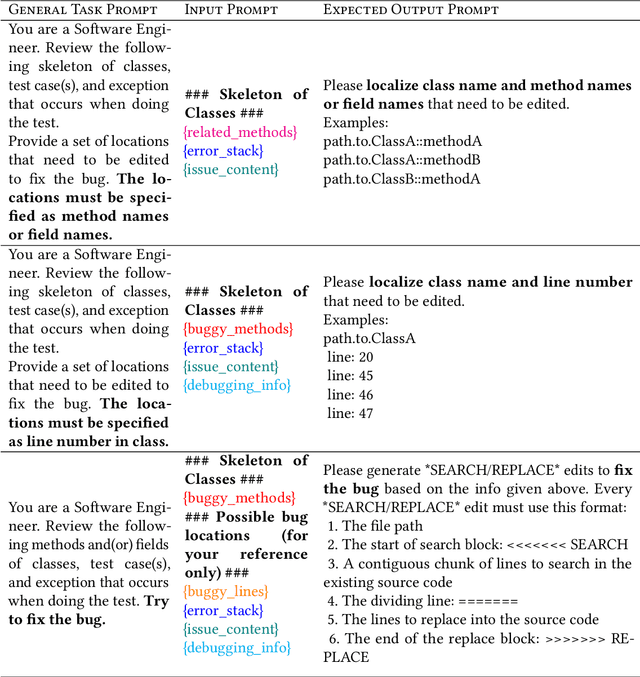
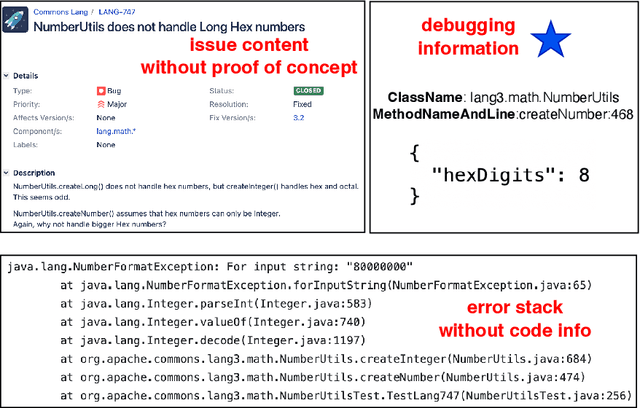
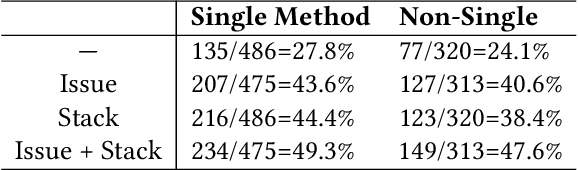
LLMs have garnered considerable attention for their potential to streamline Automated Program Repair (APR). LLM-based approaches can either insert the correct code or directly generate patches when provided with buggy methods. However, most of LLM-based APR methods rely on a single type of software information, without fully leveraging different software artifacts. Despite this, many LLM-based approaches do not explore which specific types of information best assist in APR. Addressing this gap is crucial for advancing LLM-based APR techniques. We propose DEVLoRe to use issue content (description and message) and stack error traces to localize buggy methods, then rely on debug information in buggy methods and issue content and stack error to localize buggy lines and generate plausible patches which can pass all unit tests. The results show that while issue content is particularly effective in assisting LLMs with fault localization and program repair, different types of software artifacts complement each other. By incorporating different artifacts, DEVLoRe successfully locates 49.3% and 47.6% of single and non-single buggy methods and generates 56.0% and 14.5% plausible patches for the Defects4J v2.0 dataset, respectively. This outperforms current state-of-the-art APR methods. The source code and experimental results of this work for replication are available at https://github.com/XYZboom/DEVLoRe.
Copilot Refinement: Addressing Code Smells in Copilot-Generated Python Code
Jan 25, 2024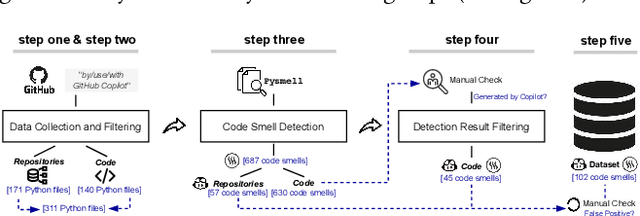
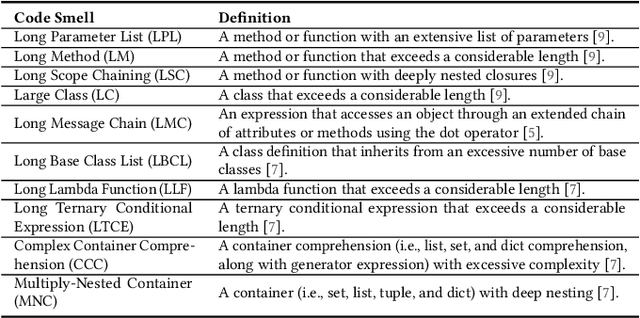

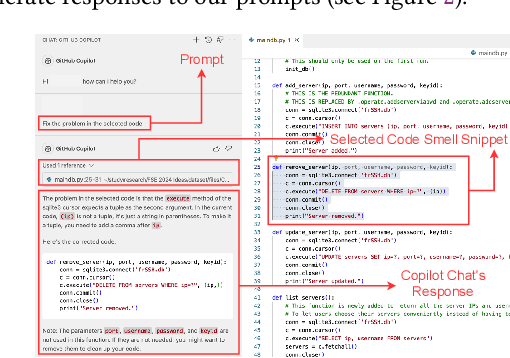
As one of the most popular dynamic languages, Python experiences a decrease in readability and maintainability when code smells are present. Recent advancements in Large Language Models have sparked growing interest in AI-enabled tools for both code generation and refactoring. GitHub Copilot is one such tool that has gained widespread usage. Copilot Chat, released on September 2023, functions as an interactive tool aims at facilitating natural language-powered coding. However, limited attention has been given to understanding code smells in Copilot-generated Python code and Copilot's ability to fix the code smells it generates. To this end, we built a dataset comprising 102 code smells in Copilot-generated Python code. Our aim is to first explore the occurrence of code smells in Copilot-generated Python code and then evaluate the effectiveness of Copilot in fixing these code smells employing different prompts. The results show that 8 out of 10 types of Python smells can be detected in Copilot-generated Python code, among which Multiply-Nested Container is the most common one. For these code smells, Copilot Chat achieves a highest fixing rate of 87.1%, showing promise in fixing Python code smells generated by Copilot itself. Besides, the effectiveness of Copilot Chat in fixing these smells can be improved with the provision of more detailed prompts. However, using Copilot Chat to fix these smells might introduce new code smells.