 Add to Chrome
 Add to Firefox
 Add to Edge
MARVEL: Universal Murray's Law-informed Vessel Tree Segmentation and Topology Estimation
May 25, 2026
Vascular circulation follows fundamental biophysical principles that optimize mass transport and metabolic energy expenditure, which can be effectively modeled by Murray's law. However, contemporary deep learning methods for vascular segmentation often neglect these biophysical constraints. This leads to physiologically implausible branching and misclassification vascular trees, rendering. These automated segmentation results are unreliable unreliable for downstream clinical tasks such as blood flow simulation or disease quantification. In this paper, we introduce MARVEL (Universal MurrAy's law-infoRmed Vessel sEgmentation and topoLogy estimation), a backbone-agnostic framework that integrates biophysical priors into vascular tree extraction. MARVEL combines per-pixel supervision with explicit radius predictions to enforce local bifurcation constraints derived from an empirical width-exponent mapping. We implement these constraints as differentiable regularizers during training to guide models toward physiologically consistent reconstructions. We evaluate MARVEL on eight public datasets across multiple vascular modalities and segmentation backbones. Results demonstrate MARVEL's superior performance in segmentation accuracy, topological consistency, and physiological plausibility. By converting segmented masks into graph-based hemodynamic simulations, we demonstrate that MARVEL preserves the subtle pathological narrowing and topological connectivity required to distinguish hypertensive from normotensive eyes. Results show that MARVEL significantly improves the classification of hypertension via arteriovenous pressure differences in the eye (p < 0.001), outperforming baseline models in both topological consistency and clinical predictive value.

Coordinate-based neural representations for computational adaptive optics in widefield microscopy
Jul 07, 2023Widefield microscopy is widely used for non-invasive imaging of biological structures at subcellular resolution. When applied to complex specimen, its image quality is degraded by sample-induced optical aberration. Adaptive optics can correct wavefront distortion and restore diffraction-limited resolution but require wavefront sensing and corrective devices, increasing system complexity and cost. Here, we describe a self-supervised machine learning algorithm, CoCoA, that performs joint wavefront estimation and three-dimensional structural information extraction from a single input 3D image stack without the need for external training dataset. We implemented CoCoA for widefield imaging of mouse brain tissues and validated its performance with direct-wavefront-sensing-based adaptive optics. Importantly, we systematically explored and quantitatively characterized the limiting factors of CoCoA's performance. Using CoCoA, we demonstrated the first in vivo widefield mouse brain imaging using machine-learning-based adaptive optics. Incorporating coordinate-based neural representations and a forward physics model, the self-supervised scheme of CoCoA should be applicable to microscopy modalities in general.
Fast and accurate aberration estimation from 3D bead images using convolutional neural networks
Jun 02, 2020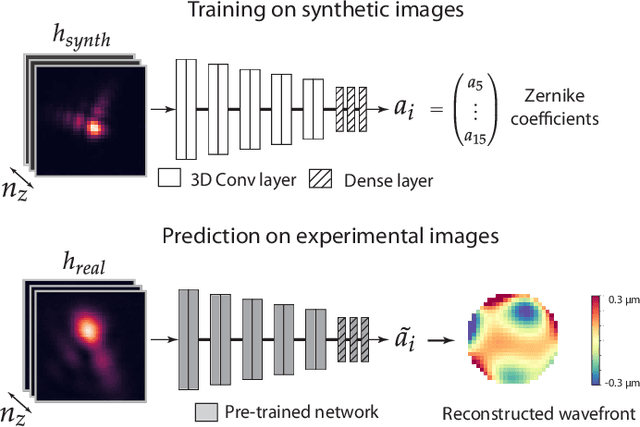
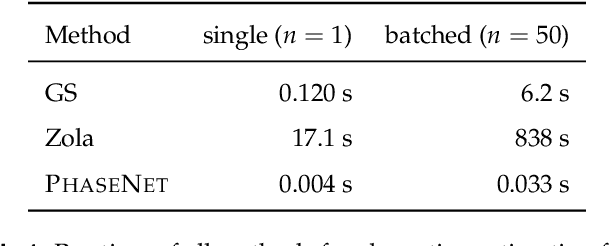
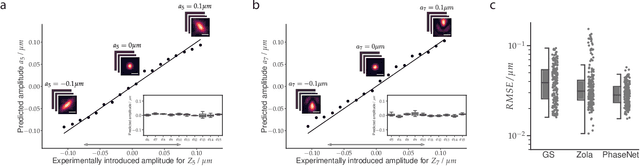
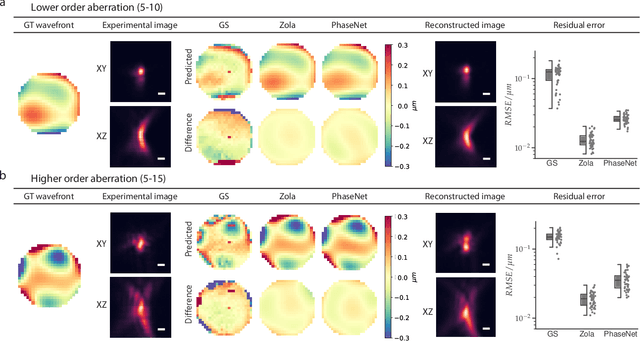
Estimating optical aberrations from volumetric intensity images is a key step in sensorless adaptive optics for microscopy. Here we describe a method (PHASENET) for fast and accurate aberration measurement from experimentally acquired 3D bead images using convolutional neural networks. Importantly, we show that networks trained only on synthetically generated data can successfully predict aberrations from experimental images. We demonstrate our approach on two data sets acquired with different microscopy modalities and find that PHASENET yields results better than or comparable to classical methods while being orders of magnitude faster. We furthermore show that the number of focal planes required for satisfactory prediction is related to different symmetry groups of Zernike modes. PHASENET is freely available as open-source software in Python.