 Add to Chrome
 Add to Firefox
 Add to Edge
PlanBench-XL: Evaluating Long-Horizon Planning of LLM Tool-Use Agents in Large-Scale Tool Ecosystems
Jun 21, 2026
LLM agents increasingly operate in large tool ecosystems, where real-world tasks require discovering relevant tools, inferring implicit sub-goals, and adapting to dynamic environments over long horizons. However, existing benchmarks rarely evaluate planning under retrieval-limited tool visibility. To address this gap, we introduce PlanBench-XL, an interactive benchmark of 327 retail tasks over 1,665 tools that tests whether agents can iteratively retrieve usable tools, invoke them to uncover intermediate evidence for subsequent calls toward the final goal. PlanBench-XL further features an optional blocking mechanism that simulates real-world unpredictability through missing, failing, or distracting tool functions, forcing agents to detect disrupted paths and adapt at runtime. Experiments on ten leading LLMs show that massive-tool planning remains challenging: while GPT-5.4 achieves 51.90% accuracy in block-free settings, it collapses to 11.36% under the most severe blocking condition. Further analysis shows that agents are especially vulnerable when failures lack explicit error signals or when recovery requires longer alternative tool-use paths. These results establish PlanBench-XL as a testbed for diagnosing agentic planning failures and highlight the need for robust adaptive planning in long-horizon tasks with large, imperfect tool environments.

K12-KGraph: A Curriculum-Aligned Knowledge Graph for Benchmarking and Training Educational LLMs
May 10, 2026Large language models (LLMs) are increasingly used in K-12 education, yet existing benchmarks such as C-Eval, CMMLU, GaokaoBench, and EduEval mainly evaluate factual recall through exam-style question answering. Effective educational AI additionally requires curriculum cognition: understanding how knowledge is structured through prerequisite chains, concept taxonomies, experiment-concept links, and pedagogical sequencing. To address this gap, we introduce K12-KGraph, a curriculum-aligned knowledge graph extracted from official People's Education Press textbooks across mathematics, physics, chemistry, and biology from primary to high school. The graph contains seven node types (Concept, Skill, Experiment, Exercise, Section, Chapter, Book) and nine relation types covering taxonomy, prerequisite, association, verification, assessment, location, and order. Based on this graph, we construct two resources: (1) K12-Bench, a 23,640-question multi-select benchmark spanning five graph-derived task families (Ground, Prereq, Neighbor, Evidence, and Locate); and (2) K12-Train, a KG-guided supervised fine-tuning corpus of approximately 2,300 QA pairs synthesized from graph structure and node attributes. Experiments reveal substantial deficiencies in curriculum cognition: on K12-Bench, Gemini-3-Flash achieves only 57% exact match, while the best open-source model, Gemma-4-31B-IT, reaches 46%. Under a strictly matched 2,300-sample SFT budget on Qwen3-4B-Base and Llama-3.1-8B-Base, K12-Train consistently outperforms equally sized subsets from eight mainstream instruction-tuning corpora on both GaokaoBench and EduEval, demonstrating that curriculum-structured supervision is highly sample-efficient for educational tuning. We release the graph, benchmark, training data, and full construction pipeline.
Prospect Theory Fails for LLMs: Revealing Instability of Decision-Making under Epistemic Uncertainty
Aug 12, 2025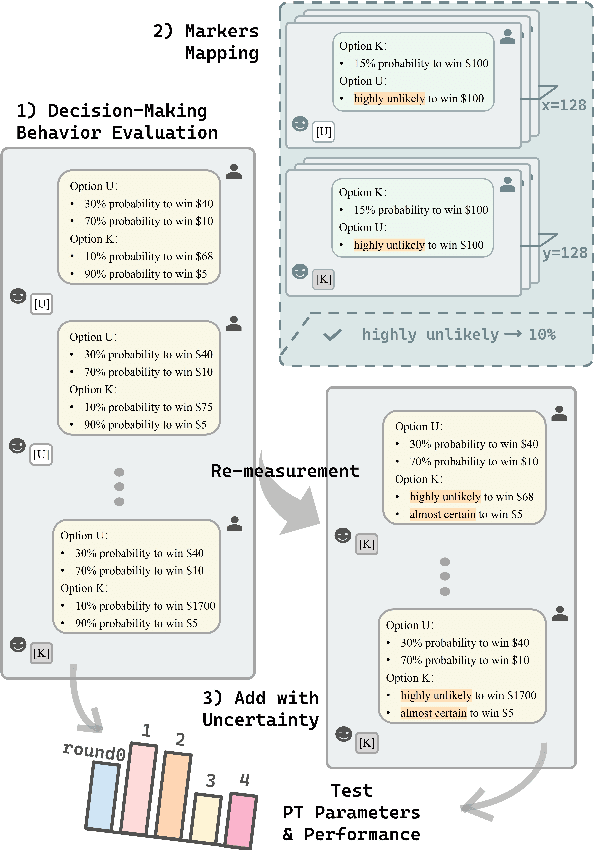
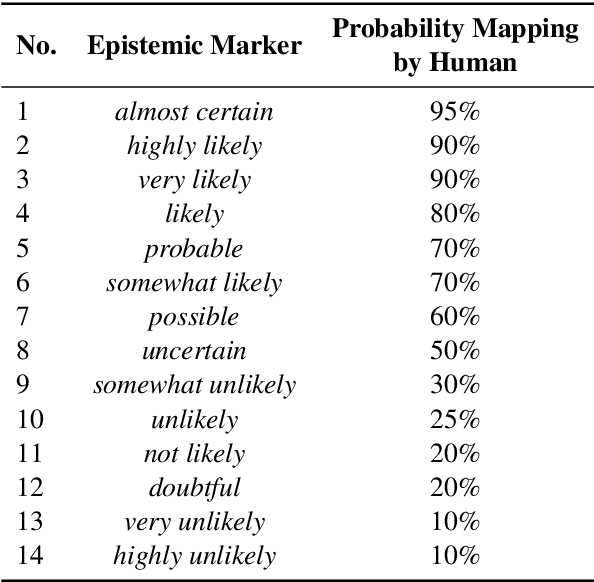
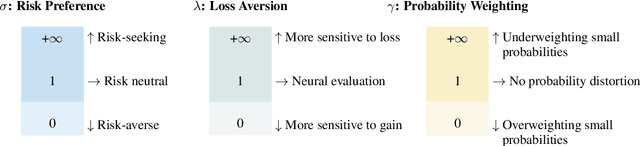
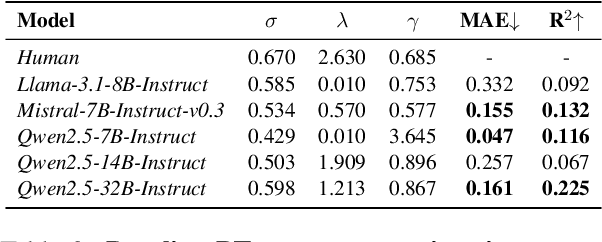
Prospect Theory (PT) models human decision-making under uncertainty, while epistemic markers (e.g., maybe) serve to express uncertainty in language. However, it remains largely unexplored whether Prospect Theory applies to contemporary Large Language Models and whether epistemic markers, which express human uncertainty, affect their decision-making behaviour. To address these research gaps, we design a three-stage experiment based on economic questionnaires. We propose a more general and precise evaluation framework to model LLMs' decision-making behaviour under PT, introducing uncertainty through the empirical probability values associated with commonly used epistemic markers in comparable contexts. We then incorporate epistemic markers into the evaluation framework based on their corresponding probability values to examine their influence on LLM decision-making behaviours. Our findings suggest that modelling LLMs' decision-making with PT is not consistently reliable, particularly when uncertainty is expressed in diverse linguistic forms. Our code is released in https://github.com/HKUST-KnowComp/MarPT.