 Add to Chrome
 Add to Firefox
 Add to Edge
When Are Trade-Off Functions Testable from Finite Samples?
May 11, 2026
We study finite-sample inference for the trade-off function of two unknown probability distributions, the function that traces the optimal type I/type II error frontier in binary testing. Given samples from distributions $P$ and $Q$, we consider the problem of testing whether their trade-off function lies above a benchmark curve $f_0$ or falls below a weaker benchmark $f_1$. Without structural restrictions, this problem is impossible uniformly over nonparametric classes. We identify a sharp condition under which it becomes possible. The key structural assumption is that the Neyman--Pearson rejection regions for $(P,Q)$ are attainable, up to null sets, by a prescribed class $S$ of measurable sets. Within this exact attainability framework, finite Vapnik--Chervonenkis dimension of $S$ is both sufficient and necessary for nontrivial finite-sample testing. We construct a test with nonasymptotic error guarantees: type I error control is valid without assuming attainability, while power holds uniformly over attainable alternatives satisfying an explicit separation condition. By inverting the test, we also obtain simultaneous confidence bands for the whole trade-off curve. Finally, we study the sharpness and robustness of the procedure. In the monotone likelihood-ratio model, we derive local separation rates and prove matching lower bounds up to logarithmic factors. We also allow approximate, rather than exact, attainability; this extension yields finite-sample guarantees for univariate log-concave distributions by approximating their rejection regions with unions of intervals.

Sparse Low-rank Adaptation of Pre-trained Language Models
Nov 20, 2023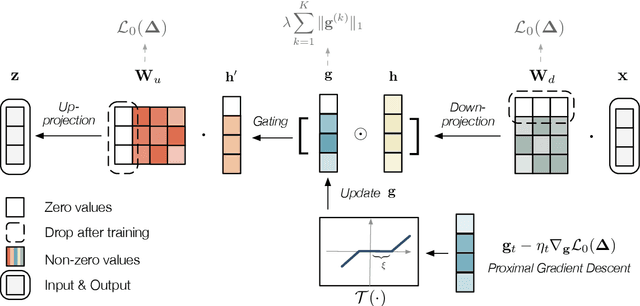
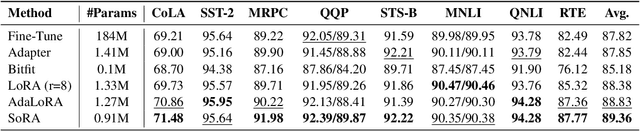
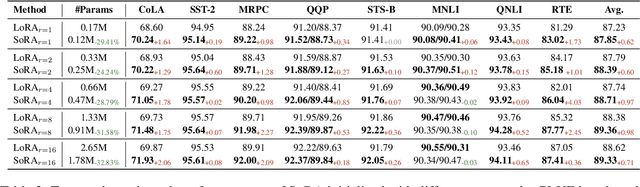
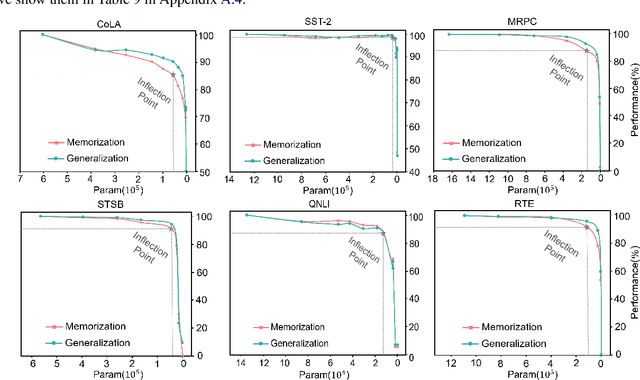
Fine-tuning pre-trained large language models in a parameter-efficient manner is widely studied for its effectiveness and efficiency. The popular method of low-rank adaptation (LoRA) offers a notable approach, hypothesizing that the adaptation process is intrinsically low-dimensional. Although LoRA has demonstrated commendable performance, it is implemented with a fixed and unalterable intrinsic rank that might not always be the ideal choice. Recognizing the need for more flexible adaptation, we extend the methodology of LoRA to an innovative approach we call sparse low-rank adaptation (SoRA) that enables dynamic adjustments to the intrinsic rank during the adaptation process. We achieve this through the incorporation of a gate unit optimized with proximal gradient method in the training stage, controlling the cardinality of rank under the sparsity of the gate. In the subsequent inference stage, we eliminate the parameter blocks corresponding to the zeroed-out ranks, to reduce each SoRA module back to a concise yet rank-optimal LoRA. Our approach strengthens the representation power of LoRA by initializing it with a higher rank, while efficiently taming a temporarily increased number of parameters via updating in a sparse way. We further introduce a sparsifying scheduler for SoRA, aiming to examine the impact of the number of non-zero parameters on the model's memorization and generalization. Our experimental results demonstrate that SoRA can outperform other baselines even with 70% retained parameters and 70% training time.