 Add to Chrome
 Add to Firefox
 Add to Edge
When Are Trade-Off Functions Testable from Finite Samples?
May 11, 2026
We study finite-sample inference for the trade-off function of two unknown probability distributions, the function that traces the optimal type I/type II error frontier in binary testing. Given samples from distributions $P$ and $Q$, we consider the problem of testing whether their trade-off function lies above a benchmark curve $f_0$ or falls below a weaker benchmark $f_1$. Without structural restrictions, this problem is impossible uniformly over nonparametric classes. We identify a sharp condition under which it becomes possible. The key structural assumption is that the Neyman--Pearson rejection regions for $(P,Q)$ are attainable, up to null sets, by a prescribed class $S$ of measurable sets. Within this exact attainability framework, finite Vapnik--Chervonenkis dimension of $S$ is both sufficient and necessary for nontrivial finite-sample testing. We construct a test with nonasymptotic error guarantees: type I error control is valid without assuming attainability, while power holds uniformly over attainable alternatives satisfying an explicit separation condition. By inverting the test, we also obtain simultaneous confidence bands for the whole trade-off curve. Finally, we study the sharpness and robustness of the procedure. In the monotone likelihood-ratio model, we derive local separation rates and prove matching lower bounds up to logarithmic factors. We also allow approximate, rather than exact, attainability; this extension yields finite-sample guarantees for univariate log-concave distributions by approximating their rejection regions with unions of intervals.

Auditing Differential Privacy in the Black-Box Setting
Mar 15, 2025This paper introduces a novel theoretical framework for auditing differential privacy (DP) in a black-box setting. Leveraging the concept of $f$-differential privacy, we explicitly define type I and type II errors and propose an auditing mechanism based on conformal inference. Our approach robustly controls the type I error rate under minimal assumptions. Furthermore, we establish a fundamental impossibility result, demonstrating the inherent difficulty of simultaneously controlling both type I and type II errors without additional assumptions. Nevertheless, under a monotone likelihood ratio (MLR) assumption, our auditing mechanism effectively controls both errors. We also extend our method to construct valid confidence bands for the trade-off function in the finite-sample regime.
Privacy Preserving Adaptive Experiment Design
Feb 05, 2024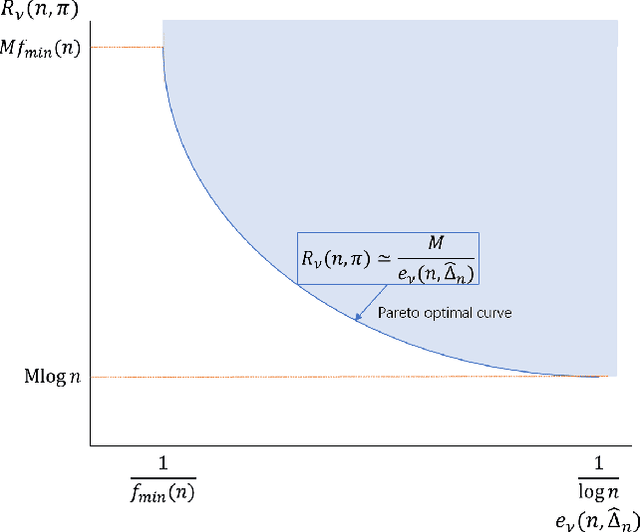
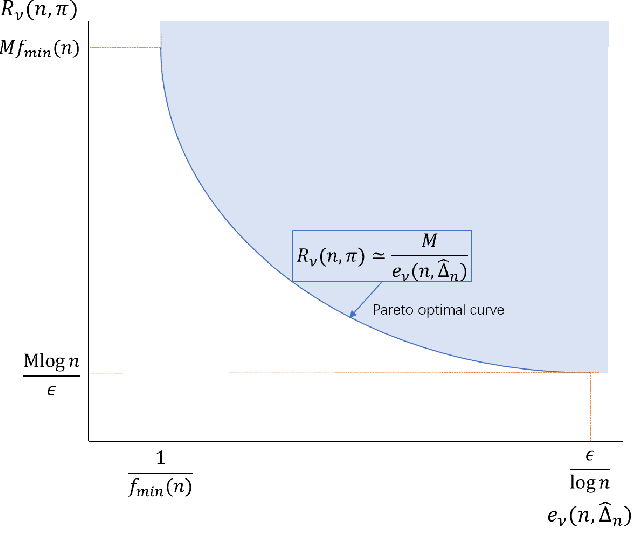
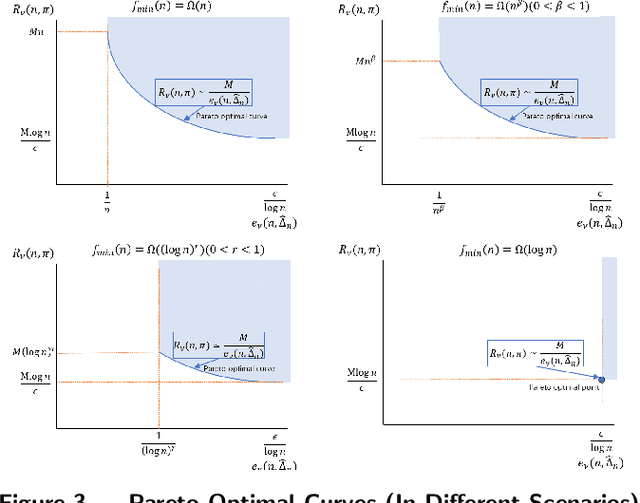
Adaptive experiment is widely adopted to estimate conditional average treatment effect (CATE) in clinical trials and many other scenarios. While the primary goal in experiment is to maximize estimation accuracy, due to the imperative of social welfare, it's also crucial to provide treatment with superior outcomes to patients, which is measured by regret in contextual bandit framework. These two objectives often lead to contrast optimal allocation mechanism. Furthermore, privacy concerns arise in clinical scenarios containing sensitive data like patients health records. Therefore, it's essential for the treatment allocation mechanism to incorporate robust privacy protection measures. In this paper, we investigate the tradeoff between loss of social welfare and statistical power in contextual bandit experiment. We propose a matched upper and lower bound for the multi-objective optimization problem, and then adopt the concept of Pareto optimality to mathematically characterize the optimality condition. Furthermore, we propose differentially private algorithms which still matches the lower bound, showing that privacy is "almost free". Additionally, we derive the asymptotic normality of the estimator, which is essential in statistical inference and hypothesis testing.