 Add to Chrome
 Add to Firefox
 Add to Edge
SOLARIS: Speculative Offloading of Latent-bAsed Representation for Inference Scaling
Apr 13, 2026
Recent advances in recommendation scaling laws have led to foundation models of unprecedented complexity. While these models offer superior performance, their computational demands make real-time serving impractical, often forcing practitioners to rely on knowledge distillation-compromising serving quality for efficiency. To address this challenge, we present SOLARIS (Speculative Offloading of Latent-bAsed Representation for Inference Scaling), a novel framework inspired by speculative decoding. SOLARIS proactively precomputes user-item interaction embeddings by predicting which user-item pairs are likely to appear in future requests, and asynchronously generating their foundation model representations ahead of time. This approach decouples the costly foundation model inference from the latency-critical serving path, enabling real-time knowledge transfer from models previously considered too expensive for online use. Deployed across Meta's advertising system serving billions of daily requests, SOLARIS achieves 0.67% revenue-driving top-line metrics gain, demonstrating its effectiveness at scale.

Meta Lattice: Model Space Redesign for Cost-Effective Industry-Scale Ads Recommendations
Dec 15, 2025The rapidly evolving landscape of products, surfaces, policies, and regulations poses significant challenges for deploying state-of-the-art recommendation models at industry scale, primarily due to data fragmentation across domains and escalating infrastructure costs that hinder sustained quality improvements. To address this challenge, we propose Lattice, a recommendation framework centered around model space redesign that extends Multi-Domain, Multi-Objective (MDMO) learning beyond models and learning objectives. Lattice addresses these challenges through a comprehensive model space redesign that combines cross-domain knowledge sharing, data consolidation, model unification, distillation, and system optimizations to achieve significant improvements in both quality and cost-efficiency. Our deployment of Lattice at Meta has resulted in 10% revenue-driving top-line metrics gain, 11.5% user satisfaction improvement, 6% boost in conversion rate, with 20% capacity saving.
External Large Foundation Model: How to Efficiently Serve Trillions of Parameters for Online Ads Recommendation
Feb 26, 2025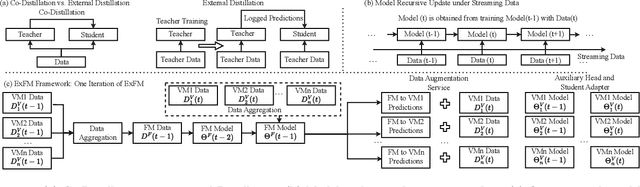
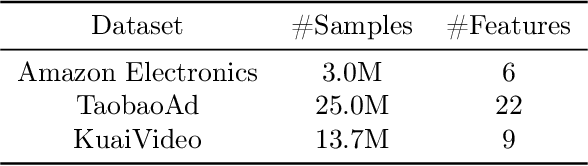
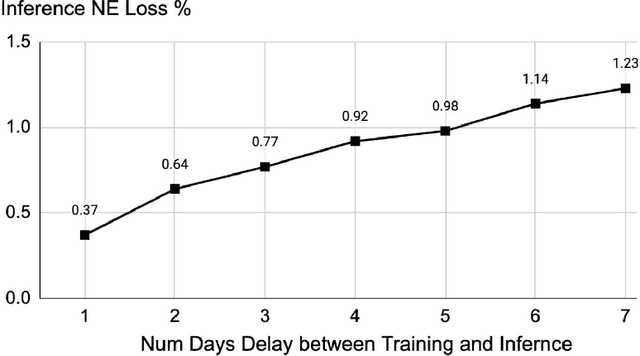
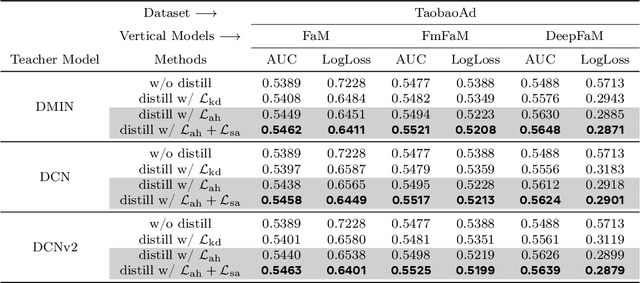
Ads recommendation is a prominent service of online advertising systems and has been actively studied. Recent studies indicate that scaling-up and advanced design of the recommendation model can bring significant performance improvement. However, with a larger model scale, such prior studies have a significantly increasing gap from industry as they often neglect two fundamental challenges in industrial-scale applications. First, training and inference budgets are restricted for the model to be served, exceeding which may incur latency and impair user experience. Second, large-volume data arrive in a streaming mode with data distributions dynamically shifting, as new users/ads join and existing users/ads leave the system. We propose the External Large Foundation Model (ExFM) framework to address the overlooked challenges. Specifically, we develop external distillation and a data augmentation system (DAS) to control the computational cost of training/inference while maintaining high performance. We design the teacher in a way like a foundation model (FM) that can serve multiple students as vertical models (VMs) to amortize its building cost. We propose Auxiliary Head and Student Adapter to mitigate the data distribution gap between FM and VMs caused by the streaming data issue. Comprehensive experiments on internal industrial-scale applications and public datasets demonstrate significant performance gain by ExFM.