 Add to Chrome
 Add to Firefox
 Add to Edge
Not All Patches are Equal: Sampling Matters for Visible-Infrared Pre-Training
Jul 22, 2026
Visible-infrared (VIS-IR) alignment is a key pre-training task for robust multi-sensor perception. Most existing methods use uniform patch-wise contrastive learning, but this can be unreliable in VIS-IR data because imaging-physics differences make some spatially paired regions inherently less comparable, and aligning them with equal strength hinders representation learning and downstream transfer. In this paper, we revisit VIS-IR pre-training from a sampling perspective and propose Importance-Aware Sampling (IAS), which adjusts training emphasis based on patch reliability. Specifically, IAS (i) derives patch weights from infrared structural cues and uses them to reweight the contrastive objective; (ii) learns a soft importance mask with a lightweight sampler, optionally warm-started from the hand-crafted prior; and (iii) employs a patch curriculum learning strategy that gradually expands from high-reliability regions to harder patches. It is worth noting that IAS is plug-and-play and works with both patch-/correlation-level alignment (e.g., UNIV-style) and image-level contrastive baselines (e.g., ImageBind-style). Extensive experiments on multiple VIS-IR benchmarks demonstrate consistent improvements over strong baselines, including for IR semantic segmentation, IR object detection and VIS semantic segmentation and cross-modal retrieval task. Code will be released on https://github.com/KlayMa527/IAS.

DiffuseGAE: Controllable and High-fidelity Image Manipulation from Disentangled Representation
Jul 12, 2023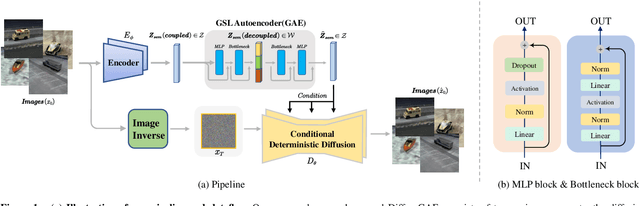

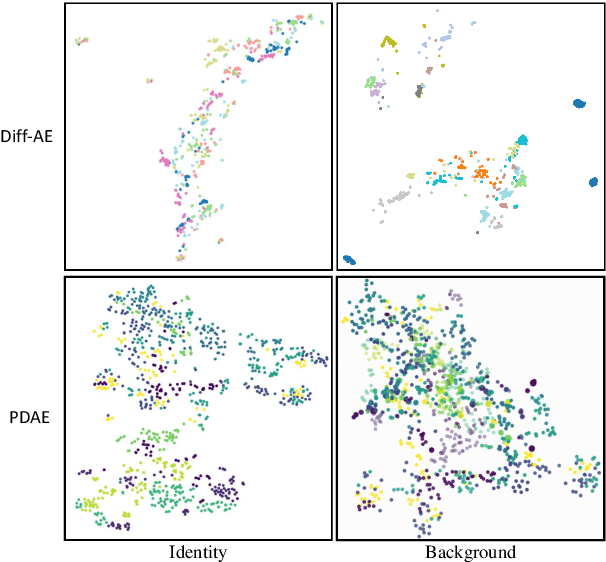
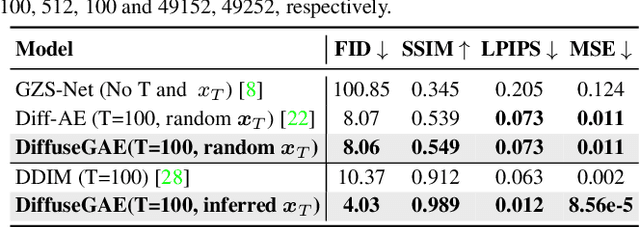
Diffusion probabilistic models (DPMs) have shown remarkable results on various image synthesis tasks such as text-to-image generation and image inpainting. However, compared to other generative methods like VAEs and GANs, DPMs lack a low-dimensional, interpretable, and well-decoupled latent code. Recently, diffusion autoencoders (Diff-AE) were proposed to explore the potential of DPMs for representation learning via autoencoding. Diff-AE provides an accessible latent space that exhibits remarkable interpretability, allowing us to manipulate image attributes based on latent codes from the space. However, previous works are not generic as they only operated on a few limited attributes. To further explore the latent space of Diff-AE and achieve a generic editing pipeline, we proposed a module called Group-supervised AutoEncoder(dubbed GAE) for Diff-AE to achieve better disentanglement on the latent code. Our proposed GAE has trained via an attribute-swap strategy to acquire the latent codes for multi-attribute image manipulation based on examples. We empirically demonstrate that our method enables multiple-attributes manipulation and achieves convincing sample quality and attribute alignments, while significantly reducing computational requirements compared to pixel-based approaches for representational decoupling. Code will be released soon.