 Add to Chrome
 Add to Firefox
 Add to Edge
Overthink-Triggered Slowdown Attacks on LVLM-Based Robotic Systems
Jul 01, 2026
Large Vision-Language Models (LVLMs) have been increasingly integrated into robotic systems. However, these models may exhibit overthinking behaviors, where they generate excessively long reasoning traces, incurring an excessive inference time. This overthinking behavior poses a serious risk to robotic systems, as the adversary can deliberately trigger overthinking to slow down the decision making of a victim robotic system, causing a variety of safety issues (i.e., an overthinking-induced slowdown attack). To initiate this attack, an adversary can embed carefully crafted, human-readable scene text into the visual scene observed by a victim robotic agent, causing significant inference delays even under a strict black-box setting. Therefore, the embedded scene text serves as a significant "trigger" for the attack. This work systematically identifies and validates transferable triggers of overthinking in robotic systems by introducing a three-stage framework. First, we construct a diverse corpus of reasoning-intensive scene text and extract overthinking-correlated lexical features from short response prefixes. Second, we perform an efficient black-box search guided by a prefix-based proxy score while selectively confirming a small set of top candidates with full latency measurements. Third, we evaluate black-box transfer using a fixed pool of triggers on unseen images and multiple LVLMs, reporting latency amplification and attack success rates under standard thresholds. Across three representative LVLMs, all triggers yield slowdown ratios greater than 1.0x, with the strongest single-trigger case reaching 6.96x. The physical printing of the text trigger still causes up to 4.74x latency amplification. These results demonstrate that our discovered triggers are transferred between multiple LVLM models and consistently cause significant slowdowns in robotic systems.

Rich-U-Net: A medical image segmentation model for fusing spatial depth features and capturing minute structural details
Mar 31, 2026Medical image segmentation is of great significance in analysis of illness. The use of deep neural networks in medical image segmentation can help doctors extract regions of interest from complex medical images, thereby improving diagnostic accuracy and enabling better assessment of the condition to formulate treatment plans. However, most current medical image segmentation methods underperform in accurately extracting spatial information from medical images and mining potential complex structures and variations. In this article, we introduce the Rich-U-Net model, which effectively integrates both spatial and depth features. This fusion enhances the model's capability to detect fine structures and intricate details within complex medical images. Our multi-level and multi-dimensional feature fusion and optimization strategies enable our model to achieve fine structure localization and accurate segmentation results in medical image segmentation. Experiments on the ISIC2018, BUSI, GLAS, and CVC datasets show that Rich-U-Net surpasses other state-of-the-art models in Dice, IoU, and HD95 metrics.
When Mamba Meets xLSTM: An Efficient and Precise Method with the XLSTM-VMUNet Model for Skin lesion Segmentation
Nov 14, 2024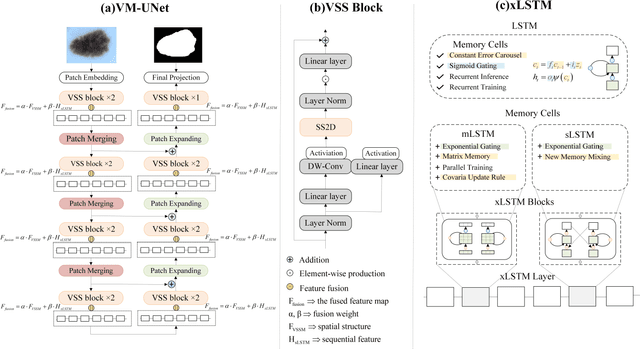
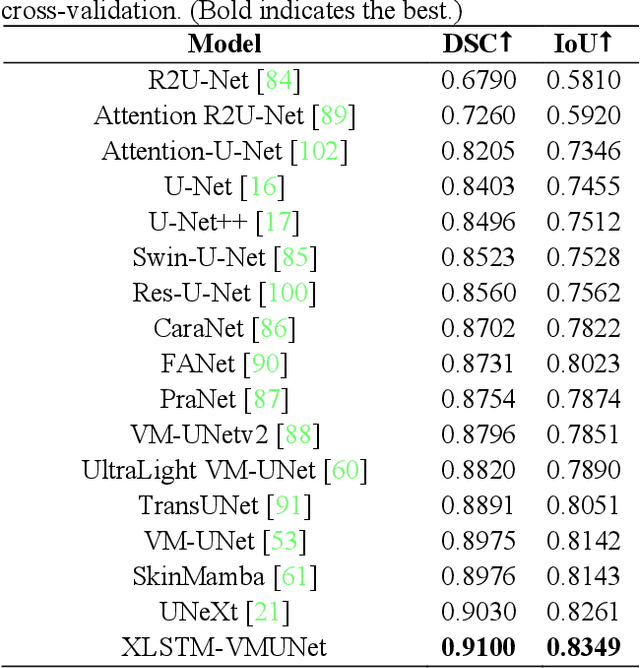
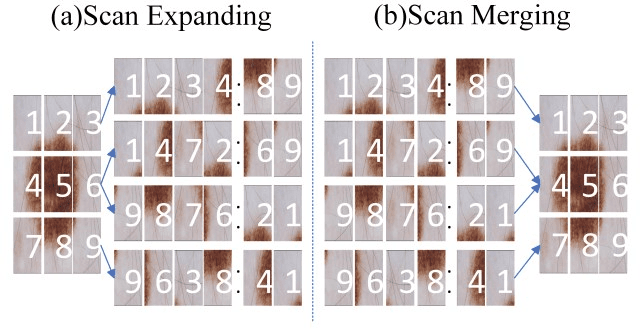
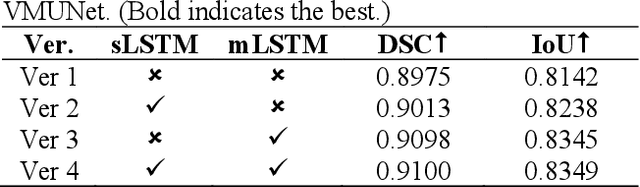
Automatic melanoma segmentation is essential for early skin cancer detection, yet challenges arise from the heterogeneity of melanoma, as well as interfering factors like blurred boundaries, low contrast, and imaging artifacts. While numerous algorithms have been developed to address these issues, previous approaches have often overlooked the need to jointly capture spatial and sequential features within dermatological images. This limitation hampers segmentation accuracy, especially in cases with indistinct borders or structurally similar lesions. Additionally, previous models lacked both a global receptive field and high computational efficiency. In this work, we present the XLSTM-VMUNet Model, which jointly capture spatial and sequential features within derma-tological images successfully. XLSTM-VMUNet can not only specialize in extracting spatial features from images, focusing on the structural characteristics of skin lesions, but also enhance contextual understanding, allowing more effective handling of complex medical image structures. Experiment results on the ISIC2018 dataset demonstrate that XLSTM-VMUNet outperforms VMUNet by 1.25% on DSC and 2.07% on IoU, with faster convergence and consistently high segmentation perfor-mance. Our code of XLSTM-VMUNet is available at https://github.com/MrFang/xLSTM-VMUNet.
Towards Efficient 3D Object Detection in Bird's-Eye-View Space for Autonomous Driving: A Convolutional-Only Approach
Dec 01, 2023

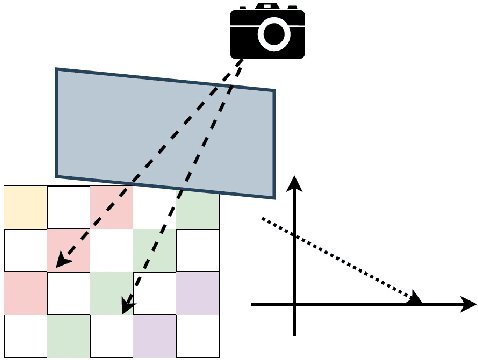

3D object detection in Bird's-Eye-View (BEV) space has recently emerged as a prevalent approach in the field of autonomous driving. Despite the demonstrated improvements in accuracy and velocity estimation compared to perspective view methods, the deployment of BEV-based techniques in real-world autonomous vehicles remains challenging. This is primarily due to their reliance on vision-transformer (ViT) based architectures, which introduce quadratic complexity with respect to the input resolution. To address this issue, we propose an efficient BEV-based 3D detection framework called BEVENet, which leverages a convolutional-only architectural design to circumvent the limitations of ViT models while maintaining the effectiveness of BEV-based methods. Our experiments show that BEVENet is 3$\times$ faster than contemporary state-of-the-art (SOTA) approaches on the NuScenes challenge, achieving a mean average precision (mAP) of 0.456 and a nuScenes detection score (NDS) of 0.555 on the NuScenes validation dataset, with an inference speed of 47.6 frames per second. To the best of our knowledge, this study stands as the first to achieve such significant efficiency improvements for BEV-based methods, highlighting their enhanced feasibility for real-world autonomous driving applications.
Improvement of a dedicated model for open domain persona-aware dialogue generation
Aug 27, 2020
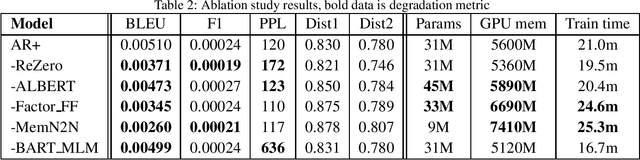
This paper analyzes some speed and performance improvement methods of Transformer architecture in recent years, mainly its application in dedicated model training. The dedicated model studied here refers to the open domain persona-aware dialogue generation model, and the dataset is multi turn short dialogue, The total length of a single input sequence is no more than 105 tokens. Therefore, many improvements in the architecture and attention mechanism of transformer architecture for long sequence processing are not discussed in this paper. The source code of the experiments has been open sourced: https://github.com/ghosthamlet/persona