 Add to Chrome
 Add to Firefox
 Add to Edge
Structural Evaluation Metrics for SVG Generation via Leave-One-Out Analysis
Apr 09, 2026
Scalable Vector Graphics (SVG) represent visual content as structured, editable code. Each element (path, shape, or text node) can be individually inspected, transformed, or removed. This structural editability is a main motivation for SVG generation, yet prevailing evaluation protocols primarily reduce the output to a single similarity score against a reference image or input texts, measuring how faithfully the result reproduces an image or follows the instructions, but not how well it preserves the structural properties that make SVG valuable. In particular, existing metrics cannot determine which generated elements contribute positively to overall visual quality, how visual concepts map to specific parts of the code, or whether the generated output supports meaningful downstream editing. We introduce element-level leave-one-out (LOO) analysis, inspired by the classic jackknife estimator. The procedure renders the SVG with and without each element, measures the resulting visual change, and derives a suite of structural quality metrics. Despite its simplicity, the jackknife's capacity to decompose an aggregate statistic into per-sample contributions translates directly to this setting. From a single mechanism, we obtain: (1) quality scores per element through LOO scoring that enable zero-shot artifact detection; (2) concept-element attribution that maps each element to the visual concept it serves; and (3) four structural metrics, purity, coverage, compactness, and locality, that quantify SVG modularity from complementary perspectives. We validate these metrics on over 19,000 edits (5 types) across 5 generation systems and 3 complexity tiers.

Graphic-Design-Bench: A Comprehensive Benchmark for Evaluating AI on Graphic Design Tasks
Apr 07, 2026We introduce GraphicDesignBench (GDB), the first comprehensive benchmark suite designed specifically to evaluate AI models on the full breadth of professional graphic design tasks. Unlike existing benchmarks that focus on natural-image understanding or generic text-to-image synthesis, GDB targets the unique challenges of professional design work: translating communicative intent into structured layouts, rendering typographically faithful text, manipulating layered compositions, producing valid vector graphics, and reasoning about animation. The suite comprises 50 tasks organized along five axes: layout, typography, infographics, template & design semantics and animation, each evaluated under both understanding and generation settings, and grounded in real-world design templates drawn from the LICA layered-composition dataset. We evaluate a set of frontier closed-source models using a standardized metric taxonomy covering spatial accuracy, perceptual quality, text fidelity, semantic alignment, and structural validity. Our results reveal that current models fall short on the core challenges of professional design: spatial reasoning over complex layouts, faithful vector code generation, fine-grained typographic perception, and temporal decomposition of animations remain largely unsolved. While high-level semantic understanding is within reach, the gap widens sharply as tasks demand precision, structure, and compositional awareness. GDB provides a rigorous, reproducible testbed for tracking progress toward AI systems that can function as capable design collaborators. The full evaluation framework is publicly available.
DANTE-AD: Dual-Vision Attention Network for Long-Term Audio Description
Mar 31, 2025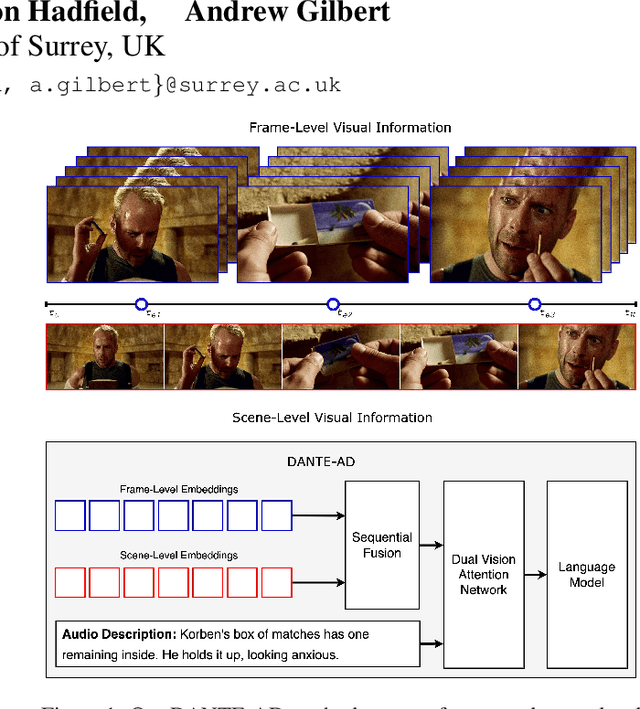
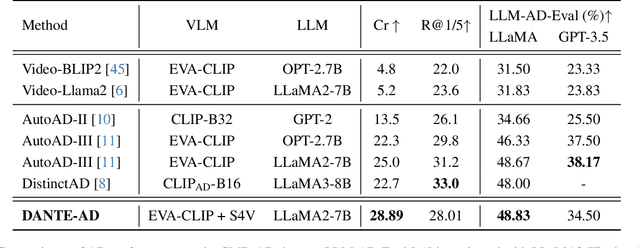
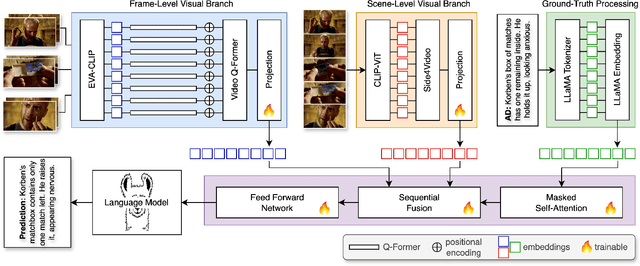
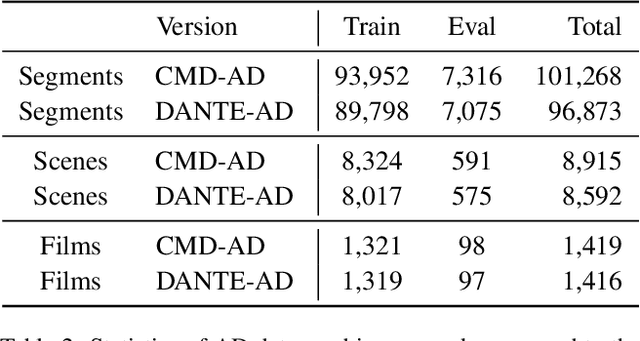
Audio Description is a narrated commentary designed to aid vision-impaired audiences in perceiving key visual elements in a video. While short-form video understanding has advanced rapidly, a solution for maintaining coherent long-term visual storytelling remains unresolved. Existing methods rely solely on frame-level embeddings, effectively describing object-based content but lacking contextual information across scenes. We introduce DANTE-AD, an enhanced video description model leveraging a dual-vision Transformer-based architecture to address this gap. DANTE-AD sequentially fuses both frame and scene level embeddings to improve long-term contextual understanding. We propose a novel, state-of-the-art method for sequential cross-attention to achieve contextual grounding for fine-grained audio description generation. Evaluated on a broad range of key scenes from well-known movie clips, DANTE-AD outperforms existing methods across traditional NLP metrics and LLM-based evaluations.