 Add to Chrome
 Add to Firefox
 Add to Edge
Graphic-Design-Bench: A Comprehensive Benchmark for Evaluating AI on Graphic Design Tasks
Apr 07, 2026
We introduce GraphicDesignBench (GDB), the first comprehensive benchmark suite designed specifically to evaluate AI models on the full breadth of professional graphic design tasks. Unlike existing benchmarks that focus on natural-image understanding or generic text-to-image synthesis, GDB targets the unique challenges of professional design work: translating communicative intent into structured layouts, rendering typographically faithful text, manipulating layered compositions, producing valid vector graphics, and reasoning about animation. The suite comprises 50 tasks organized along five axes: layout, typography, infographics, template & design semantics and animation, each evaluated under both understanding and generation settings, and grounded in real-world design templates drawn from the LICA layered-composition dataset. We evaluate a set of frontier closed-source models using a standardized metric taxonomy covering spatial accuracy, perceptual quality, text fidelity, semantic alignment, and structural validity. Our results reveal that current models fall short on the core challenges of professional design: spatial reasoning over complex layouts, faithful vector code generation, fine-grained typographic perception, and temporal decomposition of animations remain largely unsolved. While high-level semantic understanding is within reach, the gap widens sharply as tasks demand precision, structure, and compositional awareness. GDB provides a rigorous, reproducible testbed for tracking progress toward AI systems that can function as capable design collaborators. The full evaluation framework is publicly available.

PosterLlama: Bridging Design Ability of Langauge Model to Contents-Aware Layout Generation
Apr 02, 2024

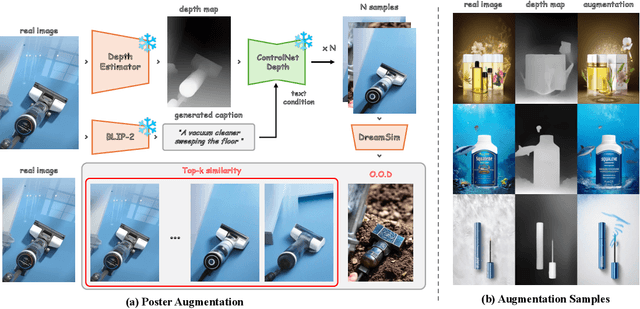

Visual layout plays a critical role in graphic design fields such as advertising, posters, and web UI design. The recent trend towards content-aware layout generation through generative models has shown promise, yet it often overlooks the semantic intricacies of layout design by treating it as a simple numerical optimization. To bridge this gap, we introduce PosterLlama, a network designed for generating visually and textually coherent layouts by reformatting layout elements into HTML code and leveraging the rich design knowledge embedded within language models. Furthermore, we enhance the robustness of our model with a unique depth-based poster augmentation strategy. This ensures our generated layouts remain semantically rich but also visually appealing, even with limited data. Our extensive evaluations across several benchmarks demonstrate that PosterLlama outperforms existing methods in producing authentic and content-aware layouts. It supports an unparalleled range of conditions, including but not limited to unconditional layout generation, element conditional layout generation, layout completion, among others, serving as a highly versatile user manipulation tool.