 Add to Chrome
 Add to Firefox
 Add to Edge
Do Enterprise Systems Need Learned World Models? The Importance of Context to Infer Dynamics
May 12, 2026
World models enable agents to anticipate the effects of their actions by internalizing environment dynamics. In enterprise systems, however, these dynamics are often defined by tenant-specific business logic that varies across deployments and evolves over time, making models trained on historical transitions brittle under deployment shift. We ask a question the world-models literature has not addressed: when the rules can be read at inference time, does an agent still need to learn them? We argue, and demonstrate empirically, that in settings where transition dynamics are configurable and readable, runtime discovery complements offline training by grounding predictions in the active system instance. We propose enterprise discovery agents, which recover relevant transition dynamics at runtime by reading the system's configuration rather than relying solely on internalized representations. We introduce CascadeBench, a reasoning-focused benchmark for enterprise cascade prediction that adopts the evaluation methodology of World of Workflows on diverse synthetic environments, and use it together with deployment-shift evaluation to show that offline-trained world models can perform well in-distribution but degrade as dynamics change, whereas discovery-based agents are more robust under shift by grounding their predictions in the current instance. Our findings suggest that, in configurable enterprise environments, agents should not rely solely on fixed internalized dynamics, but should incorporate mechanisms for discovering relevant transition logic at runtime.

Curry-DPO: Enhancing Alignment using Curriculum Learning & Ranked Preferences
Mar 12, 2024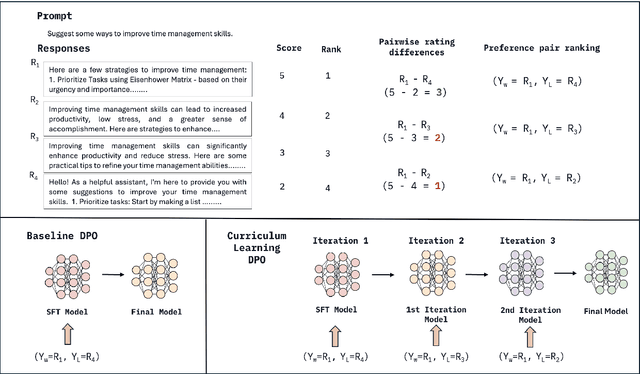
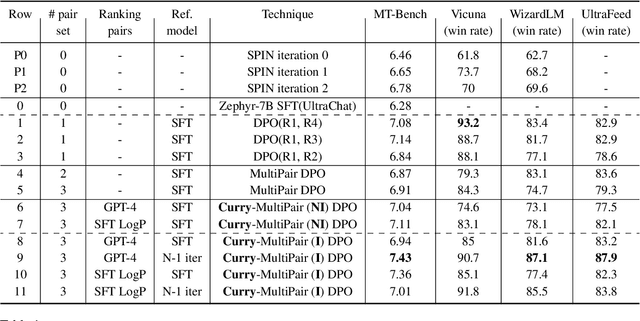
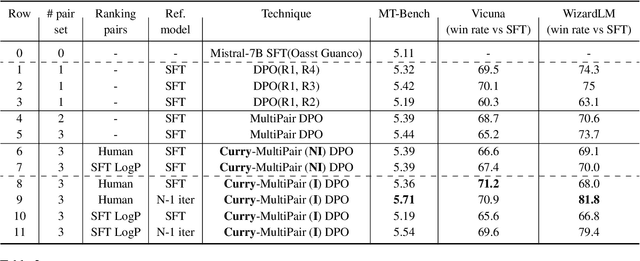
Direct Preference Optimization (DPO) is an effective technique that leverages pairwise preference data (usually one chosen and rejected response pair per user prompt) to align LLMs to human preferences. In practice, multiple responses can exist for a given prompt with varying quality relative to each other. With availability of such quality ratings for multiple responses, we propose utilizing these responses to create multiple preference pairs for a given prompt. Our work focuses on systematically using the constructed multiple preference pair in DPO training via curriculum learning methodology. In particular, we order these multiple pairs of preference data from easy to hard (emulating curriculum training) according to various criteria. We show detailed comparisons of our proposed approach to the standard single-pair DPO setting. Our method, which we call Curry-DPO consistently shows increased performance gains on MTbench, Vicuna, WizardLM, and the UltraFeedback test set, highlighting its effectiveness. More specifically, Curry-DPO achieves a score of 7.43 on MT-bench with Zephy-7B model outperforming majority of existing LLMs with similar parameter size. Curry-DPO also achieves the highest adjusted win rates on Vicuna, WizardLM, and UltraFeedback test datasets (90.7%, 87.1%, and 87.9% respectively) in our experiments, with notable gains of upto 7.5% when compared to standard DPO technique.