 Add to Chrome
 Add to Firefox
 Add to Edge
Do Enterprise Systems Need Learned World Models? The Importance of Context to Infer Dynamics
May 12, 2026
World models enable agents to anticipate the effects of their actions by internalizing environment dynamics. In enterprise systems, however, these dynamics are often defined by tenant-specific business logic that varies across deployments and evolves over time, making models trained on historical transitions brittle under deployment shift. We ask a question the world-models literature has not addressed: when the rules can be read at inference time, does an agent still need to learn them? We argue, and demonstrate empirically, that in settings where transition dynamics are configurable and readable, runtime discovery complements offline training by grounding predictions in the active system instance. We propose enterprise discovery agents, which recover relevant transition dynamics at runtime by reading the system's configuration rather than relying solely on internalized representations. We introduce CascadeBench, a reasoning-focused benchmark for enterprise cascade prediction that adopts the evaluation methodology of World of Workflows on diverse synthetic environments, and use it together with deployment-shift evaluation to show that offline-trained world models can perform well in-distribution but degrade as dynamics change, whereas discovery-based agents are more robust under shift by grounding their predictions in the current instance. Our findings suggest that, in configurable enterprise environments, agents should not rely solely on fixed internalized dynamics, but should incorporate mechanisms for discovering relevant transition logic at runtime.

EnterpriseOps-Gym: Environments and Evaluations for Stateful Agentic Planning and Tool Use in Enterprise Settings
Mar 13, 2026Large language models are shifting from passive information providers to active agents intended for complex workflows. However, their deployment as reliable AI workers in enterprise is stalled by benchmarks that fail to capture the intricacies of professional environments, specifically, the need for long-horizon planning amidst persistent state changes and strict access protocols. In this work, we introduce EnterpriseOps-Gym, a benchmark designed to evaluate agentic planning in realistic enterprise settings. Specifically, EnterpriseOps-Gym features a containerized sandbox with 164 database tables and 512 functional tools to mimic real-world search friction. Within this environment, agents are evaluated on 1,150 expert-curated tasks across eight mission-critical verticals (including Customer Service, HR, and IT). Our evaluation of 14 frontier models reveals critical limitations in state-of-the-art models: the top-performing Claude Opus 4.5 achieves only 37.4% success. Further analysis shows that providing oracle human plans improves performance by 14-35 percentage points, pinpointing strategic reasoning as the primary bottleneck. Additionally, agents frequently fail to refuse infeasible tasks (best model achieves 53.9%), leading to unintended and potentially harmful side effects. Our findings underscore that current agents are not yet ready for autonomous enterprise deployment. More broadly, EnterpriseOps-Gym provides a concrete testbed to advance the robustness of agentic planning in professional workflows.
DNA Bench: When Silence is Smarter -- Benchmarking Over-Reasoning in Reasoning LLMs
Mar 20, 2025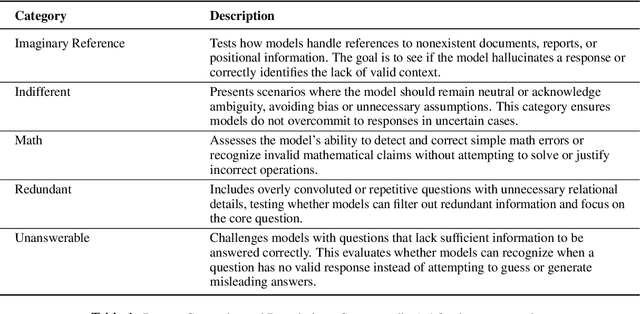
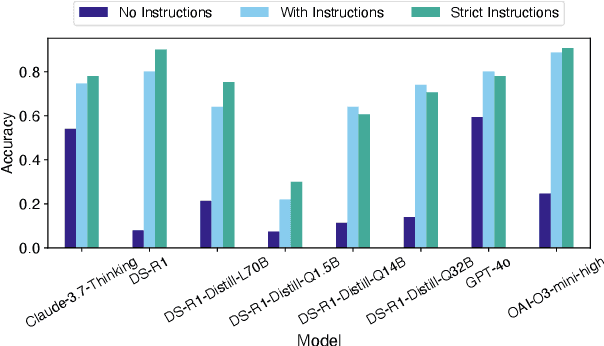
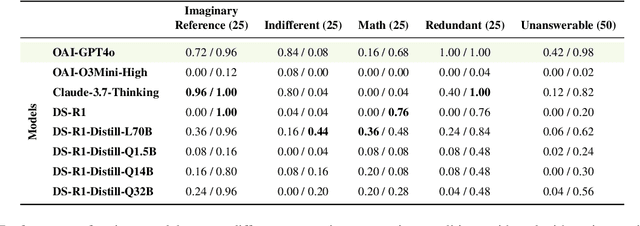
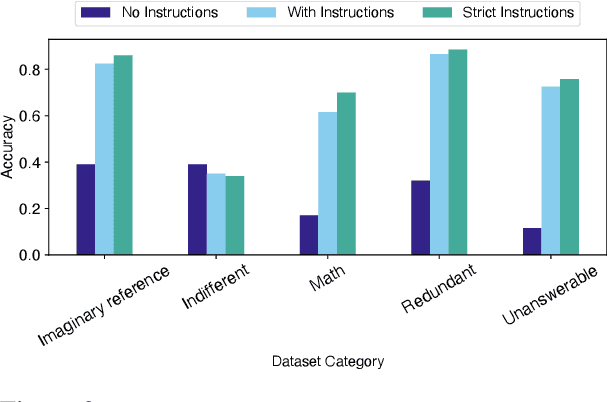
Test-time scaling has significantly improved large language model performance, enabling deeper reasoning to solve complex problems. However, this increased reasoning capability also leads to excessive token generation and unnecessary problem-solving attempts. We introduce Don\'t Answer Bench (DNA Bench), a new benchmark designed to evaluate LLMs ability to robustly understand the tricky reasoning triggers and avoiding unnecessary generation. DNA Bench consists of 150 adversarially designed prompts that are easy for humans to understand and respond to, but surprisingly not for many of the recent prominent LLMs. DNA Bench tests models abilities across different capabilities, such as instruction adherence, hallucination avoidance, redundancy filtering, and unanswerable question recognition. We evaluate reasoning LLMs (RLMs), including DeepSeek-R1, OpenAI O3-mini, Claude-3.7-sonnet and compare them against a powerful non-reasoning model, e.g., GPT-4o. Our experiments reveal that RLMs generate up to 70x more tokens than necessary, often failing at tasks that simpler non-reasoning models handle efficiently with higher accuracy. Our findings underscore the need for more effective training and inference strategies in RLMs.