 Add to Chrome
 Add to Firefox
 Add to Edge
Bridging the Generalization Gap in Adverse Weather Segmentation: A Training Recipe Perspective
May 27, 2026
This paper describes our approach for the 8th UG2+ Workshop (CVPR 2026) Track~2, which targets semantic segmentation of outdoor scenes degraded by five weather conditions: blur, darkness, snow, haze, and glare. A central challenge we observe is a severe generalization gap -- models that perform well on the validation set often collapse on the test set. For instance, SegFormer-B5 drops 16.1 mIoU points from validation to test, suggesting that model capacity alone is insufficient for robustness. We investigate whether a carefully designed training recipe, rather than architectural complexity, can address this gap. Starting from a pre-trained SegMAN-S backbone, we systematically study the effects of domain-adaptive fine-tuning, multi-source data mixing, scene-balanced sampling, and synthetic degradation augmentation. Our final system achieves 59.9\% mIoU on the official test set while maintaining a validation-test gap of only 6.5 points -- less than half that of larger models. We analyze negative results from architectural modifications, loss function variants, and model scaling to provide practical insights for weather-robust segmentation under limited data.

MARS2 2025 Challenge on Multimodal Reasoning: Datasets, Methods, Results, Discussion, and Outlook
Sep 17, 2025
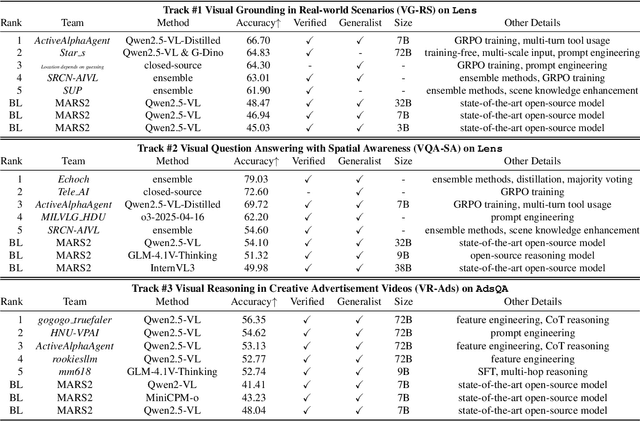

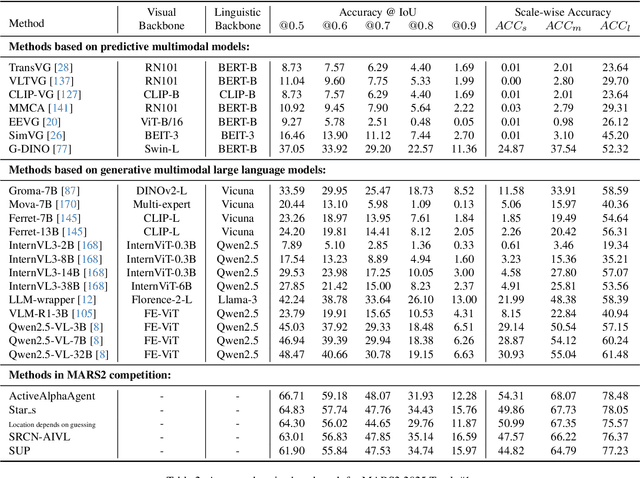
This paper reviews the MARS2 2025 Challenge on Multimodal Reasoning. We aim to bring together different approaches in multimodal machine learning and LLMs via a large benchmark. We hope it better allows researchers to follow the state-of-the-art in this very dynamic area. Meanwhile, a growing number of testbeds have boosted the evolution of general-purpose large language models. Thus, this year's MARS2 focuses on real-world and specialized scenarios to broaden the multimodal reasoning applications of MLLMs. Our organizing team released two tailored datasets Lens and AdsQA as test sets, which support general reasoning in 12 daily scenarios and domain-specific reasoning in advertisement videos, respectively. We evaluated 40+ baselines that include both generalist MLLMs and task-specific models, and opened up three competition tracks, i.e., Visual Grounding in Real-world Scenarios (VG-RS), Visual Question Answering with Spatial Awareness (VQA-SA), and Visual Reasoning in Creative Advertisement Videos (VR-Ads). Finally, 76 teams from the renowned academic and industrial institutions have registered and 40+ valid submissions (out of 1200+) have been included in our ranking lists. Our datasets, code sets (40+ baselines and 15+ participants' methods), and rankings are publicly available on the MARS2 workshop website and our GitHub organization page https://github.com/mars2workshop/, where our updates and announcements of upcoming events will be continuously provided.