 Add to Chrome
 Add to Firefox
 Add to Edge
AMPLIFAI: A Multiphase CT Dataset for Benchmarking Clinical Reasoning in LI-RADS Assessment of Liver Lesions
Aug 14, 2026
Hepatocellular carcinoma (HCC) is the third leading cause of cancer-related mortality worldwide, with early detection improving survival from <20\% to >70\%. The standardized LI-RADS criteria establish a biopsy-free, fully imaging-based framework that can serve as a foundation for automating HCC diagnosis with artificial intelligence (AI). However, the lack of large, publicly available datasets with high-quality labels has limited the development of AI models for LI-RADS characterization. We introduce the \textbf{AMPLIFAI} dataset, the first public dataset of multiphase abdominal CT scans annotated with LI-RADS categories and segmented for three major LI-RADS features: arterial phase hyperenhancement, washout, and enhancing capsule. Following the \emph{Datasheets for Datasets} format, this paper details the dataset's composition, curation process, and annotation pipeline to facilitate transparent, reproducible research.

Is Domain Adaptation Always Helpful? A Frozen-Backbone Study of Cross-Domain Sentiment Transfer
Jul 07, 2026Sentiment analysis with frozen pre-trained language model (PLM) backbones has become a common paradigm, yet the practical benefit of explicit domain adaptation remains unclear, particularly when backbones encode varying degrees of target-domain knowledge. We present a preliminary case study evaluating a controlled family of frozen embedding backbones (Qwen3-Embedding 0.6B, 4B, 8B), alongside RoBERTa-base and FinBERT. We train a lightweight MLP adapter on consumer reviews using Domain-Adversarial Neural Networks (DANN), Maximum Mean Discrepancy (MMD), and Supervised Contrastive Learning (SCL), and evaluate transfer to movie reviews (SST-2) and a heavily restricted subset of financial news (Financial PhraseBank). Within this constrained sample, we observe two distinct transfer patterns. On SST-2, domain adaptation provides negligible gain regardless of scale. On the financial subset, explicit domain adaptation appears to recover substantial performance for small general-purpose backbones. Notably, we find that adversarial alignment (DANN) is associated with degraded performance for domain-specialized backbones like FinBERT, consistent with erosion of pre-existing domain-specific structure, whereas supervised contrastive loss appears to preserve it. These preliminary findings suggest that the efficacy of explicit domain adaptation is highly contingent on whether the frozen backbone already possesses target-domain coverage.
CRESTomics: Analyzing Carotid Plaques in the CREST-2 Trial with a New Additive Classification Model
Mar 04, 2026Accurate characterization of carotid plaques is critical for stroke prevention in patients with carotid stenosis. We analyze 500 plaques from CREST-2, a multi-center clinical trial, to identify radiomics-based markers from B-mode ultrasound images linked with high-risk. We propose a new kernel-based additive model, combining coherence loss with group-sparse regularization for nonlinear classification. Group-wise additive effects of each feature group are visualized using partial dependence plots. Results indicate our method accurately and interpretably assesses plaques, revealing a strong association between plaque texture and clinical risk.
X-Mark: Saliency-Guided Robust Dataset Ownership Verification for Medical Imaging
Feb 10, 2026High-quality medical imaging datasets are essential for training deep learning models, but their unauthorized use raises serious copyright and ethical concerns. Medical imaging presents a unique challenge for existing dataset ownership verification methods designed for natural images, as static watermark patterns generated in fixed-scale images scale poorly dynamic and high-resolution scans with limited visual diversity and subtle anatomical structures, while preserving diagnostic quality. In this paper, we propose X-Mark, a sample-specific clean-label watermarking method for chest x-ray copyright protection. Specifically, X-Mark uses a conditional U-Net to generate unique perturbations within salient regions of each sample. We design a multi-component training objective to ensure watermark efficacy, robustness against dynamic scaling processes while preserving diagnostic quality and visual-distinguishability. We incorporate Laplacian regularization into our training objective to penalize high-frequency perturbations and achieve watermark scale-invariance. Ownership verification is performed in a black-box setting to detect characteristic behaviors in suspicious models. Extensive experiments on CheXpert verify the effectiveness of X-Mark, achieving WSR of 100% and reducing probability of false positives in Ind-M scenario by 12%, while demonstrating resistance to potential adaptive attacks.
Expanding the Horizon: Enabling Hybrid Quantum Transfer Learning for Long-Tailed Chest X-Ray Classification
Apr 30, 2024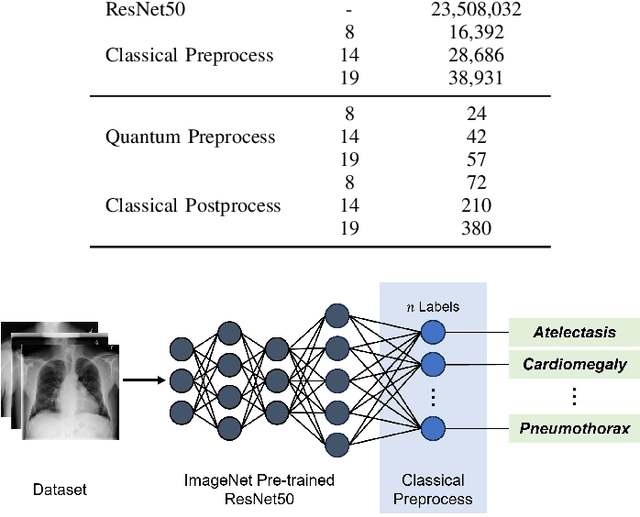
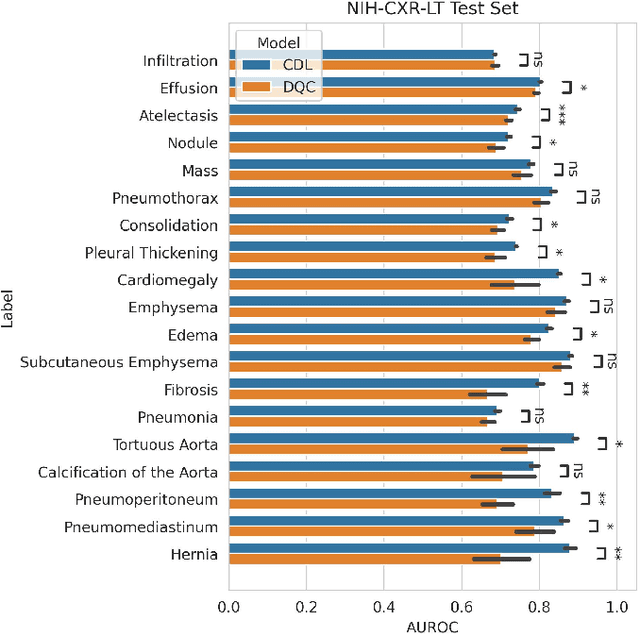
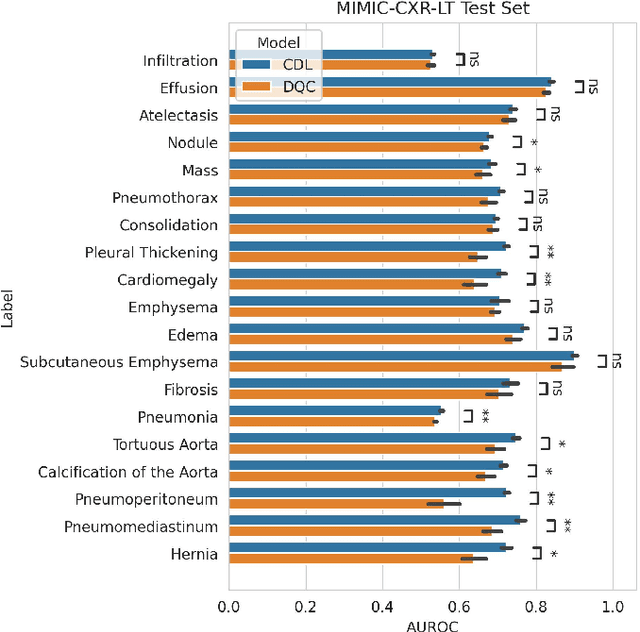
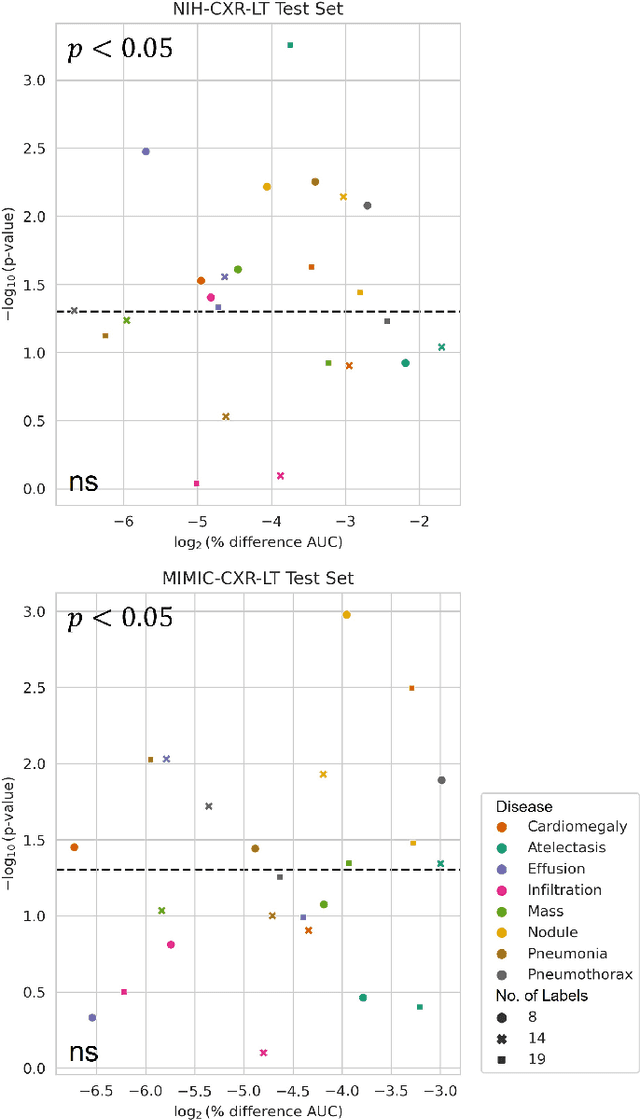
Quantum machine learning (QML) has the potential for improving the multi-label classification of rare, albeit critical, diseases in large-scale chest x-ray (CXR) datasets due to theoretical quantum advantages over classical machine learning (CML) in sample efficiency and generalizability. While prior literature has explored QML with CXRs, it has focused on binary classification tasks with small datasets due to limited access to quantum hardware and computationally expensive simulations. To that end, we implemented a Jax-based framework that enables the simulation of medium-sized qubit architectures with significant improvements in wall-clock time over current software offerings. We evaluated the performance of our Jax-based framework in terms of efficiency and performance for hybrid quantum transfer learning for long-tailed classification across 8, 14, and 19 disease labels using large-scale CXR datasets. The Jax-based framework resulted in up to a 58% and 95% speed-up compared to PyTorch and TensorFlow implementations, respectively. However, compared to CML, QML demonstrated slower convergence and an average AUROC of 0.70, 0.73, and 0.74 for the classification of 8, 14, and 19 CXR disease labels. In comparison, the CML models had an average AUROC of 0.77, 0.78, and 0.80 respectively. In conclusion, our work presents an accessible implementation of hybrid quantum transfer learning for long-tailed CXR classification with a computationally efficient Jax-based framework.
Improving Multi-Center Generalizability of GAN-Based Fat Suppression using Federated Learning
Apr 10, 2024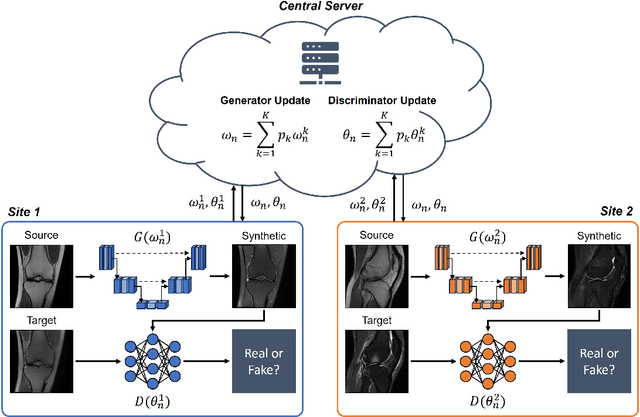
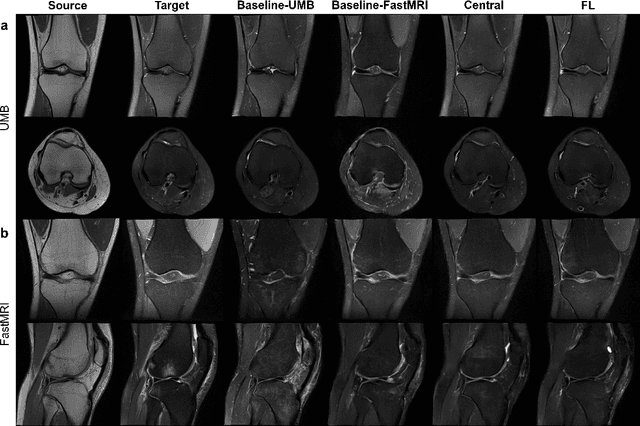
Generative Adversarial Network (GAN)-based synthesis of fat suppressed (FS) MRIs from non-FS proton density sequences has the potential to accelerate acquisition of knee MRIs. However, GANs trained on single-site data have poor generalizability to external data. We show that federated learning can improve multi-center generalizability of GANs for synthesizing FS MRIs, while facilitating privacy-preserving multi-institutional collaborations.
Anytime, Anywhere, Anyone: Investigating the Feasibility of Segment Anything Model for Crowd-Sourcing Medical Image Annotations
Mar 22, 2024Curating annotations for medical image segmentation is a labor-intensive and time-consuming task that requires domain expertise, resulting in "narrowly" focused deep learning (DL) models with limited translational utility. Recently, foundation models like the Segment Anything Model (SAM) have revolutionized semantic segmentation with exceptional zero-shot generalizability across various domains, including medical imaging, and hold a lot of promise for streamlining the annotation process. However, SAM has yet to be evaluated in a crowd-sourced setting to curate annotations for training 3D DL segmentation models. In this work, we explore the potential of SAM for crowd-sourcing "sparse" annotations from non-experts to generate "dense" segmentation masks for training 3D nnU-Net models, a state-of-the-art DL segmentation model. Our results indicate that while SAM-generated annotations exhibit high mean Dice scores compared to ground-truth annotations, nnU-Net models trained on SAM-generated annotations perform significantly worse than nnU-Net models trained on ground-truth annotations ($p<0.001$, all).
Hidden in Plain Sight: Undetectable Adversarial Bias Attacks on Vulnerable Patient Populations
Feb 08, 2024The proliferation of artificial intelligence (AI) in radiology has shed light on the risk of deep learning (DL) models exacerbating clinical biases towards vulnerable patient populations. While prior literature has focused on quantifying biases exhibited by trained DL models, demographically targeted adversarial bias attacks on DL models and its implication in the clinical environment remains an underexplored field of research in medical imaging. In this work, we demonstrate that demographically targeted label poisoning attacks can introduce adversarial underdiagnosis bias in DL models and degrade performance on underrepresented groups without impacting overall model performance. Moreover, our results across multiple performance metrics and demographic groups like sex, age, and their intersectional subgroups indicate that a group's vulnerability to undetectable adversarial bias attacks is directly correlated with its representation in the model's training data.
One Copy Is All You Need: Resource-Efficient Streaming of Medical Imaging Data at Scale
Jul 01, 2023Large-scale medical imaging datasets have accelerated development of artificial intelligence tools for clinical decision support. However, the large size of these datasets is a bottleneck for users with limited storage and bandwidth. Many users may not even require such large datasets as AI models are often trained on lower resolution images. If users could directly download at their desired resolution, storage and bandwidth requirements would significantly decrease. However, it is impossible to anticipate every users' requirements and impractical to store the data at multiple resolutions. What if we could store images at a single resolution but send them at different ones? We propose MIST, an open-source framework to operationalize progressive resolution for streaming medical images at multiple resolutions from a single high-resolution copy. We demonstrate that MIST can dramatically reduce imaging infrastructure inefficiencies for hosting and streaming medical images by >90%, while maintaining diagnostic quality for deep learning applications.
High-Throughput AI Inference for Medical Image Classification and Segmentation using Intelligent Streaming
May 24, 2023As the adoption of AI systems within the clinical setup grows, limitations in bandwidth could create communication bottlenecks when streaming imaging data, leading to delays in patient diagnosis and treatment. As such, healthcare providers and AI vendors will require greater computational infrastructure, therefore dramatically increasing costs. To that end, we developed intelligent streaming, a state-of-the-art framework to enable accelerated, cost-effective, bandwidth-optimized, and computationally efficient AI inference for clinical decision making at scale. For classification, intelligent streaming reduced the data transmission by 99.01% and decoding time by 98.58%, while increasing throughput by 27.43x. For segmentation, our framework reduced data transmission by 90.32%, decoding time by 90.26%, while increasing throughput by 4.20x. Our work demonstrates that intelligent streaming results in faster turnaround times, and reduced overall cost of data and transmission, without negatively impacting clinical decision making using AI systems.