 Add to Chrome
 Add to Firefox
 Add to Edge
AMPLIFAI: A Multiphase CT Dataset for Benchmarking Clinical Reasoning in LI-RADS Assessment of Liver Lesions
Aug 14, 2026
Hepatocellular carcinoma (HCC) is the third leading cause of cancer-related mortality worldwide, with early detection improving survival from <20\% to >70\%. The standardized LI-RADS criteria establish a biopsy-free, fully imaging-based framework that can serve as a foundation for automating HCC diagnosis with artificial intelligence (AI). However, the lack of large, publicly available datasets with high-quality labels has limited the development of AI models for LI-RADS characterization. We introduce the \textbf{AMPLIFAI} dataset, the first public dataset of multiphase abdominal CT scans annotated with LI-RADS categories and segmented for three major LI-RADS features: arterial phase hyperenhancement, washout, and enhancing capsule. Following the \emph{Datasheets for Datasets} format, this paper details the dataset's composition, curation process, and annotation pipeline to facilitate transparent, reproducible research.

Escaping the Big Data Paradigm with Compact Transformers
Apr 12, 2021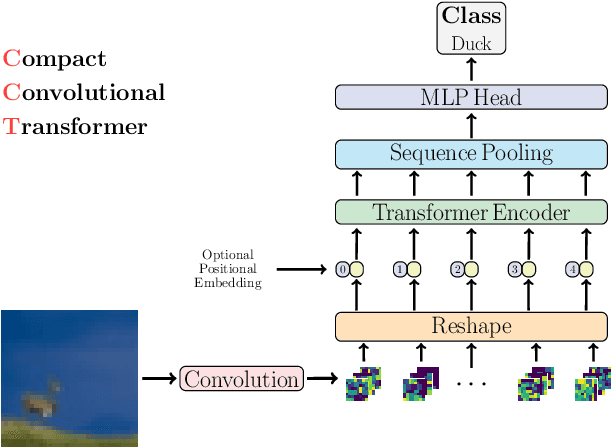
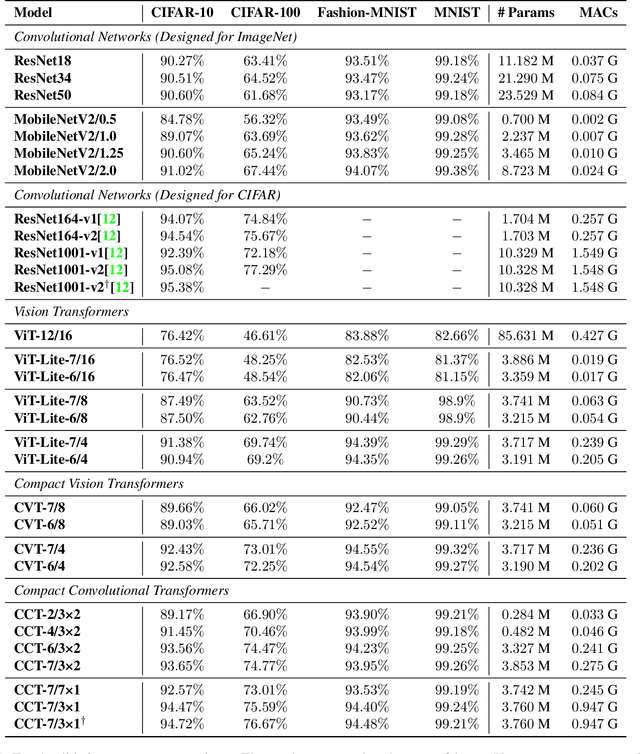
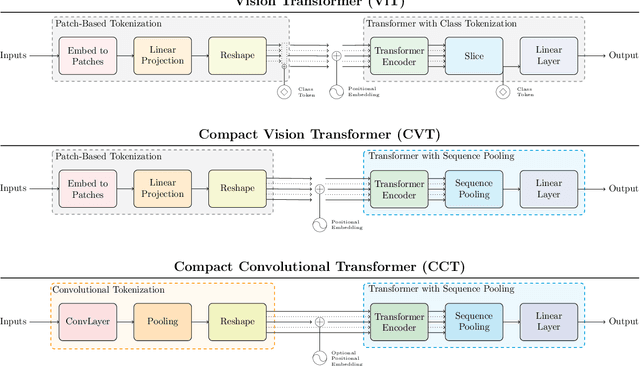
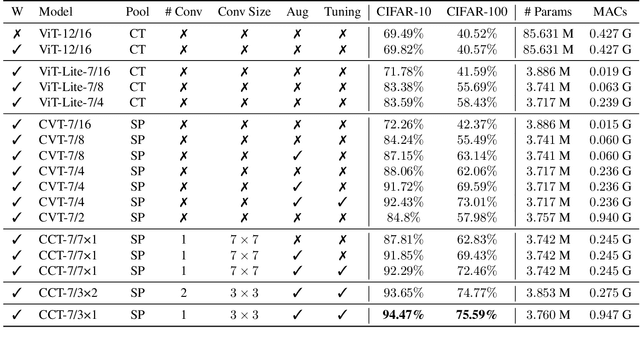
With the rise of Transformers as the standard for language processing, and their advancements in computer vision, along with their unprecedented size and amounts of training data, many have come to believe that they are not suitable for small sets of data. This trend leads to great concerns, including but not limited to: limited availability of data in certain scientific domains and the exclusion of those with limited resource from research in the field. In this paper, we dispel the myth that transformers are "data hungry" and therefore can only be applied to large sets of data. We show for the first time that with the right size and tokenization, transformers can perform head-to-head with state-of-the-art CNNs on small datasets. Our model eliminates the requirement for class token and positional embeddings through a novel sequence pooling strategy and the use of convolutions. We show that compared to CNNs, our compact transformers have fewer parameters and MACs, while obtaining similar accuracies. Our method is flexible in terms of model size, and can have as little as 0.28M parameters and achieve reasonable results. It can reach an accuracy of 94.72% when training from scratch on CIFAR-10, which is comparable with modern CNN based approaches, and a significant improvement over previous Transformer based models. Our simple and compact design democratizes transformers by making them accessible to those equipped with basic computing resources and/or dealing with important small datasets. Our code and pre-trained models will be made publicly available at https://github.com/SHI-Labs/Compact-Transformers.