 Add to Chrome
 Add to Firefox
 Add to Edge
SDO: Structure-Aware Data Organization for Efficient LLM Post-Training
Jul 29, 2026
Post-training of large language models is expensive, and existing efficiency improvements mainly focus on selecting informative samples or designing training schedules. However, data organization itself is usually treated as a static preprocessing step: embedding-based grouping methods construct fixed partitions before training and cannot adapt to the evolving sample exposure during optimization. As a result, all samples receive similar exposure despite their different optimization needs, leading to redundant updates for some samples while leaving others under-optimized. To address this problem, we propose SDO (Structure-Aware Data Organization), a plug-and-play data organization framework with an exposure-driven feedback mechanism that organizes mini-batch composition and sample exposure according to representation-space structure. SDO operates epoch by epoch on frozen external embeddings, avoiding model warm-up training overhead: within each epoch, locality-aware batching forms coherent mini-batches via KNN neighborhood traversal; across epochs, exposure-balanced scheduling records per-sample participation and reduces the sampling probability of over-exposed samples to preserve long-term coverage. Across SFT, DPO, and GRPO, SDO accelerates convergence, with the largest gains observed in the early-to-mid phase, producing more coherent gradients and more balanced accuracy across question types without permanently excluding training samples.

GitTaskBench: A Benchmark for Code Agents Solving Real-World Tasks Through Code Repository Leveraging
Aug 26, 2025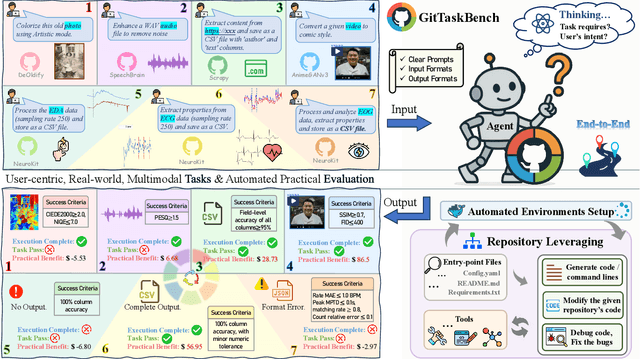
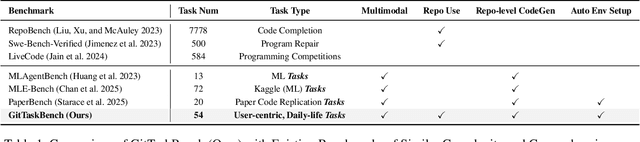
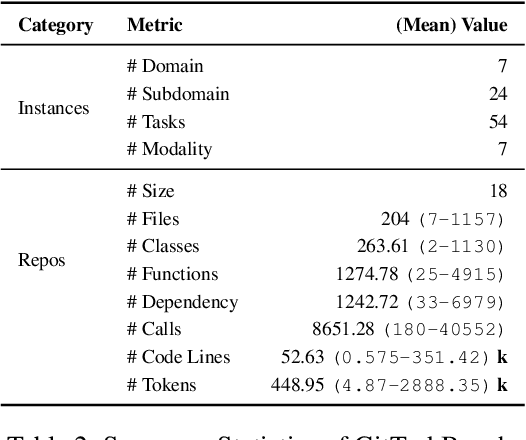
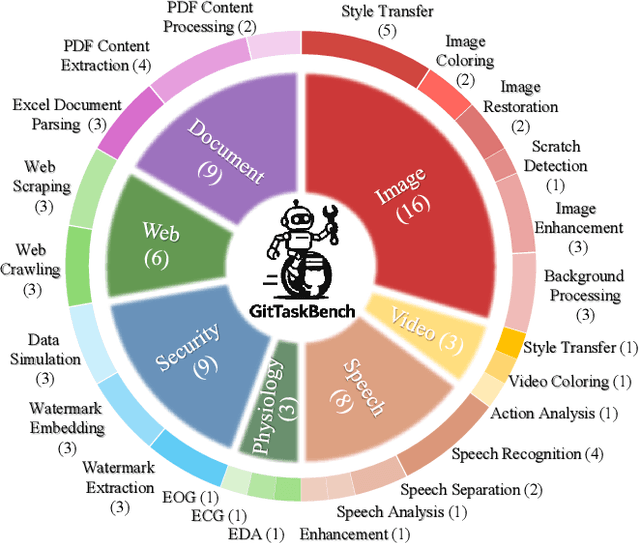
Beyond scratch coding, exploiting large-scale code repositories (e.g., GitHub) for practical tasks is vital in real-world software development, yet current benchmarks rarely evaluate code agents in such authentic, workflow-driven scenarios. To bridge this gap, we introduce GitTaskBench, a benchmark designed to systematically assess this capability via 54 realistic tasks across 7 modalities and 7 domains. Each task pairs a relevant repository with an automated, human-curated evaluation harness specifying practical success criteria. Beyond measuring execution and task success, we also propose the alpha-value metric to quantify the economic benefit of agent performance, which integrates task success rates, token cost, and average developer salaries. Experiments across three state-of-the-art agent frameworks with multiple advanced LLMs show that leveraging code repositories for complex task solving remains challenging: even the best-performing system, OpenHands+Claude 3.7, solves only 48.15% of tasks. Error analysis attributes over half of failures to seemingly mundane yet critical steps like environment setup and dependency resolution, highlighting the need for more robust workflow management and increased timeout preparedness. By releasing GitTaskBench, we aim to drive progress and attention toward repository-aware code reasoning, execution, and deployment -- moving agents closer to solving complex, end-to-end real-world tasks. The benchmark and code are open-sourced at https://github.com/QuantaAlpha/GitTaskBench.
RepoMaster: Autonomous Exploration and Understanding of GitHub Repositories for Complex Task Solving
May 27, 2025
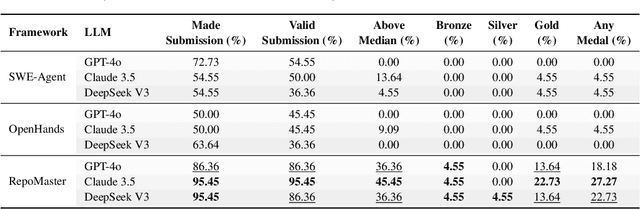
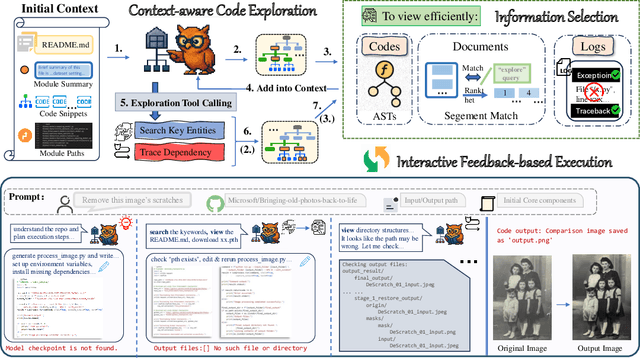
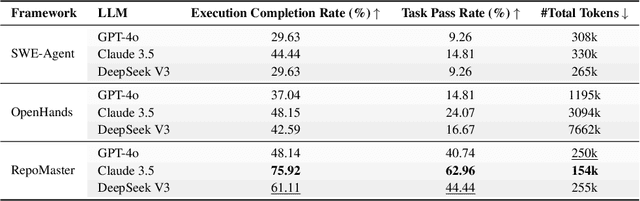
The ultimate goal of code agents is to solve complex tasks autonomously. Although large language models (LLMs) have made substantial progress in code generation, real-world tasks typically demand full-fledged code repositories rather than simple scripts. Building such repositories from scratch remains a major challenge. Fortunately, GitHub hosts a vast, evolving collection of open-source repositories, which developers frequently reuse as modular components for complex tasks. Yet, existing frameworks like OpenHands and SWE-Agent still struggle to effectively leverage these valuable resources. Relying solely on README files provides insufficient guidance, and deeper exploration reveals two core obstacles: overwhelming information and tangled dependencies of repositories, both constrained by the limited context windows of current LLMs. To tackle these issues, we propose RepoMaster, an autonomous agent framework designed to explore and reuse GitHub repositories for solving complex tasks. For efficient understanding, RepoMaster constructs function-call graphs, module-dependency graphs, and hierarchical code trees to identify essential components, providing only identified core elements to the LLMs rather than the entire repository. During autonomous execution, it progressively explores related components using our exploration tools and prunes information to optimize context usage. Evaluated on the adjusted MLE-bench, RepoMaster achieves a 110% relative boost in valid submissions over the strongest baseline OpenHands. On our newly released GitTaskBench, RepoMaster lifts the task-pass rate from 24.1% to 62.9% while reducing token usage by 95%. Our code and demonstration materials are publicly available at https://github.com/wanghuacan/RepoMaster.