 Add to Chrome
 Add to Firefox
 Add to Edge
A Unified Calibration Framework for High-Accuracy Articulated Robot Kinematics
Jan 23, 2026
Researchers have identified various sources of tool positioning errors for articulated industrial robots and have proposed dedicated compensation strategies. However, these typically require individual, specialized experiments with separate models and identification procedures. This article presents a unified approach to the static calibration of industrial robots that identifies a robot model, including geometric and non-geometric effects (compliant bending, thermal deformation, gear transmission errors), using only a single, straightforward experiment for data collection. The model augments the kinematic chain with virtual joints for each modeled effect and realizes the identification using Gauss-Newton optimization with analytic gradients. Fisher information spectra show that the estimation is well-conditioned and the parameterization near-minimal, whereas systematic temporal cross-validation and model ablations demonstrate robustness of the model identification. The resulting model is very accurate and its identification robust, achieving a mean position error of 26.8 $μm$ on a KUKA KR30 industrial robot compared to 102.3 $μm$ for purely geometric calibration.

Data-Efficient Online Learning of Ball Placement in Robot Table Tennis
Aug 28, 2023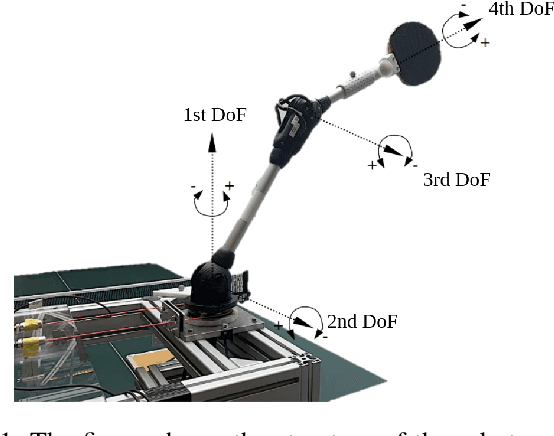
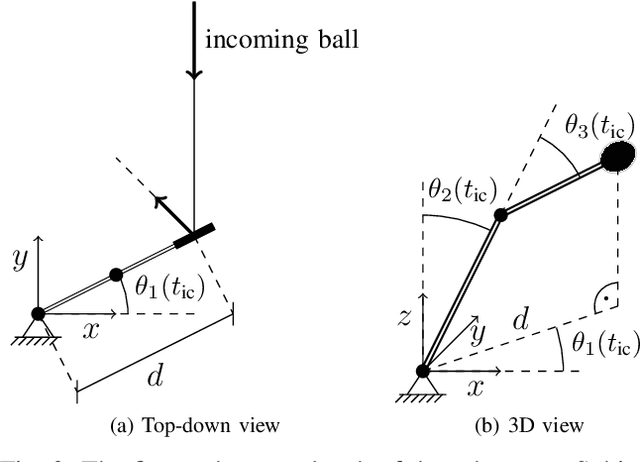
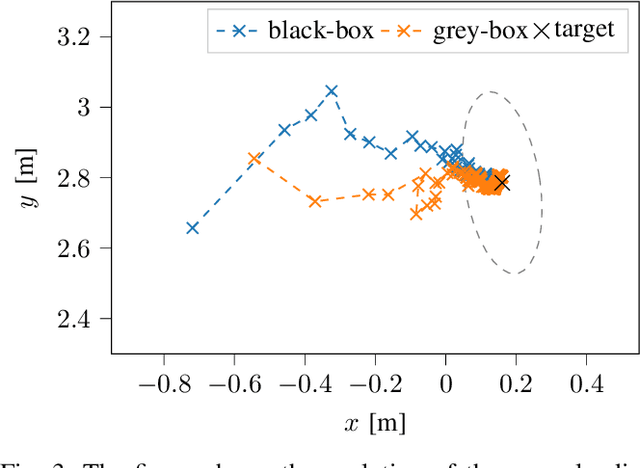
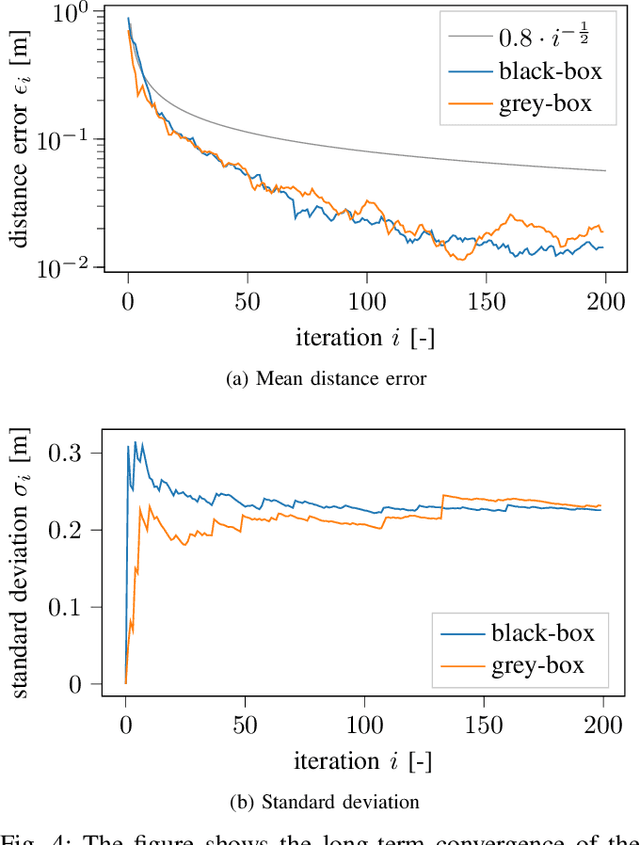
We present an implementation of an online optimization algorithm for hitting a predefined target when returning ping-pong balls with a table tennis robot. The online algorithm optimizes over so-called interception policies, which define the manner in which the robot arm intercepts the ball. In our case, these are composed of the state of the robot arm (position and velocity) at interception time. Gradient information is provided to the optimization algorithm via the mapping from the interception policy to the landing point of the ball on the table, which is approximated with a black-box and a grey-box approach. Our algorithm is applied to a robotic arm with four degrees of freedom that is driven by pneumatic artificial muscles. As a result, the robot arm is able to return the ball onto any predefined target on the table after about 2-5 iterations. We highlight the robustness of our approach by showing rapid convergence with both the black-box and the grey-box gradients. In addition, the small number of iterations required to reach close proximity to the target also underlines the sample efficiency. A demonstration video can be found here: https://youtu.be/VC3KJoCss0k.
Black-Box vs. Gray-Box: A Case Study on Learning Table Tennis Ball Trajectory Prediction with Spin and Impacts
May 24, 2023In this paper, we present a method for table tennis ball trajectory filtering and prediction. Our gray-box approach builds on a physical model. At the same time, we use data to learn parameters of the dynamics model, of an extended Kalman filter, and of a neural model that infers the ball's initial condition. We demonstrate superior prediction performance of our approach over two black-box approaches, which are not supplied with physical prior knowledge. We demonstrate that initializing the spin from parameters of the ball launcher using a neural network drastically improves long-time prediction performance over estimating the spin purely from measured ball positions. An accurate prediction of the ball trajectory is crucial for successful returns. We therefore evaluate the return performance with a pneumatic artificial muscular robot and achieve a return rate of 29/30 (97.7%).