 Add to Chrome
 Add to Firefox
 Add to Edge
GLIMPSE : Real-Time Text Recognition and Contextual Understanding for VQA in Wearables
Feb 13, 2026
Video Large Language Models (Video LLMs) have shown remarkable progress in understanding and reasoning about visual content, particularly in tasks involving text recognition and text-based visual question answering (Text VQA). However, deploying Text VQA on wearable devices faces a fundamental tension: text recognition requires high-resolution video, but streaming high-quality video drains battery and causes thermal throttling. Moreover, existing models struggle to maintain coherent temporal context when processing text across multiple frames in real-time streams. We observe that text recognition and visual reasoning have asymmetric resolution requirements - OCR needs fine detail while scene understanding tolerates coarse features. We exploit this asymmetry with a hybrid architecture that performs selective high-resolution OCR on-device while streaming low-resolution video for visual context. On a benchmark of text-based VQA samples across five task categories, our system achieves 72% accuracy at 0.49x the power consumption of full-resolution streaming, enabling sustained VQA sessions on resource-constrained wearables without sacrificing text understanding quality.

AnyMAL: An Efficient and Scalable Any-Modality Augmented Language Model
Sep 27, 2023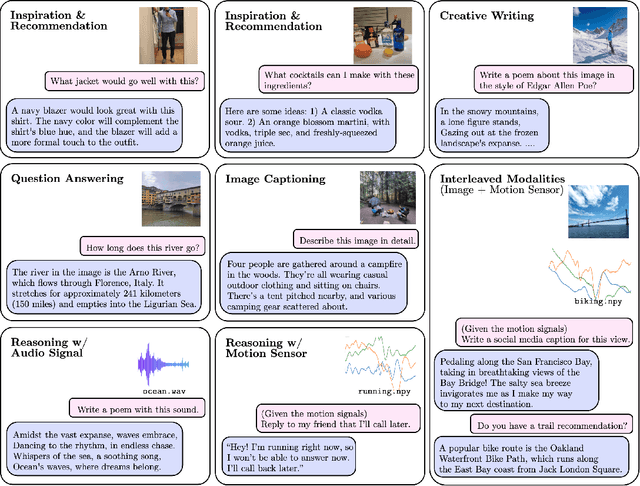
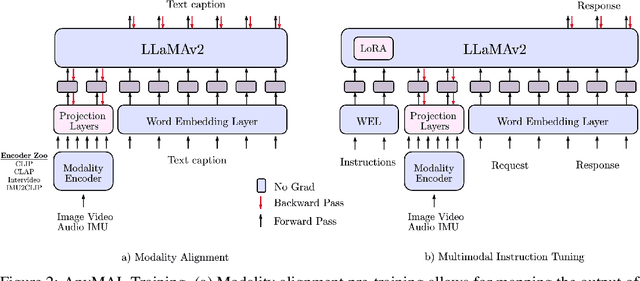

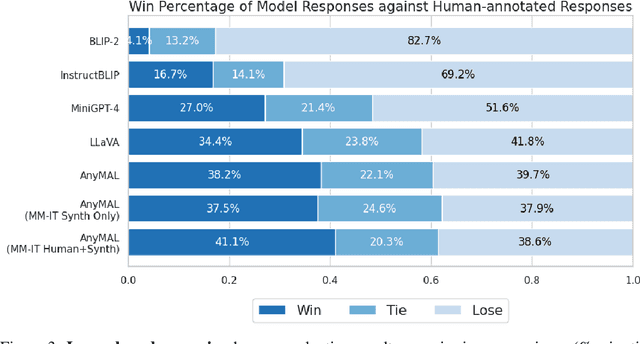
We present Any-Modality Augmented Language Model (AnyMAL), a unified model that reasons over diverse input modality signals (i.e. text, image, video, audio, IMU motion sensor), and generates textual responses. AnyMAL inherits the powerful text-based reasoning abilities of the state-of-the-art LLMs including LLaMA-2 (70B), and converts modality-specific signals to the joint textual space through a pre-trained aligner module. To further strengthen the multimodal LLM's capabilities, we fine-tune the model with a multimodal instruction set manually collected to cover diverse topics and tasks beyond simple QAs. We conduct comprehensive empirical analysis comprising both human and automatic evaluations, and demonstrate state-of-the-art performance on various multimodal tasks.
A Study on the Efficiency and Generalization of Light Hybrid Retrievers
Oct 04, 2022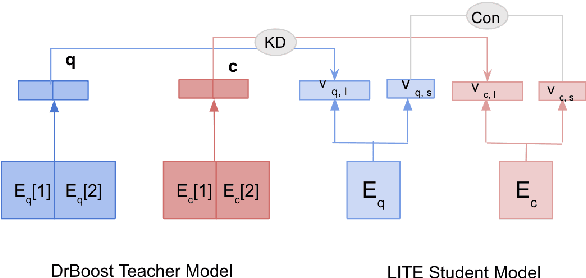
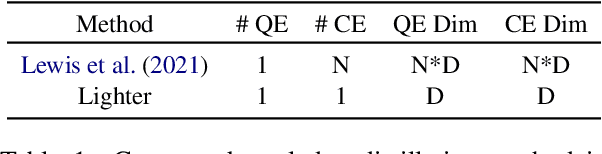
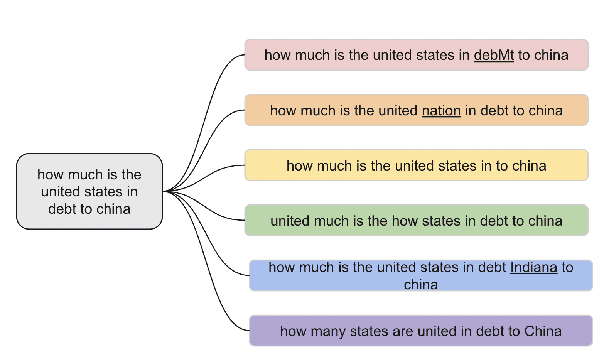
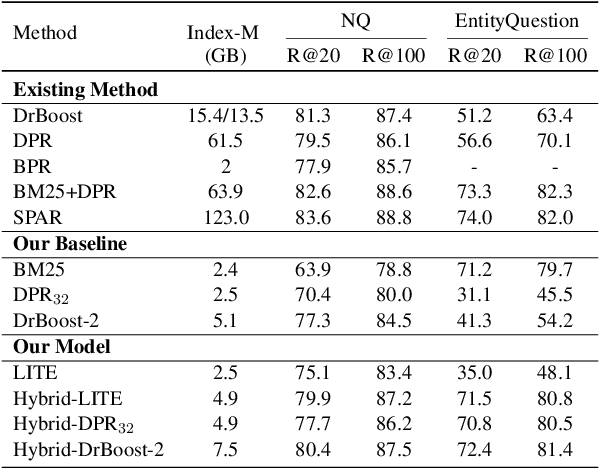
Existing hybrid retrievers which integrate sparse and dense retrievers, are indexing-heavy, limiting their applicability in real-world on-devices settings. We ask the question "Is it possible to reduce the indexing memory of hybrid retrievers without sacrificing performance?" Driven by this question, we leverage an indexing-efficient dense retriever (i.e. DrBoost) to obtain a light hybrid retriever. Moreover, to further reduce the memory, we introduce a lighter dense retriever (LITE) which is jointly trained on contrastive learning and knowledge distillation from DrBoost. Compared to previous heavy hybrid retrievers, our Hybrid-LITE retriever saves 13 memory while maintaining 98.0 performance. In addition, we study the generalization of light hybrid retrievers along two dimensions, out-of-domain (OOD) generalization and robustness against adversarial attacks. We evaluate models on two existing OOD benchmarks and create six adversarial attack sets for robustness evaluation. Experiments show that our light hybrid retrievers achieve better robustness performance than both sparse and dense retrievers. Nevertheless there is a large room to improve the robustness of retrievers, and our datasets can aid future research.
Best Practices for Data-Efficient Modeling in NLG:How to Train Production-Ready Neural Models with Less Data
Nov 08, 2020Natural language generation (NLG) is a critical component in conversational systems, owing to its role of formulating a correct and natural text response. Traditionally, NLG components have been deployed using template-based solutions. Although neural network solutions recently developed in the research community have been shown to provide several benefits, deployment of such model-based solutions has been challenging due to high latency, correctness issues, and high data needs. In this paper, we present approaches that have helped us deploy data-efficient neural solutions for NLG in conversational systems to production. We describe a family of sampling and modeling techniques to attain production quality with light-weight neural network models using only a fraction of the data that would be necessary otherwise, and show a thorough comparison between each. Our results show that domain complexity dictates the appropriate approach to achieve high data efficiency. Finally, we distill the lessons from our experimental findings into a list of best practices for production-level NLG model development, and present them in a brief runbook. Importantly, the end products of all of the techniques are small sequence-to-sequence models (2Mb) that we can reliably deploy in production.