 Add to Chrome
 Add to Firefox
 Add to Edge
GLIMPSE : Real-Time Text Recognition and Contextual Understanding for VQA in Wearables
Feb 13, 2026
Video Large Language Models (Video LLMs) have shown remarkable progress in understanding and reasoning about visual content, particularly in tasks involving text recognition and text-based visual question answering (Text VQA). However, deploying Text VQA on wearable devices faces a fundamental tension: text recognition requires high-resolution video, but streaming high-quality video drains battery and causes thermal throttling. Moreover, existing models struggle to maintain coherent temporal context when processing text across multiple frames in real-time streams. We observe that text recognition and visual reasoning have asymmetric resolution requirements - OCR needs fine detail while scene understanding tolerates coarse features. We exploit this asymmetry with a hybrid architecture that performs selective high-resolution OCR on-device while streaming low-resolution video for visual context. On a benchmark of text-based VQA samples across five task categories, our system achieves 72% accuracy at 0.49x the power consumption of full-resolution streaming, enabling sustained VQA sessions on resource-constrained wearables without sacrificing text understanding quality.

Improving Faithfulness of Abstractive Summarization by Controlling Confounding Effect of Irrelevant Sentences
Dec 19, 2022
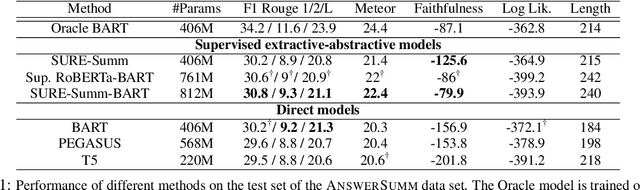

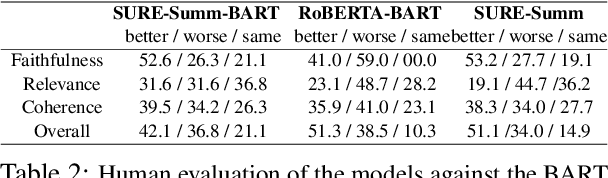
Lack of factual correctness is an issue that still plagues state-of-the-art summarization systems despite their impressive progress on generating seemingly fluent summaries. In this paper, we show that factual inconsistency can be caused by irrelevant parts of the input text, which act as confounders. To that end, we leverage information-theoretic measures of causal effects to quantify the amount of confounding and precisely quantify how they affect the summarization performance. Based on insights derived from our theoretical results, we design a simple multi-task model to control such confounding by leveraging human-annotated relevant sentences when available. Crucially, we give a principled characterization of data distributions where such confounding can be large thereby necessitating the use of human annotated relevant sentences to generate factual summaries. Our approach improves faithfulness scores by 20\% over strong baselines on AnswerSumm \citep{fabbri2021answersumm}, a conversation summarization dataset where lack of faithfulness is a significant issue due to the subjective nature of the task. Our best method achieves the highest faithfulness score while also achieving state-of-the-art results on standard metrics like ROUGE and METEOR. We corroborate these improvements through human evaluation.
Best Practices for Data-Efficient Modeling in NLG:How to Train Production-Ready Neural Models with Less Data
Nov 08, 2020Natural language generation (NLG) is a critical component in conversational systems, owing to its role of formulating a correct and natural text response. Traditionally, NLG components have been deployed using template-based solutions. Although neural network solutions recently developed in the research community have been shown to provide several benefits, deployment of such model-based solutions has been challenging due to high latency, correctness issues, and high data needs. In this paper, we present approaches that have helped us deploy data-efficient neural solutions for NLG in conversational systems to production. We describe a family of sampling and modeling techniques to attain production quality with light-weight neural network models using only a fraction of the data that would be necessary otherwise, and show a thorough comparison between each. Our results show that domain complexity dictates the appropriate approach to achieve high data efficiency. Finally, we distill the lessons from our experimental findings into a list of best practices for production-level NLG model development, and present them in a brief runbook. Importantly, the end products of all of the techniques are small sequence-to-sequence models (2Mb) that we can reliably deploy in production.