 Add to Chrome
 Add to Firefox
 Add to Edge
Level Crossing Rate Analysis for Optimal Single-user RIS Systems
Mar 11, 2026
We analyse the level crossing rate (LCR) of an uplink single-user (SU) reconfigurable intelligent surface (RIS) aided system. It is assumed that the RIS to base station (RIS-BS) channel is deployed as line-of-sight (LoS), and the user (UE)-RIS and UE-BS channels are correlated Rayleigh. For the optimal RIS reflection matrix, we derive a novel and exact analytical LCR expression for when the direct (UE-BS) channel is blocked, i.e. the RIS-only channel. Also, the existing exact expression for the direct-only channel (equivalent to classical maximal-ratio-combining (MRC)) suffers from extreme numerical precision problems when the BS has many elements. Therefore, we propose a new stable and accurate approximation to the LCR of the direct channel. The approximation is based on replacing any small similar eigenvalues of the channel correlation matrix by their average. We show that increasing the number of elements at the RIS or BS and decreasing channel correlation makes the LCR drop more rapidly for thresholds away from the mean SNR. Crucially, we find that RIS systems do not significantly amplify temporal variations in the channel. This is particularly beneficial for RIS systems considering the difficulty in acquiring channel state information (CSI).

Phase Selection and Analysis for Multi-frequency Multi-user RIS Systems Employing Subsurfaces in Correlated Ricean and Rayleigh Environments
Nov 24, 2024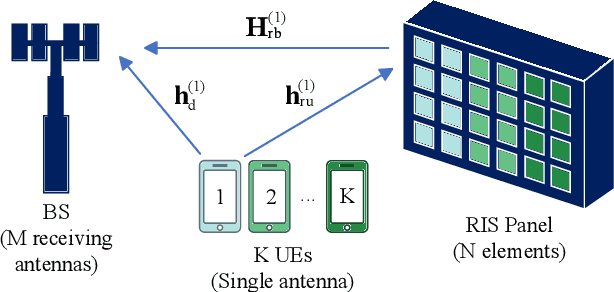
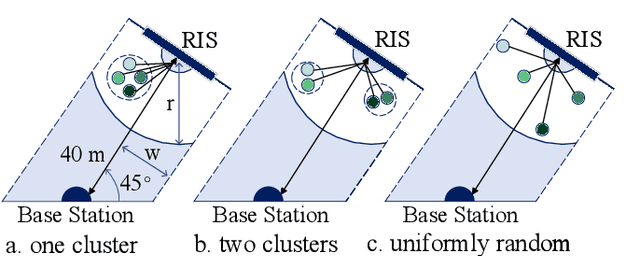
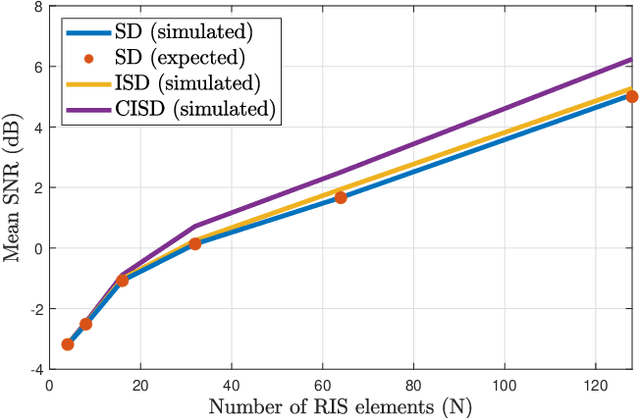
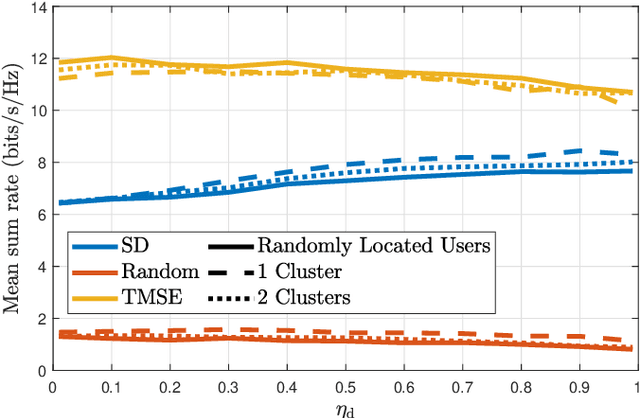
We analyse the performance of a reconfigurable intelligent surface (RIS) aided system where the RIS is divided into subsurfaces. Each subsurface is designed specifically for one user, who is served on their own frequency band. The other subsurfaces (those not designed for this user) provide additional uncontrolled scattering. We derive the exact closed-form expression for the mean signal-to-noise ratio (SNR) of the subsurface design (SD) when all channels experience correlated Ricean fading. We simplify this to find the mean SNR for line-of-sight (LoS) channels and channels experiencing correlated Rayleigh fading. An iterative SD (ISD) process is proposed, where subsurfaces are designed sequentially, and the phases that are already set are used to enhance the design of the remaining subsurfaces. This is extended to a converged ISD (CISD), where the ISD process is repeated multiple times until the SNR increases by less than a specified tolerance. The ISD and CISD both provide a performance improvement over SD, which increases as the number of RIS elements (N) increases. The SD is significantly simpler than the lowest complexity multi-user (MU) method we know of, and despite each user having less bandwidth, the SD outperforms the existing method in some key scenarios. The SD is more robust to strongly LoS channels and clustered users, as it does not rely on spatial multiplexing like other MU methods. Combined with the complexity reduction, this makes the SD an attractive phase selection method.