 Add to Chrome
 Add to Firefox
 Add to Edge
Deep Learning-Based Computer Vision for Beam Selection and Proactive Blockage Prediction
May 06, 2026
Millimeter-wave communication faces two critical challenges: propagation losses requiring costly narrow-beam alignment, and penetration losses causing link failures from blocked line-of-sight paths. We address propagation loss through a novel vision-aided beam selection framework that integrates RGB imagery with received power profiles for efficient transmitter identification and beam prediction. This framework achieves 98.96% top-5 beam prediction accuracy, surpassing current state-of-the-art methods by at least 6% across all metrics. We address penetration loss through a proactive blockage prediction framework using a modified object tracker with weighted centroid-based depth estimation. This represents the first analysis of simultaneous non-uniform mobility of both transmitters and obstacles. Evaluated on completely unseen data, this framework achieves over 98% accuracy in predicting blockages up to three frames ahead, establishing strong performance benchmarks.

Beam Squinting Effects in Super Wideband Communication Systems
Apr 16, 2026Beam squint, the frequency-dependent shift of the main beam, poses a major challenge for wideband antenna arrays. This paper focuses on the beam squint effects in super wideband (SW) systems, where high mutual coupling (MC) effects are present. These high MC effects complicate beamforming (BF) by creating frequency-dependent phase relationships that invalidate conventional approaches. To accurately model MC effects, this paper uses a circuit-theoretic framework for tightly coupled SW uniform linear arrays (ULAs). We derive closed-form expressions for the average received signal-to-noise ratio (SNR) with BF in conventional half-wavelength spaced, weakly coupled arrays and validate them. Extending our analysis to tightly coupled SW arrays, we demonstrate that, in contrast to conventional weakly coupled arrays, the effective true time delays exhibit a nonlinear dependence on frequency due to coupling-induced phase shifts. A comparative analysis reveals that strong MC in SW arrays significantly reduces squint in phase-controlled BF, extending the usable bandwidth considerably.
Deep Learning based Computer-vision for Enhanced Beamforming
Dec 04, 2024
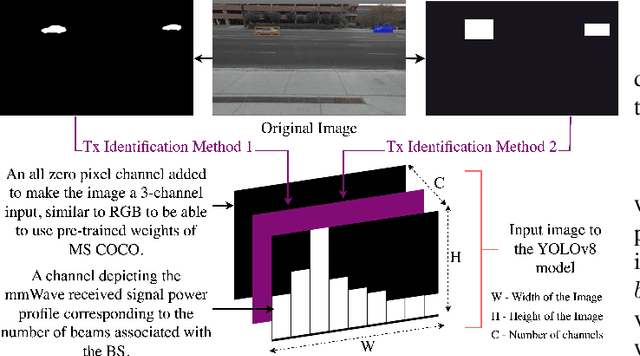
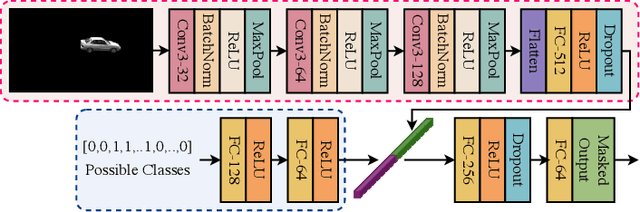
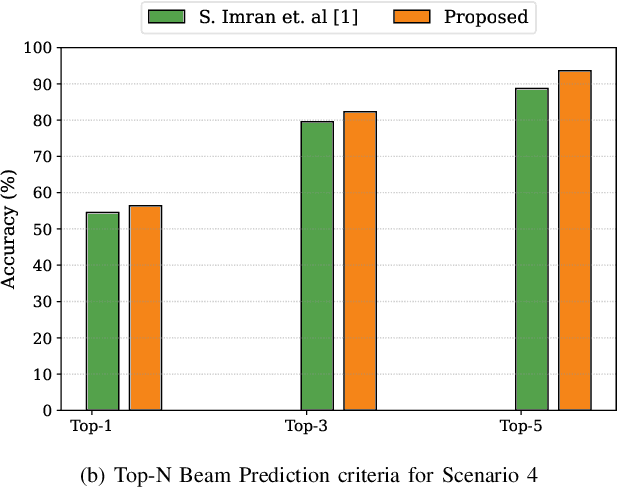
Meeting the high data rate demands of modern applications necessitates the utilization of high-frequency spectrum bands, including millimeter-wave and sub-terahertz bands. However, these frequencies require precise alignment of narrow communication beams between transmitters and receivers, typically resulting in significant beam training overhead. This paper introduces a novel end-to-end vision-aided beamforming framework that utilizes images to predict optimal beams while considering geometric adjustments to reduce overhead. Our model demonstrates robust adaptability to dynamic environments without relying on additional training data where the experimental results indicate a top-5 beam prediction accuracy of 98.96%, significantly surpassing current state-of-the-art solutions in vision-aided beamforming.
Rician Channel Modelling for Super Wideband MIMO Communications
Nov 04, 2024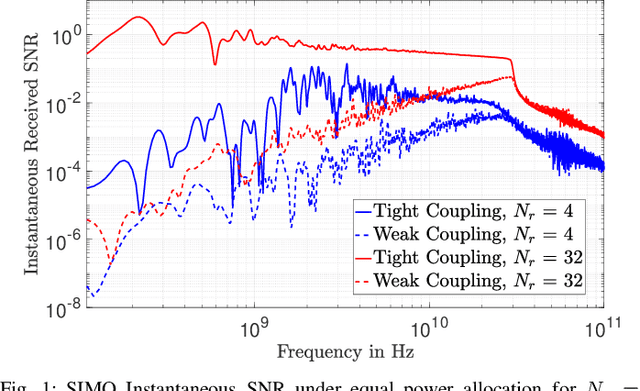
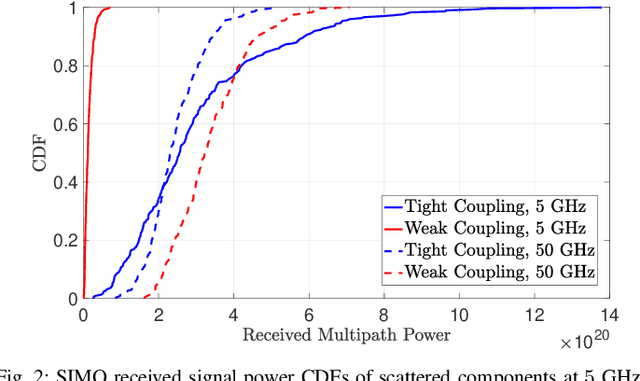
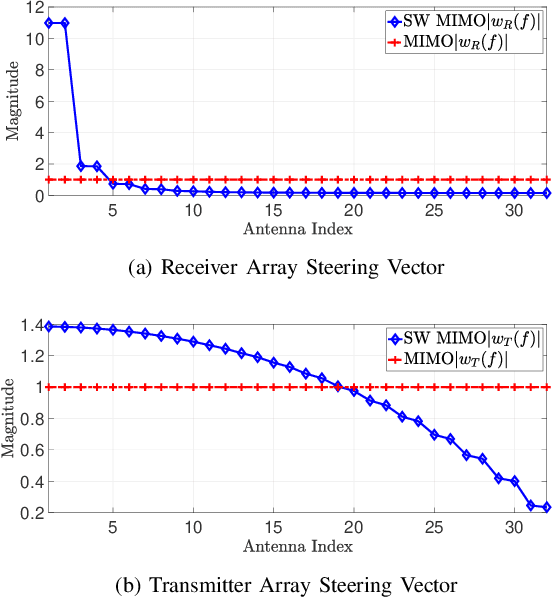
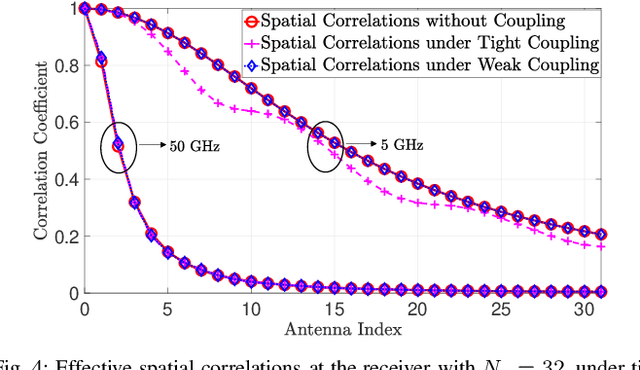
Recent developments in Multiple-Input-Multiple-Output (MIMO) technology include packing a large number of antenna elements in a compact array to access the bandwidth benefits provided by higher mutual coupling (MC). The resulting super-wideband (SW) systems require a circuit-theoretic framework to handle the MC and channel models which span extremely large bands. Hence, in this paper, we make two key contributions. First, we develop a physically-consistent Rician channel model for use with SW systems. Secondly, we express the circuit-theoretic models in terms of a standard MIMO model, so that insights into the effects of antenna layouts, MC, and bandwidth can be made using standard communication theory. For example, we show the bandwidth widening resulting from the new channel model. In addition, we show that MC distorts line-of-sight paths which has beamforming implications. We also highlight the interaction between spatial correlation and MC and show that tight coupling reduces spatial correlations at low frequencies.