 Add to Chrome
 Add to Firefox
 Add to Edge
KV-PRM: Efficient Process Reward Modeling via KV-Cache Transfer for Multi-Agent Test-Time Scaling
Jul 10, 2026
Process Reward Models (PRMs) have been proven to be highly effective in guiding test-time scaling (TTS) methods, which significantly boost the capabilities of LLM-based multi-agent systems. However, existing PRMs are text-based: they re-encode the entire trajectory text from scratch. In long multi-agent rollouts, the scoring cost, growing quadratically with respect to sequence length L, creates a severe computational bottleneck, severely limiting PRMs' application in long-context scenarios. To resolve this, we introduce KV-PRM, a highly efficient process reward model that eliminates the heavy text re-encoding by directly reading the KV cache produced naturally during the LLM's generation phase. By processing a single "verify token" against the pre-existing KV cache, KV-PRM reduces the scoring cost from O(L^2) to O(L). We formally prove that the KV cache contains strictly greater information capacity than text, and is more efficient for downstream reward modeling. Empirically, across the MATH, GSM8K, and AIME benchmarks, KV-PRM matches or strictly outperforms text-PRMs under various TTS methods such as Beam Search, MCTS, and Weighted Voting, with up to a 5,000x reduction in scoring FLOPs, a 37x reduction in latency, and a 34x reduction in per-sequence memory footprint compared to text-based PRMs.

Closing the Loop on Latent Reasoning via Test-Time Reconstruction
Jun 04, 2026Recent work moves intermediate reasoning from natural-language traces into latent or cache-level representations to reduce token overhead and avoid a discrete communication bottleneck. However, this shift also removes a key advantage of textual reasoning: intermediate states are no longer inspectable, making it difficult to determine whether a latent state still preserves the constraints of the original query. As a result, latent reasoning typically operates in an open loop, where a latent state is produced and consumed without an input-anchored fidelity check. We propose ReLAT (Reconstruction-Guided Latent Reasoning At Test Time), a self-supervised test-time training method that closes this loop using the query itself as the reference. Our key observation is that if a latent state faithfully represents a query, the query should be recoverable from it; if the query cannot be recovered, the latent state has lost task-relevant information. ReLAT operationalizes this principle by constructing a differentiable Question -> Latent Thought -> Question cycle and optimizing query reconstruction loss through the latent thought before answer generation. This anchors opaque latent computation to the problem specification it is supposed to represent. Across mathematical reasoning, knowledge QA, and code generation benchmarks on the Qwen family, ReLAT consistently improves over single-model inference, text-based collaboration, open-loop latent collaboration, and alternative test-time training objectives. On Qwen3-8B, ReLAT raises AIME 2024 accuracy from 56.7% to 73.3%, a 16.6-point gain over the strongest open-loop latent baseline.
Learning to Communicate: Toward End-to-End Optimization of Multi-Agent Language Systems
Apr 23, 2026Multi-agent systems built on large language models have shown strong performance on complex reasoning tasks, yet most work focuses on agent roles and orchestration while treating inter-agent communication as a fixed interface. Latent communication through internal representations such as key-value caches offers a promising alternative to text-based protocols, but existing approaches do not jointly optimize communication with multi-agent reasoning. Therefore we propose DiffMAS, a training framework that treats latent communication as a learnable component of multi-agent systems. DiffMAS performs parameter-efficient supervised training over multi-agent latent trajectories, enabling agents to jointly learn how information should be encoded and interpreted across interactions. Experiments on mathematical reasoning, scientific QA, code generation, and commonsense benchmarks show that DiffMAS consistently improves reasoning accuracy and decoding stability over single-agent inference, text-based multi-agent systems, and prior latent communication methods, achieving 26.7% on AIME24, 20.2% on GPQA-Diamond, and consistent gains across reasoning benchmarks.
Towards Real World Debiasing: A Fine-grained Analysis On Spurious Correlation
May 30, 2024
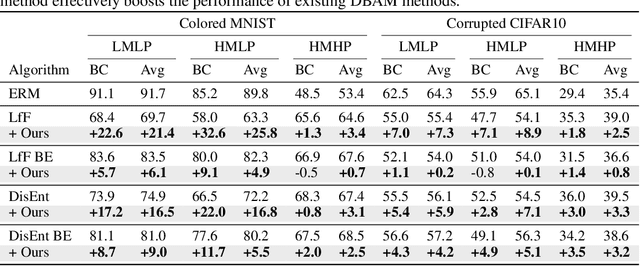

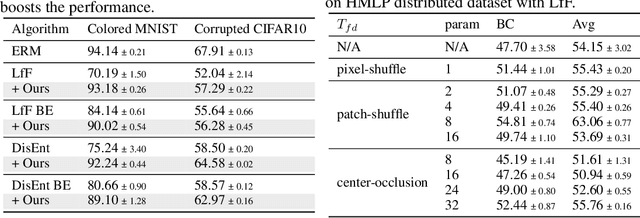
Spurious correlations in training data significantly hinder the generalization capability of machine learning models when faced with distribution shifts in real-world scenarios. To tackle the problem, numerous debias approaches have been proposed and benchmarked on datasets intentionally designed with severe biases. However, it remains to be asked: \textit{1. Do existing benchmarks really capture biases in the real world? 2. Can existing debias methods handle biases in the real world?} To answer the questions, we revisit biased distributions in existing benchmarks and real-world datasets, and propose a fine-grained framework for analyzing dataset bias by disentangling it into the magnitude and prevalence of bias. We observe and theoretically demonstrate that existing benchmarks poorly represent real-world biases. We further introduce two novel biased distributions to bridge this gap, forming a nuanced evaluation framework for real-world debiasing. Building upon these results, we evaluate existing debias methods with our evaluation framework. Results show that existing methods are incapable of handling real-world biases. Through in-depth analysis, we propose a simple yet effective approach that can be easily applied to existing debias methods, named Debias in Destruction (DiD). Empirical results demonstrate the superiority of DiD, improving the performance of existing methods on all types of biases within the proposed evaluation framework.