 Add to Chrome
 Add to Firefox
 Add to Edge
GrabVG: Graph-Attentive Binding for Visual Grounding in UAV Imagery
Aug 19, 2026
Visual grounding in Unmanned Aerial Vehicle (UAV) imagery aims to localize a target object in complex bird's-eye-view scenes according to a natural language description. However, the abundance of small, densely distributed, and visually similar objects creates high visual redundancy, while repetitive local configurations give rise to strong topological ambiguity. Existing approaches mainly focus on visual--language feature alignment or dense contextual interaction, yet they struggle to distinguish subtle inter-instance differences and effectively exploit spatial topological structures, leading to inaccurate grounding in highly crowded scenarios. To address these challenges, we propose $\textbf{GrabVG}$, a novel visual grounding framework inspired by human visual search. GrabVG explicitly decomposes grounding into two sequential stages: $\textit{preattentive hypothesis search}$ and $\textit{graph-attentive feature binding}$. Specifically, we first generate a compact set of reliable object hypotheses through distillation-guided proposal induction and text-aware hypothesis filtering, substantially reducing background distractions and semantic mismatches. These hypotheses are then organized into a sparse graph, where language-guided intra-instance visual cues and inter-instance topological relationships are jointly bound and propagated via graph attention, enabling efficient spatial reasoning and accurate target localization. Extensive experiments on AerialVG and AerialSense show that GrabVG achieves a favorable accuracy--speed trade-off, reaching 67.31$\%$ and 80.34$\%$ Acc@0.5 and outperforming the corresponding baselines by 10.55 and 8.76 percentage points, respectively.

Not All Relations Rotate Alike: Transformation-Aware Decoupling for Viewpoint-Robust 3D Scene Graph Generation
Jun 25, 20263D Scene Graph Generation (3DSGG) represents 3D scenes as structured object-relation-object graphs, providing a compact relational abstraction for spatial understanding. In embodied intelligence settings, the same 3D scene may be observed by agents from viewpoints that differ by yaw rotations. However, current 3DSGG models often fail to produce relation predictions that follow the expected transformation behavior under such viewpoint shifts. This behavior reveals an empirical mismatch related to predicate-level transformation heterogeneity: directional predicates such as left, front, right, and behind should transform with the observation frame, whereas most contact, support, and semantic predicates such as standing on and attached to should remain stable. To reduce this mismatch, we propose Transformation-Aware Decoupling (TAD), a viewpoint-robust 3DSGG framework that decouples relation reasoning according to predicate transformation behavior and is supported by viewpoint-stable object representations. TAD decomposes relation reasoning into two parts: one learns cues that should stay stable across viewpoints, while the other learns directional cues that should change with the observation frame. The two parts are merged for standard multi-label predicate prediction. Transformation-specific descriptors and group-aware auxiliary supervision encourage the two branches to capture complementary relation cues. Extensive experiments on 3DSSG show that TAD achieves state-of-the-art robustness under yaw viewpoint changes without training-time rotation augmentation, while maintaining competitive performance under the standard benchmark. The project page is available at https://tad-predicate.github.io/.
Parameter-Selective Continual Test-Time Adaptation
Jul 02, 2024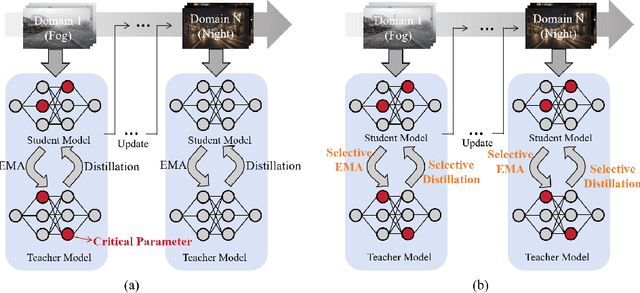
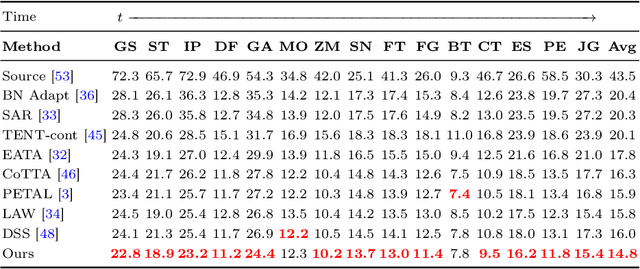
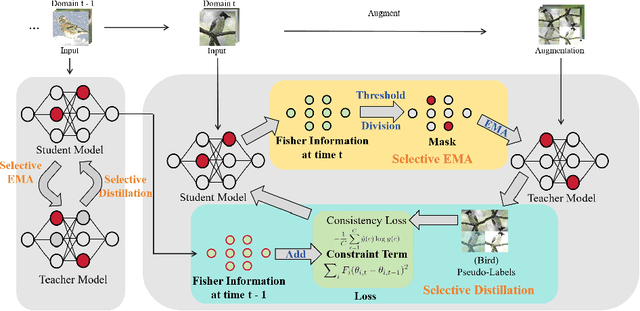
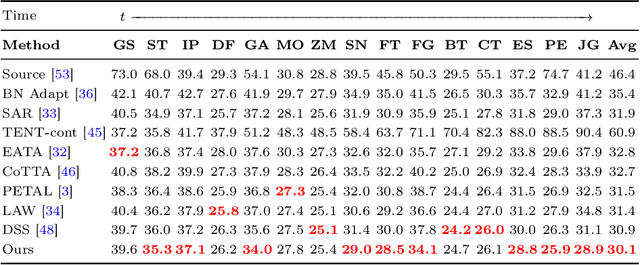
Continual Test-Time Adaptation (CTTA) aims to adapt a pretrained model to ever-changing environments during the test time under continuous domain shifts. Most existing CTTA approaches are based on the Mean Teacher (MT) structure, which contains a student and a teacher model, where the student is updated using the pseudo-labels from the teacher model, and the teacher is then updated by exponential moving average strategy. However, these methods update the MT model indiscriminately on all parameters of the model. That is, some critical parameters involving sharing knowledge across different domains may be erased, intensifying error accumulation and catastrophic forgetting. In this paper, we introduce Parameter-Selective Mean Teacher (PSMT) method, which is capable of effectively updating the critical parameters within the MT network under domain shifts. First, we introduce a selective distillation mechanism in the student model, which utilizes past knowledge to regularize novel knowledge, thereby mitigating the impact of error accumulation. Second, to avoid catastrophic forgetting, in the teacher model, we create a mask through Fisher information to selectively update parameters via exponential moving average, with preservation measures applied to crucial parameters. Extensive experimental results verify that PSMT outperforms state-of-the-art methods across multiple benchmark datasets. Our code is available at \url{https://github.com/JiaxuTian/PSMT}.
BBReach: Tight and Scalable Black-Box Reachability Analysis of Deep Reinforcement Learning Systems
Nov 21, 2022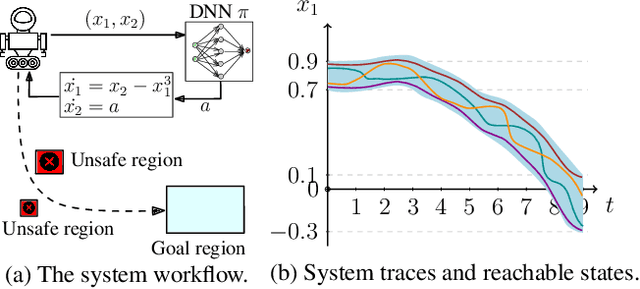
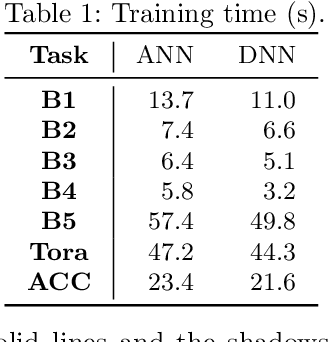
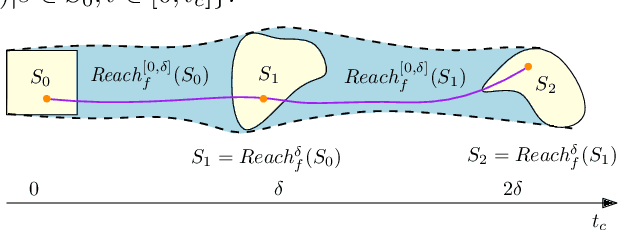
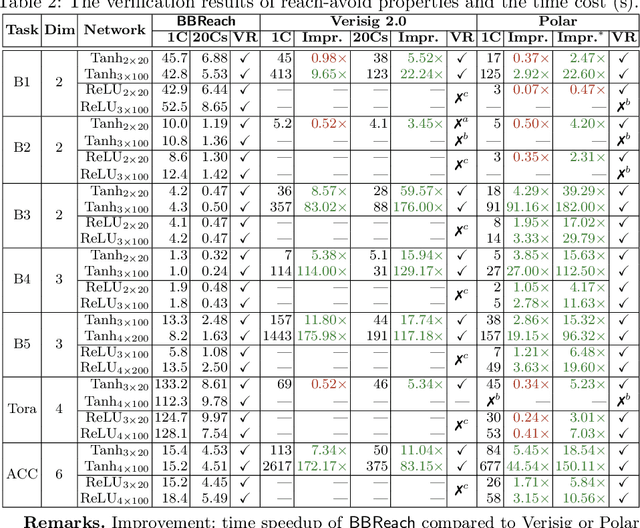
Reachability analysis is a promising technique to automatically prove or disprove the reliability and safety of AI-empowered software systems that are developed by using Deep Reinforcement Learning (DRL). Existing approaches suffer however from limited scalability and large overestimation as they must over-approximate the complex and almost inexplicable system components, namely deep neural networks (DNNs). In this paper we propose a novel, tight and scalable reachability analysis approach for DRL systems. By training on abstract states, our approach treats the embedded DNNs as black boxes to avoid the over-approximation for neural networks in computing reachable sets. To tackle the state explosion problem inherent to abstraction-based approaches, we devise a novel adjacent interval aggregation algorithm which balances the growth of abstract states and the overestimation caused by the abstraction. We implement a tool, called BBReach, and assess it on an extensive benchmark of control systems to demonstrate its tightness, scalability, and efficiency.