 Add to Chrome
 Add to Firefox
 Add to Edge
Revisiting Uncertainty: On Evidential Learning for Partially Relevant Video Retrieval
May 07, 2026
Partially relevant video retrieval aims to retrieve untrimmed videos using text queries that describe only partial content. However, the inherent asymmetry between brief queries and rich video content inevitably introduces uncertainty into the retrieval process. In this setting, vague queries often induce semantic ambiguity across videos, a challenge that is further exacerbated by the sparse temporal supervision within videos, which fails to provide sufficient matching evidence. To address this, we propose Holmes, a hierarchical evidential learning framework that aggregates multi-granular cross-modal evidence to quantify and model uncertainty explicitly. At the inter-video level, similarity scores are interpreted as evidential support and modeled via a Dirichlet distribution. Based on the proposed three-fold principle, we perform fine-grained query identification, which then guides query-adaptive calibrated learning. At the intra-video level, to accumulate denser evidence, we formulate a soft query-clip alignment via flexible optimal transport with an adaptive dustbin, which alleviates sparse temporal supervision while suppressing spurious local responses. Extensive experiments demonstrate that Holmes outperforms state-of-the-art methods. Code is released at https://github.com/lijun2005/ICML26-Holmes.

EL-VIT: Probing Vision Transformer with Interactive Visualization
Jan 23, 2024
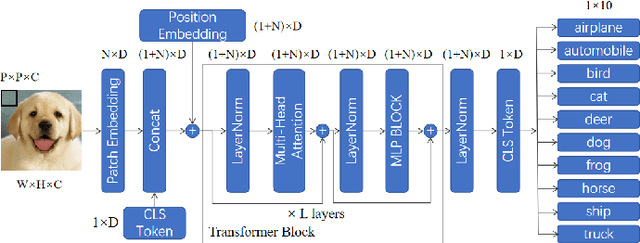
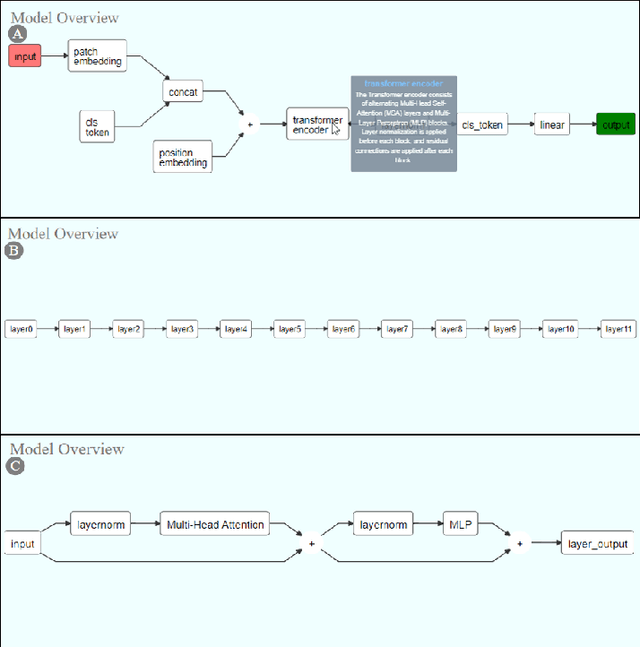
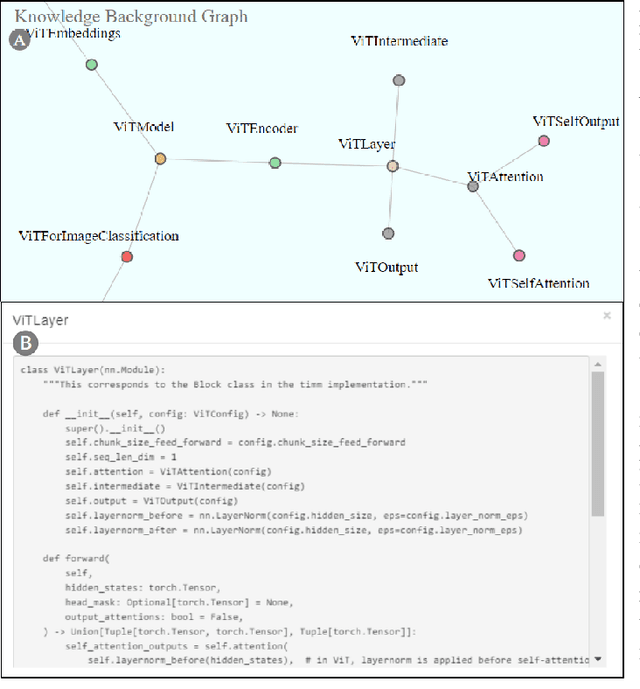
Nowadays, Vision Transformer (ViT) is widely utilized in various computer vision tasks, owing to its unique self-attention mechanism. However, the model architecture of ViT is complex and often challenging to comprehend, leading to a steep learning curve. ViT developers and users frequently encounter difficulties in interpreting its inner workings. Therefore, a visualization system is needed to assist ViT users in understanding its functionality. This paper introduces EL-VIT, an interactive visual analytics system designed to probe the Vision Transformer and facilitate a better understanding of its operations. The system consists of four layers of visualization views. The first three layers include model overview, knowledge background graph, and model detail view. These three layers elucidate the operation process of ViT from three perspectives: the overall model architecture, detailed explanation, and mathematical operations, enabling users to understand the underlying principles and the transition process between layers. The fourth interpretation view helps ViT users and experts gain a deeper understanding by calculating the cosine similarity between patches. Our two usage scenarios demonstrate the effectiveness and usability of EL-VIT in helping ViT users understand the working mechanism of ViT.