 Add to Chrome
 Add to Firefox
 Add to Edge
Juxtaposition of Shallow Reservoir-Triggered Seismicity and Deep Tectonic Locking in the Qiaojia-Dongchuan Seismic Gap
Jul 21, 2026
Identifying the critical state of mature seismic gaps is challenging, especially when anthropogenic stress perturbations, such as reservoir impoundment, superimpose on tectonic loading. Here, utilizing a high-resolution dense array catalog from the Qiaojia-Dongchuan seismic gap (hosting the second-largest hydropower station in the world), we reveal a distinct vertical decoupling mechanism. The shallow activities exhibit high b-values (1.0), indicative of fluid-driven reservoir-triggered seismicity. Conversely, deep seismicity (20 km) outlines a 'locked asperity' characterized by low b-values (less than 0.8) and high Coulomb stress accumulation rate. We further identify a complex dipping structure, suggesting compound fault kinematics. Additionally, the calculated stress accumulation suggests this seismic gap is in a critical state with elevated rupture potential. Our findings indicate that shallow induced seismicity can mask the silent accumulation of deep tectonic strain. This decoupling model provides a new framework for assessing seismic risks in reservoir-fault systems globally.

ExACT: Exemplar-Driven Calibrated Refinement for Training-Free Visual Grounding in Remote Sensing Images
Jun 27, 2026Remote sensing visual grounding (RSVG) aims to locate specific objects in high-resolution RS imagery using free-form natural language descriptions. While recent advances in multimodal large language models (MLLMs) show great potential for such open-vocabulary RSVG, their training-free adaptation is hindered by the modality gap between abstract linguistic semantics and fine-grained visual cues. In cluttered RS scenes, this gap inevitably causes severe localization drift. To bridge this gap, we propose Exemplar-driven Calibrated Refinement (ExACT), a novel training-free framework driven by a one-shot visual prompting mechanism to explicitly provide discriminative structural guidance for precise pixel-level localization. Specifically, we propose a Vision Exemplar-based Calibrator (VEC) that extracts fine-grained visual correspondences from the given exemplar to rectify the rough cross-modal priors from frozen MLLMs, effectively suppressing background artifacts and accurately outlining target boundaries. Subsequently, a Structure-Aware Refiner (SAR) employs an iterative merge-and-select clustering strategy to consolidate the calibrated priors into high-quality positive and negative geometric prompts. These prompts then guide the Segment Anything Model (SAM) to achieve precise pixel-level predictions. Extensive experiments confirm the superiority of ExACT over existing training-free and weakly-supervised methods.
TAR: Text Semantic Assisted Cross-modal Image Registration Framework for Optical and SAR Images
May 12, 2026Existing deep learning-based methods can capture shared features from optical and synthetic aperture radar (SAR) images for spatial alignment. However, optical-SAR registration remains challenging under large geometric deformations, because the model needs to simultaneously handle cross-modal appearance discrepancies and complex spatial transformations. To address this issue, this paper proposes a text semantic-assisted cross-modal image registration framework, named TAR, for optical and SAR images. TAR exploits text semantic priors from remote sensing scenes and land-cover categories to alleviate the modality gap and enhance cross-modal feature learning. TAR consists of three components: a multi-scale visual feature learning (MSFL) module, a text-assisted feature enhancement (TAFE) module, and a coarse-to-fine dense matching (CFDM) module. MSFL extracts multi-scale visual features from optical and SAR images. TAFE constructs text descriptors related to remote sensing scenes and land-cover objects, and uses a frozen RemoteCLIP text encoder to extract text features. These text features are introduced through visual-text interaction to enhance high-level visual features for more reliable coarse matching. CFDM then establishes coarse correspondences based on the enhanced high-level features and refines the matched locations using low-level features. Experimental results on cross-modal remote sensing images demonstrate the effectiveness of TAR, which achieves stronger matching performance than several state-of-the-art methods and yields significant gains under large geometric deformations.
BGG: Bridging the Geometric Gap between Cross-View images by Vision Foundation Model Adaptation for Geo-Localization
May 11, 2026Geometric differences between cross-view images, such as drone and satellite views, significantly increase the challenge of Cross-View Geo-Localization (CVGL), which aims to acquire the geolocation of images by image retrieval. To further enhance the CVGL performance, this paper proposes a parameter-efficient adaptation framework for bridging the geometric gap across images based on the vision foundation model (VFM) (e.g., DINOv3), termed BGG. BGG not only effectively leverages the general visual representations of VFM and captures the robust and consistent features from cross-view images, but also utilizes the generalization capabilities of the VFM, significantly improving the CVGL performance. It mainly contains a Multi-granularity Feature Enhancement Adapter (MFEA) and a Frequency-Aware Structural Aggregation (FASA) module. Specifically, MFEA enhances the scale adaptability and viewpoint robustness of features by multi-level dilated convolutions, effectively bridging the cross-view geometric gap with small training costs. Additionally, considering the [CLS] token lacks spatial details for precise image retrieval and localization, the FASA module modulates patch tokens in the frequency domain and performs adaptive aggregation for local structural feature enhancement. Finally, BGG fuses the enhanced local features with the [CLS] token for more accurate CVGL. Extensive experiments on University-1652 and SUES-200 datasets demonstrate that BGG has significant advantages over other methods and achieves state-of-the-art localization performance with low training costs.
Synergy Between the Strong and the Weak: Spiking Neural Networks are Inherently Self-Distillers
Oct 09, 2025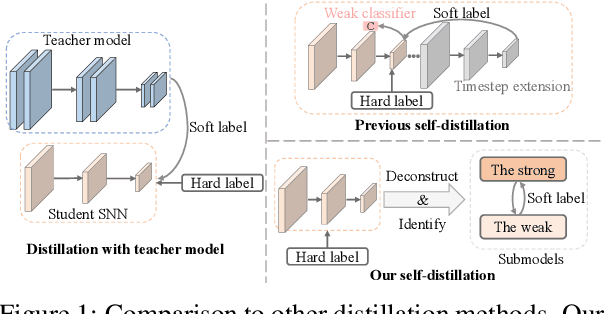
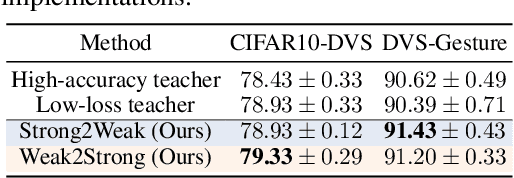
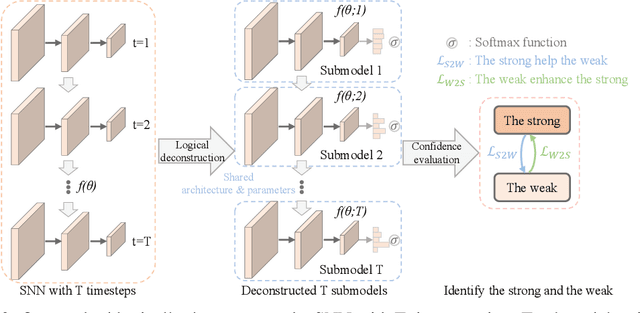
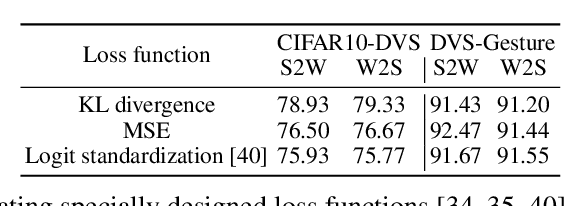
Brain-inspired spiking neural networks (SNNs) promise to be a low-power alternative to computationally intensive artificial neural networks (ANNs), although performance gaps persist. Recent studies have improved the performance of SNNs through knowledge distillation, but rely on large teacher models or introduce additional training overhead. In this paper, we show that SNNs can be naturally deconstructed into multiple submodels for efficient self-distillation. We treat each timestep instance of the SNN as a submodel and evaluate its output confidence, thus efficiently identifying the strong and the weak. Based on this strong and weak relationship, we propose two efficient self-distillation schemes: (1) \textbf{Strong2Weak}: During training, the stronger "teacher" guides the weaker "student", effectively improving overall performance. (2) \textbf{Weak2Strong}: The weak serve as the "teacher", distilling the strong in reverse with underlying dark knowledge, again yielding significant performance gains. For both distillation schemes, we offer flexible implementations such as ensemble, simultaneous, and cascade distillation. Experiments show that our method effectively improves the discriminability and overall performance of the SNN, while its adversarial robustness is also enhanced, benefiting from the stability brought by self-distillation. This ingeniously exploits the temporal properties of SNNs and provides insight into how to efficiently train high-performance SNNs.
Rethinking Spiking Neural Networks from an Ensemble Learning Perspective
Feb 20, 2025Spiking neural networks (SNNs) exhibit superior energy efficiency but suffer from limited performance. In this paper, we consider SNNs as ensembles of temporal subnetworks that share architectures and weights, and highlight a crucial issue that affects their performance: excessive differences in initial states (neuronal membrane potentials) across timesteps lead to unstable subnetwork outputs, resulting in degraded performance. To mitigate this, we promote the consistency of the initial membrane potential distribution and output through membrane potential smoothing and temporally adjacent subnetwork guidance, respectively, to improve overall stability and performance. Moreover, membrane potential smoothing facilitates forward propagation of information and backward propagation of gradients, mitigating the notorious temporal gradient vanishing problem. Our method requires only minimal modification of the spiking neurons without adapting the network structure, making our method generalizable and showing consistent performance gains in 1D speech, 2D object, and 3D point cloud recognition tasks. In particular, on the challenging CIFAR10-DVS dataset, we achieved 83.20\% accuracy with only four timesteps. This provides valuable insights into unleashing the potential of SNNs.
Multi-Bit Mechanism: A Novel Information Transmission Paradigm for Spiking Neural Networks
Jul 08, 2024Since proposed, spiking neural networks (SNNs) gain recognition for their high performance, low power consumption and enhanced biological interpretability. However, while bringing these advantages, the binary nature of spikes also leads to considerable information loss in SNNs, ultimately causing performance degradation. We claim that the limited expressiveness of current binary spikes, resulting in substantial information loss, is the fundamental issue behind these challenges. To alleviate this, our research introduces a multi-bit information transmission mechanism for SNNs. This mechanism expands the output of spiking neurons from the original single bit to multiple bits, enhancing the expressiveness of the spikes and reducing information loss during the forward process, while still maintaining the low energy consumption advantage of SNNs. For SNNs, this represents a new paradigm of information transmission. Moreover, to further utilize the limited spikes, we extract effective signals from the previous layer to re-stimulate the neurons, thus encouraging full spikes emission across various bit levels. We conducted extensive experiments with our proposed method using both direct training method and ANN-SNN conversion method, and the results show consistent performance improvements.
Shrinking Your TimeStep: Towards Low-Latency Neuromorphic Object Recognition with Spiking Neural Network
Jan 02, 2024Neuromorphic object recognition with spiking neural networks (SNNs) is the cornerstone of low-power neuromorphic computing. However, existing SNNs suffer from significant latency, utilizing 10 to 40 timesteps or more, to recognize neuromorphic objects. At low latencies, the performance of existing SNNs is drastically degraded. In this work, we propose the Shrinking SNN (SSNN) to achieve low-latency neuromorphic object recognition without reducing performance. Concretely, we alleviate the temporal redundancy in SNNs by dividing SNNs into multiple stages with progressively shrinking timesteps, which significantly reduces the inference latency. During timestep shrinkage, the temporal transformer smoothly transforms the temporal scale and preserves the information maximally. Moreover, we add multiple early classifiers to the SNN during training to mitigate the mismatch between the surrogate gradient and the true gradient, as well as the gradient vanishing/exploding, thus eliminating the performance degradation at low latency. Extensive experiments on neuromorphic datasets, CIFAR10-DVS, N-Caltech101, and DVS-Gesture have revealed that SSNN is able to improve the baseline accuracy by 6.55% ~ 21.41%. With only 5 average timesteps and without any data augmentation, SSNN is able to achieve an accuracy of 73.63% on CIFAR10-DVS. This work presents a heterogeneous temporal scale SNN and provides valuable insights into the development of high-performance, low-latency SNNs.