 Add to Chrome
 Add to Firefox
 Add to Edge
Data-Driven Identification of Quadratic Symplectic Representations of Nonlinear Hamiltonian Systems
Aug 02, 2023
We present a framework for learning Hamiltonian systems using data. This work is based on the lifting hypothesis, which posits that nonlinear Hamiltonian systems can be written as nonlinear systems with cubic Hamiltonians. By leveraging this, we obtain quadratic dynamics that are Hamiltonian in a transformed coordinate system. To that end, for given generalized position and momentum data, we propose a methodology to learn quadratic dynamical systems, enforcing the Hamiltonian structure in combination with a symplectic auto-encoder. The enforced Hamiltonian structure exhibits long-term stability of the system, while the cubic Hamiltonian function provides relatively low model complexity. For low-dimensional data, we determine a higher-order transformed coordinate system, whereas, for high-dimensional data, we find a lower-order coordinate system with the desired properties. We demonstrate the proposed methodology by means of both low-dimensional and high-dimensional nonlinear Hamiltonian systems.

$FPDM$: Domain-Specific Fast Pre-training Technique using Document-Level Metadata
Jun 09, 2023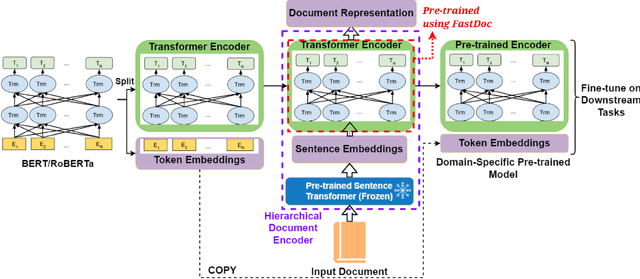
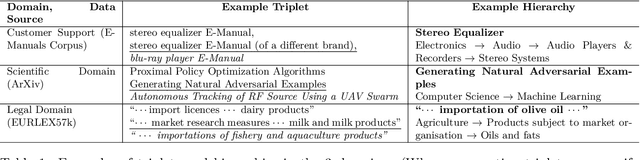
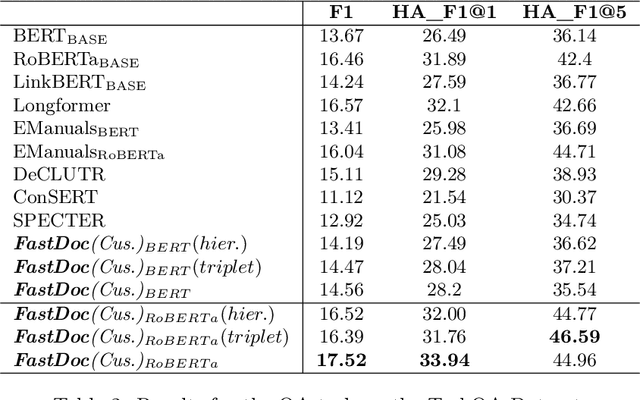
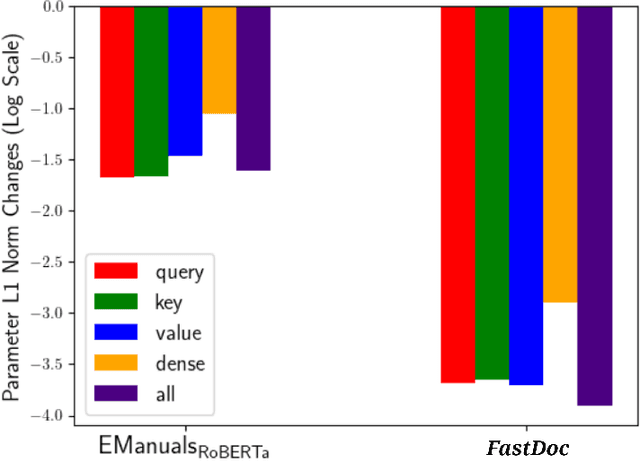
Pre-training Transformers has shown promising results on open-domain and domain-specific downstream tasks. However, state-of-the-art Transformers require an unreasonably large amount of pre-training data and compute. In this paper, we propose $FPDM$ (Fast Pre-training Technique using Document Level Metadata), a novel, compute-efficient framework that utilizes Document metadata and Domain-Specific Taxonomy as supervision signals to pre-train transformer encoder on a domain-specific corpus. The main innovation is that during domain-specific pretraining, an open-domain encoder is continually pre-trained using sentence-level embeddings as inputs (to accommodate long documents), however, fine-tuning is done with token-level embeddings as inputs to this encoder. We show that $FPDM$ outperforms several transformer-based baselines in terms of character-level F1 scores and other automated metrics in the Customer Support, Scientific, and Legal Domains, and shows a negligible drop in performance on open-domain benchmarks. Importantly, the novel use of document-level supervision along with sentence-level embedding input for pre-training reduces pre-training compute by around $1,000$, $4,500$, and $500$ times compared to MLM and/or NSP in Customer Support, Scientific, and Legal Domains, respectively. Code and datasets are available at https://bit.ly/FPDMCode.
Financial Numeric Extreme Labelling: A Dataset and Benchmarking for XBRL Tagging
Jun 06, 2023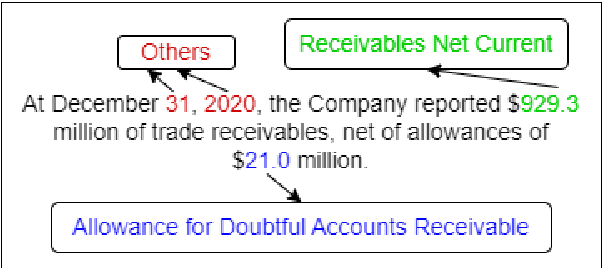
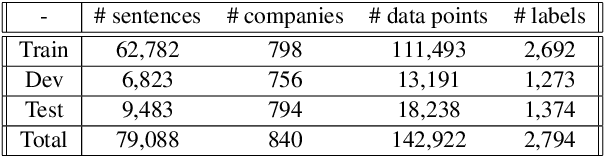
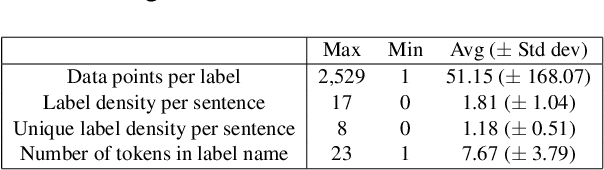
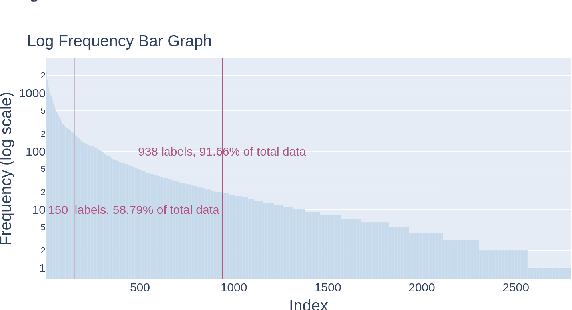
The U.S. Securities and Exchange Commission (SEC) mandates all public companies to file periodic financial statements that should contain numerals annotated with a particular label from a taxonomy. In this paper, we formulate the task of automating the assignment of a label to a particular numeral span in a sentence from an extremely large label set. Towards this task, we release a dataset, Financial Numeric Extreme Labelling (FNXL), annotated with 2,794 labels. We benchmark the performance of the FNXL dataset by formulating the task as (a) a sequence labelling problem and (b) a pipeline with span extraction followed by Extreme Classification. Although the two approaches perform comparably, the pipeline solution provides a slight edge for the least frequent labels.
FinRED: A Dataset for Relation Extraction in Financial Domain
Jun 06, 2023
Relation extraction models trained on a source domain cannot be applied on a different target domain due to the mismatch between relation sets. In the current literature, there is no extensive open-source relation extraction dataset specific to the finance domain. In this paper, we release FinRED, a relation extraction dataset curated from financial news and earning call transcripts containing relations from the finance domain. FinRED has been created by mapping Wikidata triplets using distance supervision method. We manually annotate the test data to ensure proper evaluation. We also experiment with various state-of-the-art relation extraction models on this dataset to create the benchmark. We see a significant drop in their performance on FinRED compared to the general relation extraction datasets which tells that we need better models for financial relation extraction.
Frugal Prompting for Dialog Models
May 24, 2023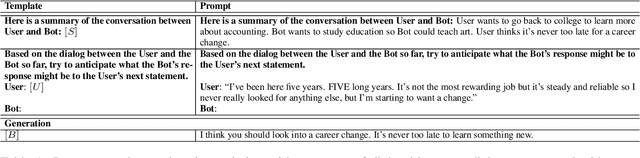
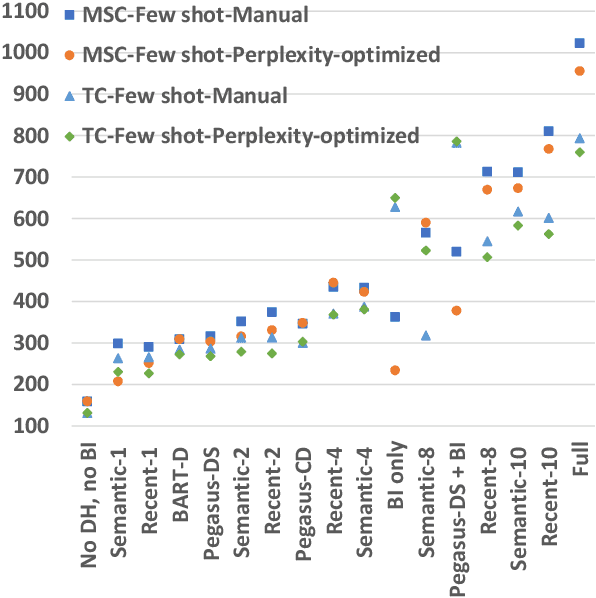
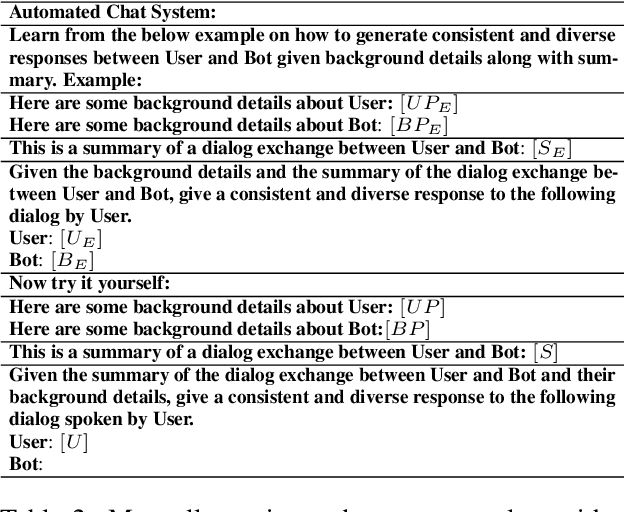
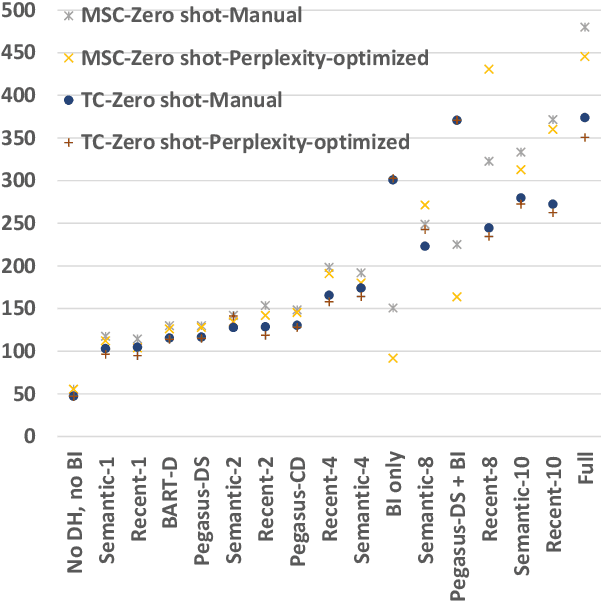
The use of large language models (LLMs) in natural language processing (NLP) tasks is rapidly increasing, leading to changes in how researchers approach problems in the field. To fully utilize these models' abilities, a better understanding of their behavior for different input protocols is required. With LLMs, users can directly interact with the models through a text-based interface to define and solve various tasks. Hence, understanding the conversational abilities of these LLMs, which may not have been specifically trained for dialog modeling, is also important. This study examines different approaches for building dialog systems using LLMs by considering various aspects of the prompt. As part of prompt tuning, we experiment with various ways of providing instructions, exemplars, current query and additional context. The research also analyzes the representations of dialog history that have the optimal usable-information density. Based on the findings, the paper suggests more compact ways of providing dialog history information while ensuring good performance and reducing model's inference-API costs. The research contributes to a better understanding of how LLMs can be effectively used for building interactive systems.
Intent Identification and Entity Extraction for Healthcare Queries in Indic Languages
Feb 19, 2023Scarcity of data and technological limitations for resource-poor languages in developing countries like India poses a threat to the development of sophisticated NLU systems for healthcare. To assess the current status of various state-of-the-art language models in healthcare, this paper studies the problem by initially proposing two different Healthcare datasets, Indian Healthcare Query Intent-WebMD and 1mg (IHQID-WebMD and IHQID-1mg) and one real world Indian hospital query data in English and multiple Indic languages (Hindi, Bengali, Tamil, Telugu, Marathi and Gujarati) which are annotated with the query intents as well as entities. Our aim is to detect query intents and extract corresponding entities. We perform extensive experiments on a set of models in various realistic settings and explore two scenarios based on the access to English data only (less costly) and access to target language data (more expensive). We analyze context specific practical relevancy through empirical analysis. The results, expressed in terms of overall F1 score show that our approach is practically useful to identify intents and entities.
SanskritShala: A Neural Sanskrit NLP Toolkit with Web-Based Interface for Pedagogical and Annotation Purposes
Feb 19, 2023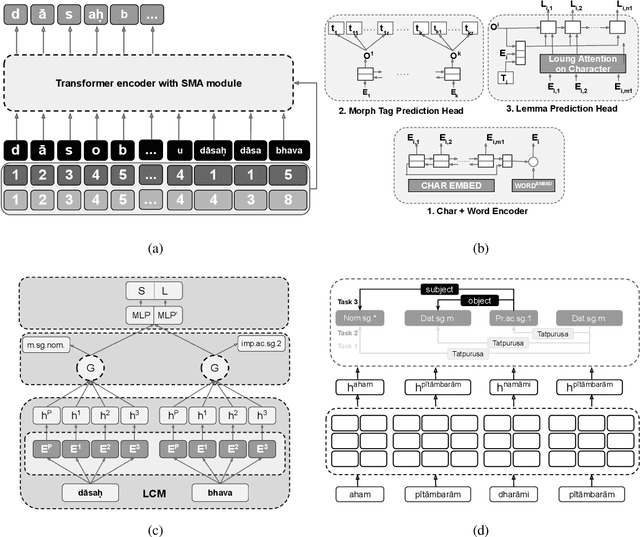
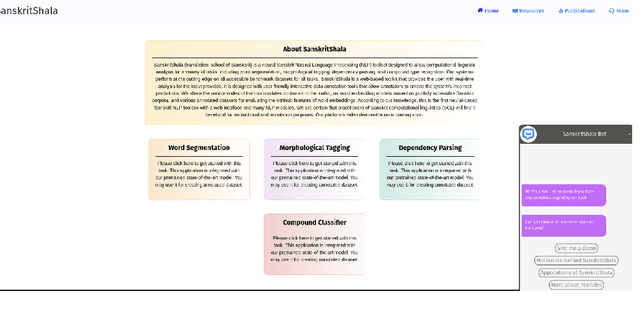
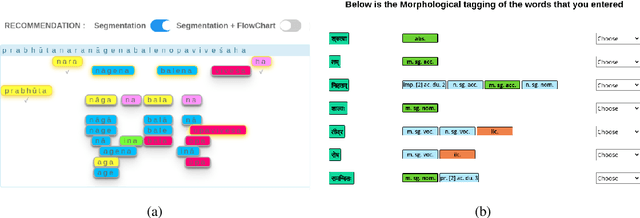
We present a neural Sanskrit Natural Language Processing (NLP) toolkit named SanskritShala (a school of Sanskrit) to facilitate computational linguistic analyses for several tasks such as word segmentation, morphological tagging, dependency parsing, and compound type identification. Our systems currently report state-of-the-art performance on available benchmark datasets for all tasks. SanskritShala is deployed as a web-based application, which allows a user to get real-time analysis for the given input. It is built with easy-to-use interactive data annotation features that allow annotators to correct the system predictions when it makes mistakes. We publicly release the source codes of the 4 modules included in the toolkit, 7 word embedding models that have been trained on publicly available Sanskrit corpora and multiple annotated datasets such as word similarity, relatedness, categorization, analogy prediction to assess intrinsic properties of word embeddings. So far as we know, this is the first neural-based Sanskrit NLP toolkit that has a web-based interface and a number of NLP modules. We are sure that the people who are willing to work with Sanskrit will find it useful for pedagogical and annotative purposes. SanskritShala is available at: https://cnerg.iitkgp.ac.in/sanskritshala. The demo video of our platform can be accessed at: https://youtu.be/x0X31Y9k0mw4.
Rank-Minimizing and Structured Model Inference
Feb 19, 2023
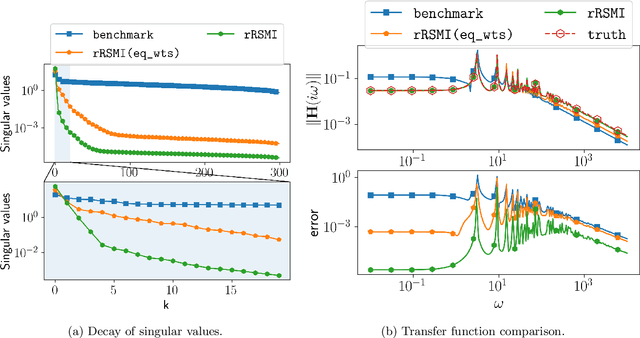
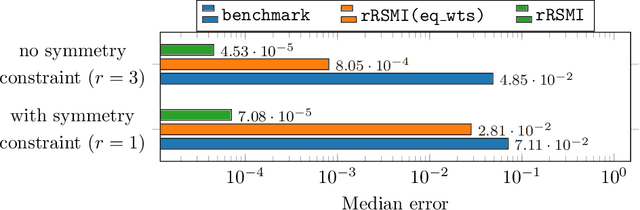

While extracting information from data with machine learning plays an increasingly important role, physical laws and other first principles continue to provide critical insights about systems and processes of interest in science and engineering. This work introduces a method that infers models from data with physical insights encoded in the form of structure and that minimizes the model order so that the training data are fitted well while redundant degrees of freedom without conditions and sufficient data to fix them are automatically eliminated. The models are formulated via solution matrices of specific instances of generalized Sylvester equations that enforce interpolation of the training data and relate the model order to the rank of the solution matrices. The proposed method numerically solves the Sylvester equations for minimal-rank solutions and so obtains models of low order. Numerical experiments demonstrate that the combination of structure preservation and rank minimization leads to accurate models with orders of magnitude fewer degrees of freedom than models of comparable prediction quality that are learned with structure preservation alone.
Inference of Continuous Linear Systems from Data with Guaranteed Stability
Jan 24, 2023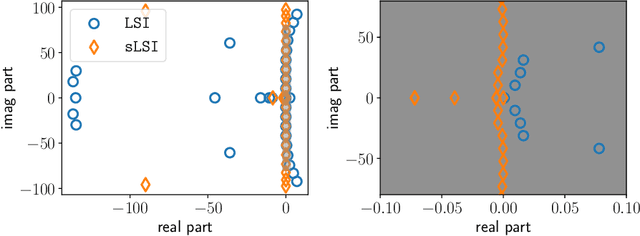
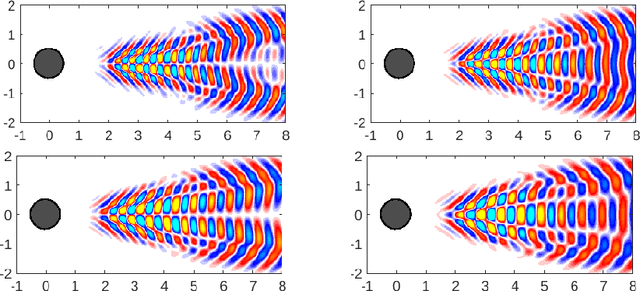
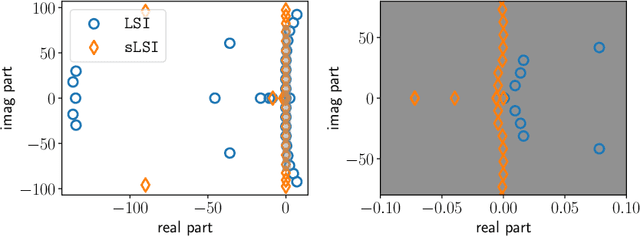
Machine-learning technologies for learning dynamical systems from data play an important role in engineering design. This research focuses on learning continuous linear models from data. Stability, a key feature of dynamic systems, is especially important in design tasks such as prediction and control. Thus, there is a need to develop methodologies that provide stability guarantees. To that end, we leverage the parameterization of stable matrices proposed in [Gillis/Sharma, Automatica, 2017] to realize the desired models. Furthermore, to avoid the estimation of derivative information to learn continuous systems, we formulate the inference problem in an integral form. We also discuss a few extensions, including those related to control systems. Numerical experiments show that the combination of a stable matrix parameterization and an integral form of differential equations allows us to learn stable systems without requiring derivative information, which can be challenging to obtain in situations with noisy or limited data.
CrysGNN : Distilling pre-trained knowledge to enhance property prediction for crystalline materials
Jan 14, 2023In recent years, graph neural network (GNN) based approaches have emerged as a powerful technique to encode complex topological structure of crystal materials in an enriched representation space. These models are often supervised in nature and using the property-specific training data, learn relationship between crystal structure and different properties like formation energy, bandgap, bulk modulus, etc. Most of these methods require a huge amount of property-tagged data to train the system which may not be available for different properties. However, there is an availability of a huge amount of crystal data with its chemical composition and structural bonds. To leverage these untapped data, this paper presents CrysGNN, a new pre-trained GNN framework for crystalline materials, which captures both node and graph level structural information of crystal graphs using a huge amount of unlabelled material data. Further, we extract distilled knowledge from CrysGNN and inject into different state of the art property predictors to enhance their property prediction accuracy. We conduct extensive experiments to show that with distilled knowledge from the pre-trained model, all the SOTA algorithms are able to outperform their own vanilla version with good margins. We also observe that the distillation process provides a significant improvement over the conventional approach of finetuning the pre-trained model. We have released the pre-trained model along with the large dataset of 800K crystal graph which we carefully curated; so that the pretrained model can be plugged into any existing and upcoming models to enhance their prediction accuracy.