 Add to Chrome
 Add to Firefox
 Add to Edge
Enforcing Topological Interaction between Implicit Surfaces via Uniform Sampling
Jul 16, 2023
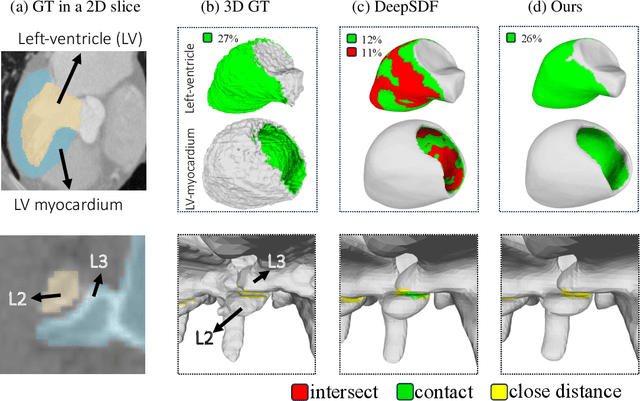
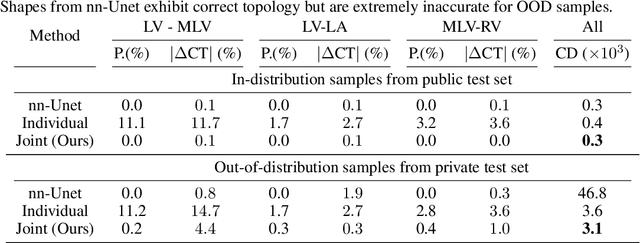
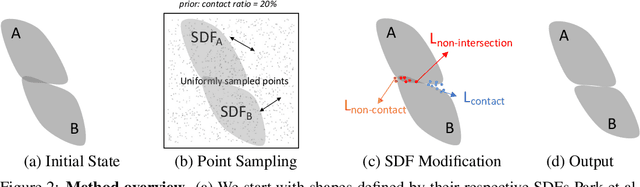

Objects interact with each other in various ways, including containment, contact, or maintaining fixed distances. Ensuring these topological interactions is crucial for accurate modeling in many scenarios. In this paper, we propose a novel method to refine 3D object representations, ensuring that their surfaces adhere to a topological prior. Our key observation is that the object interaction can be observed via a stochastic approximation method: the statistic of signed distances between a large number of random points to the object surfaces reflect the interaction between them. Thus, the object interaction can be indirectly manipulated by using choosing a set of points as anchors to refine the object surfaces. In particular, we show that our method can be used to enforce two objects to have a specific contact ratio while having no surface intersection. The conducted experiments show that our proposed method enables accurate 3D reconstruction of human hearts, ensuring proper topological connectivity between components. Further, we show that our proposed method can be used to simulate various ways a hand can interact with an arbitrary object.

ISP: Multi-Layered Garment Draping with Implicit Sewing Patterns
May 23, 2023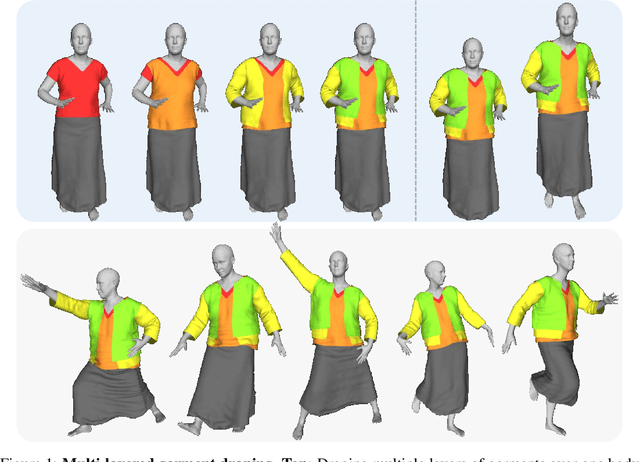
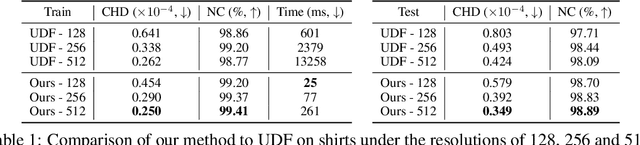
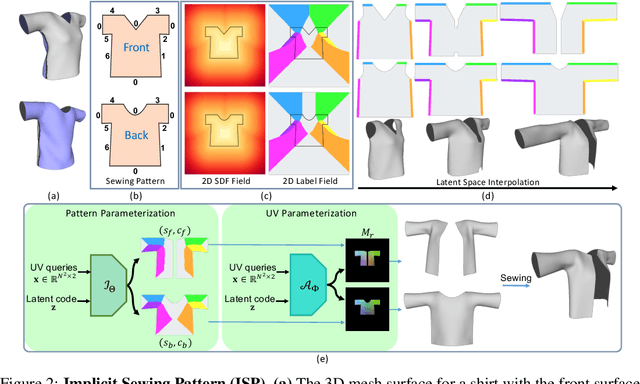
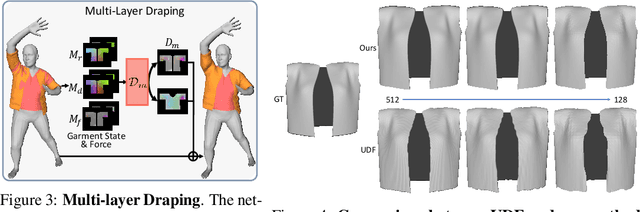
Many approaches to draping individual garments on human body models are realistic, fast, and yield outputs that are differentiable with respect to the body shape on which they are draped. However, none of them can handle multi-layered clothing, which is prevalent in everyday dress. In this paper, we introduce a parametric garment representation model that can. As in models used by clothing designers, each garment consists of individual 2D panels. Their 2D shape is defined by a Signed Distance Function and 3D shape by a 2D to 3D mapping. The 2D parameterization enables easy detection of potential collisions and the 3D parameterization handles complex shapes effectively. We show that this combination is faster and yields higher quality reconstructions than purely implicit surface representations, and makes the recovery of layered garments from images possible thanks to its differentiability. Furthermore, it supports rapid editing of garment shapes and texture by modifying individual 2D panels.
Automatic Parameterization for Aerodynamic Shape Optimization via Deep Geometric Learning
May 03, 2023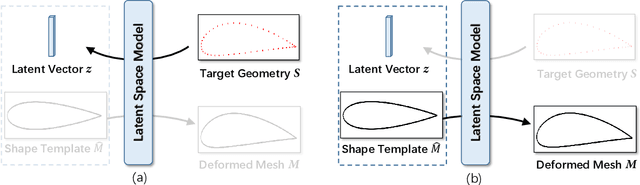
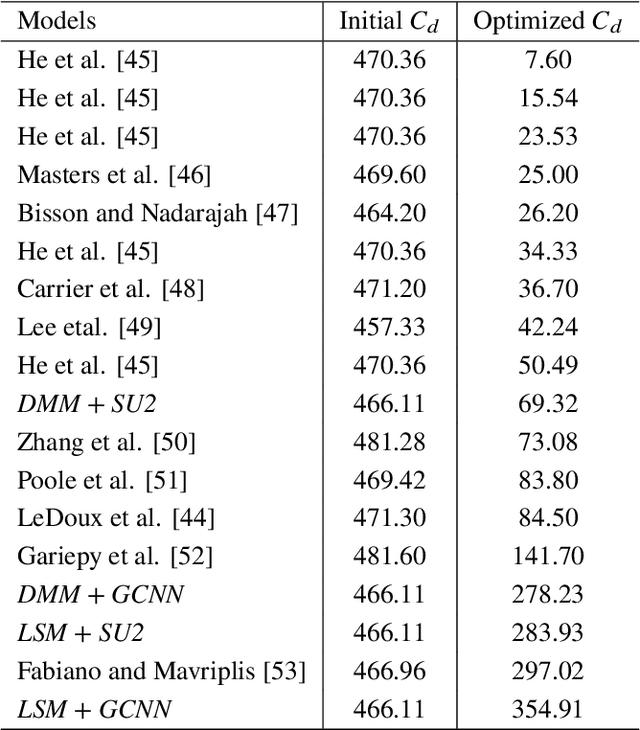
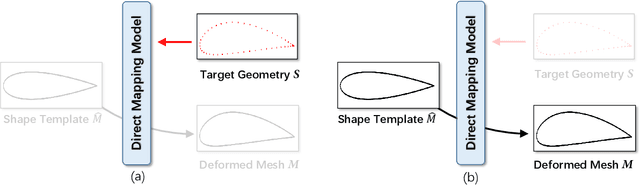
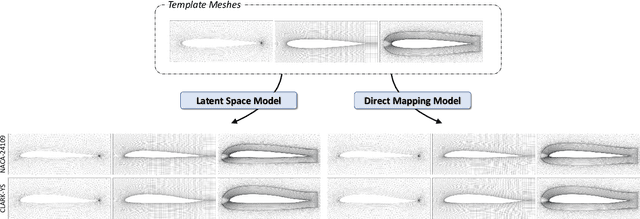
We propose two deep learning models that fully automate shape parameterization for aerodynamic shape optimization. Both models are optimized to parameterize via deep geometric learning to embed human prior knowledge into learned geometric patterns, eliminating the need for further handcrafting. The Latent Space Model (LSM) learns a low-dimensional latent representation of an object from a dataset of various geometries, while the Direct Mapping Model (DMM) builds parameterization on the fly using only one geometry of interest. We also devise a novel regularization loss that efficiently integrates volumetric mesh deformation into the parameterization model. The models directly manipulate the high-dimensional mesh data by moving vertices. LSM and DMM are fully differentiable, enabling gradient-based, end-to-end pipeline design and plug-and-play deployment of surrogate models or adjoint solvers. We perform shape optimization experiments on 2D airfoils and discuss the applicable scenarios for the two models.
GECCO: Geometrically-Conditioned Point Diffusion Models
Mar 10, 2023Diffusion models generating images conditionally on text, such as Dall-E 2 and Stable Diffusion, have recently made a splash far beyond the computer vision community. Here, we tackle the related problem of generating point clouds, both unconditionally, and conditionally with images. For the latter, we introduce a novel geometrically-motivated conditioning scheme based on projecting sparse image features into the point cloud and attaching them to each individual point, at every step in the denoising process. This approach improves geometric consistency and yields greater fidelity than current methods relying on unstructured, global latent codes. Additionally, we show how to apply recent continuous-time diffusion schemes. Our method performs on par or above the state of art on conditional and unconditional experiments on synthetic data, while being faster, lighter, and delivering tractable likelihoods. We show it can also scale to diverse indoors scenes.
AttEntropy: Segmenting Unknown Objects in Complex Scenes using the Spatial Attention Entropy of Semantic Segmentation Transformers
Dec 29, 2022Vision transformers have emerged as powerful tools for many computer vision tasks. It has been shown that their features and class tokens can be used for salient object segmentation. However, the properties of segmentation transformers remain largely unstudied. In this work we conduct an in-depth study of the spatial attentions of different backbone layers of semantic segmentation transformers and uncover interesting properties. The spatial attentions of a patch intersecting with an object tend to concentrate within the object, whereas the attentions of larger, more uniform image areas rather follow a diffusive behavior. In other words, vision transformers trained to segment a fixed set of object classes generalize to objects well beyond this set. We exploit this by extracting heatmaps that can be used to segment unknown objects within diverse backgrounds, such as obstacles in traffic scenes. Our method is training-free and its computational overhead negligible. We use off-the-shelf transformers trained for street-scene segmentation to process other scene types.
DrapeNet: Generating Garments and Draping them with Self-Supervision
Dec 07, 2022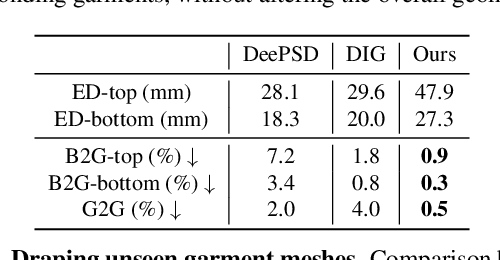
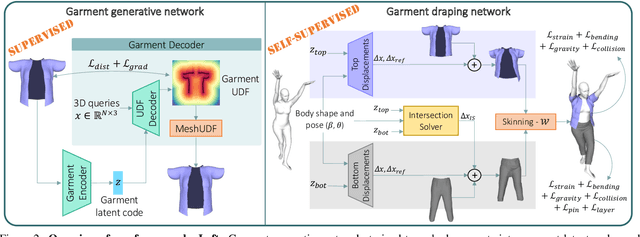

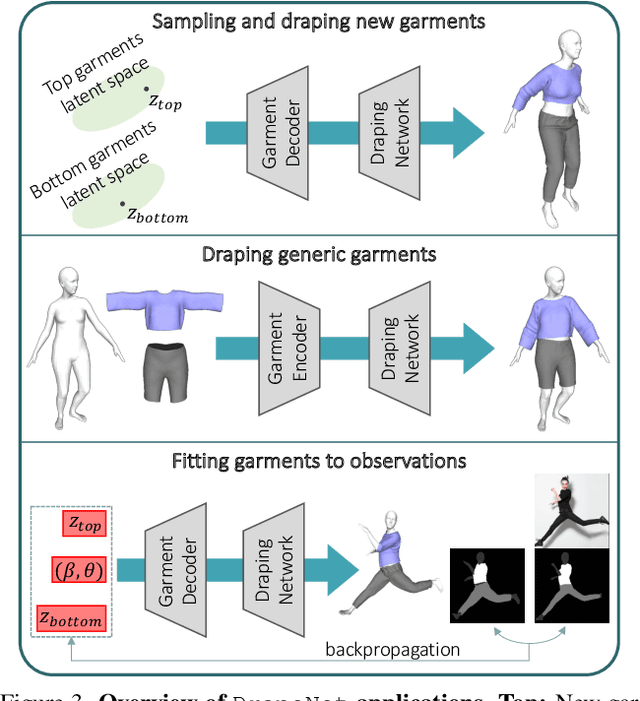
Recent approaches to drape garments quickly over arbitrary human bodies leverage self-supervision to eliminate the need for large training sets. However, they are designed to train one network per clothing item, which severely limits their generalization abilities. In our work, we rely on self-supervision to train a single network to drape multiple garments. This is achieved by predicting a 3D deformation field conditioned on the latent codes of a generative network, which models garments as unsigned distance fields. Our pipeline can generate and drape previously unseen garments of any topology, whose shape can be edited by manipulating their latent codes. Being fully differentiable, our formulation makes it possible to recover accurate 3D models of garments from partial observations -- images or 3D scans -- via gradient descent. Our code will be made publicly available.
Unsupervised 3D Keypoint Estimation with Multi-View Geometry
Nov 23, 2022Given enough annotated training data, 3D human pose estimation models can achieve high accuracy. However, annotations are not always available, especially for people performing unusual activities. In this paper, we propose an algorithm that learns to detect 3D keypoints on human bodies from multiple-views without any supervision other than the constraints multiple-view geometry provides. To ensure that the estimated 3D keypoints are meaningful, they are re-projected to each view to estimate the person's mask that the model itself has initially estimated. Our approach outperforms other state-of-the-art unsupervised 3D human pose estimation methods on the Human3.6M and MPI-INF-3DHP benchmark datasets.
ZigZag: Universal Sampling-free Uncertainty Estimation Through Two-Step Inference
Nov 21, 2022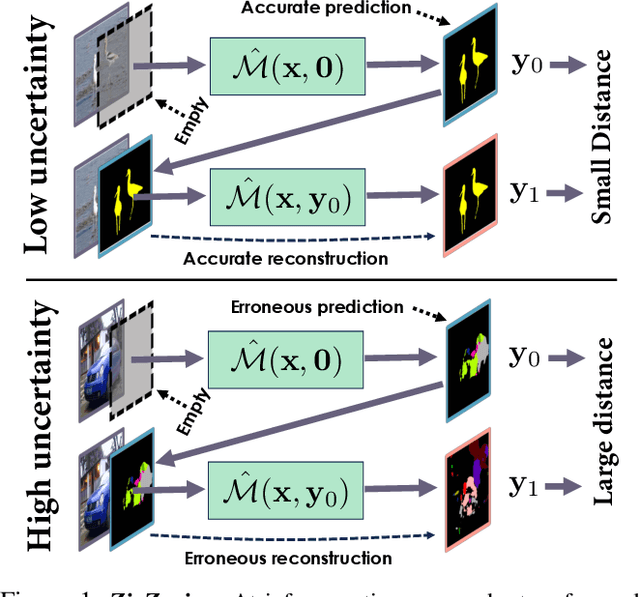
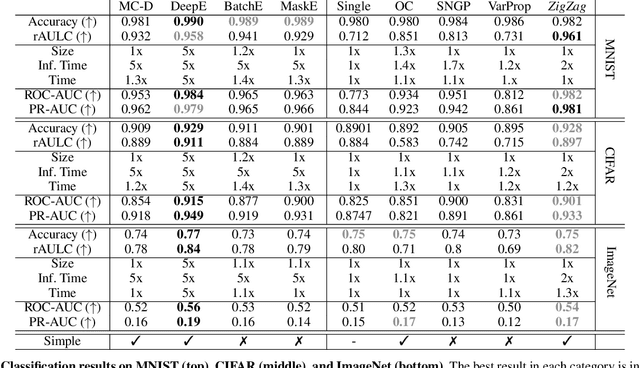
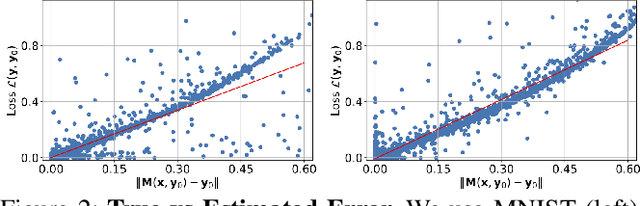
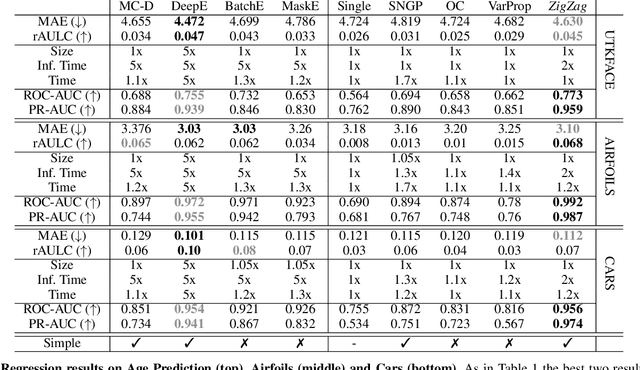
Whereas the ability of deep networks to produce useful predictions on many kinds of data has been amply demonstrated, estimating the reliability of these predictions remains challenging. Sampling approaches such as MC-Dropout and Deep Ensembles have emerged as the most popular ones for this purpose. Unfortunately, they require many forward passes at inference time, which slows them down. Sampling-free approaches can be faster but suffer from other drawbacks, such as lower reliability of uncertainty estimates, difficulty of use, and limited applicability to different types of tasks and data. In this work, we introduce a sampling-free approach that is generic and easy to deploy, while producing reliable uncertainty estimates on par with state-of-the-art methods at a significantly lower computational cost. It is predicated on training the network to produce the same output with and without additional information about that output. At inference time, when no prior information is given, we use the network's own prediction as the additional information. We prove that the difference between the two predictions is an accurate uncertainty estimate and demonstrate our approach on various types of tasks and applications.
PartAL: Efficient Partial Active Learning in Multi-Task Visual Settings
Nov 21, 2022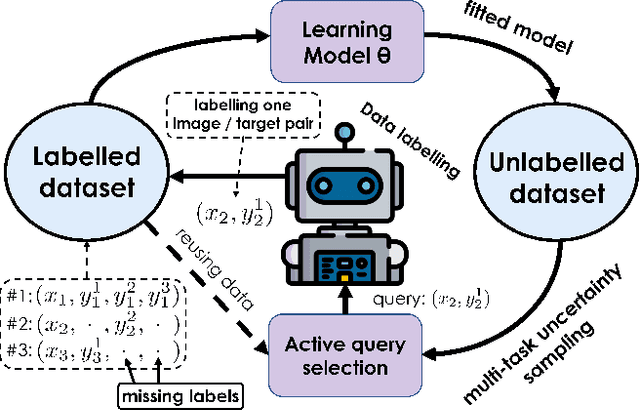
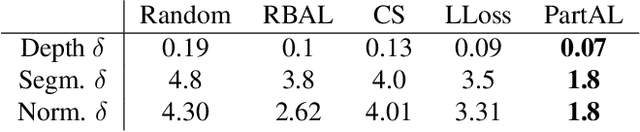
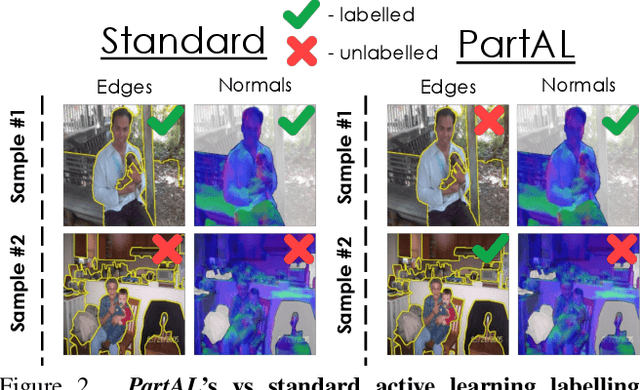
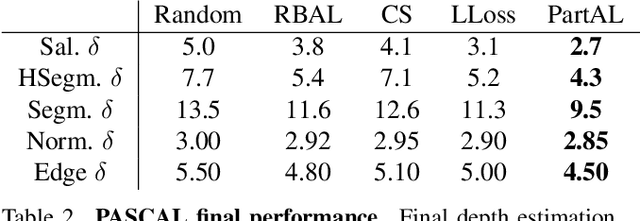
Multi-task learning is central to many real-world applications. Unfortunately, obtaining labelled data for all tasks is time-consuming, challenging, and expensive. Active Learning (AL) can be used to reduce this burden. Existing techniques typically involve picking images to be annotated and providing annotations for all tasks. In this paper, we show that it is more effective to select not only the images to be annotated but also a subset of tasks for which to provide annotations at each AL iteration. Furthermore, the annotations that are provided can be used to guess pseudo-labels for the tasks that remain unannotated. We demonstrate the effectiveness of our approach on several popular multi-task datasets.
State of the Art in Dense Monocular Non-Rigid 3D Reconstruction
Oct 27, 20223D reconstruction of deformable (or non-rigid) scenes from a set of monocular 2D image observations is a long-standing and actively researched area of computer vision and graphics. It is an ill-posed inverse problem, since--without additional prior assumptions--it permits infinitely many solutions leading to accurate projection to the input 2D images. Non-rigid reconstruction is a foundational building block for downstream applications like robotics, AR/VR, or visual content creation. The key advantage of using monocular cameras is their omnipresence and availability to the end users as well as their ease of use compared to more sophisticated camera set-ups such as stereo or multi-view systems. This survey focuses on state-of-the-art methods for dense non-rigid 3D reconstruction of various deformable objects and composite scenes from monocular videos or sets of monocular views. It reviews the fundamentals of 3D reconstruction and deformation modeling from 2D image observations. We then start from general methods--that handle arbitrary scenes and make only a few prior assumptions--and proceed towards techniques making stronger assumptions about the observed objects and types of deformations (e.g. human faces, bodies, hands, and animals). A significant part of this STAR is also devoted to classification and a high-level comparison of the methods, as well as an overview of the datasets for training and evaluation of the discussed techniques. We conclude by discussing open challenges in the field and the social aspects associated with the usage of the reviewed methods.