 Add to Chrome
 Add to Firefox
 Add to Edge
Scalix: Uncertainty-Aware Scale-Consistent Monocular SLAM
Aug 18, 2026
Cameras are ubiquitous sensors in robotics due to their compact form factor and the perceptual richness captured through visual information. Monocular SLAM enables robots to understand the environment with a minimum setup, however, it inherently suffers from scale ambiguity. A common solution is to provide multi-modal sensor configurations, such as visual-inertial systems, where scale is observable unless the robot navigates under a constant-velocity motion, a common scenario in mobile robotics. With the advent of deep-learning, geometric foundation models have been used to address this problem, but the depths maps are often noisy and scale-inconsistent across frames. In this paper, we propose Scalix, a real-time monocular SLAM framework that achieves metric-scale state estimation by integrating learned depth cues into a probabilistic factor-graph formulation. By augmenting existing monocular depth models with both per-pixel depth uncertainty and per-frame scale uncertainty, Scalix treats scale predictions as independent measurements within its optimization, leading to improved scale consistency through multi-view data associations. Experiments in large-scale outdoor and indoor environments demonstrate state-of-the-art performance on both metric and up-to-scale benchmarks while maintaining real-time operation and generalization.

Representation Abstractions as Incentives for Reinforcement Learning Agents: A Robotic Grasping Case Study
Sep 22, 2023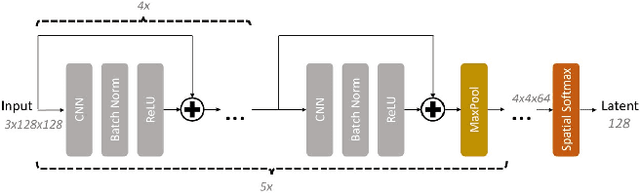
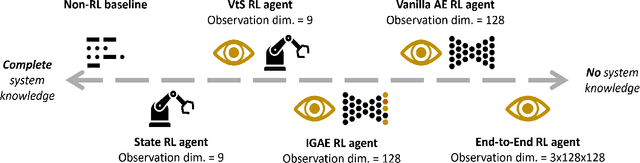
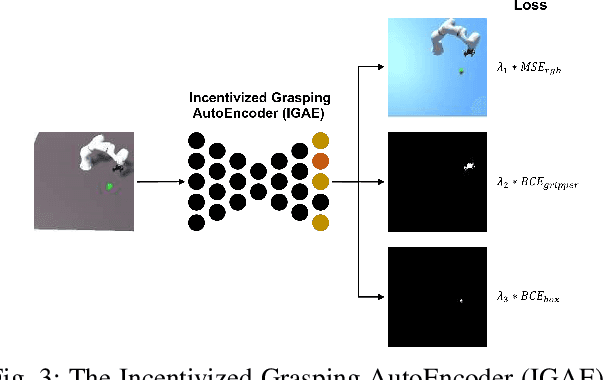
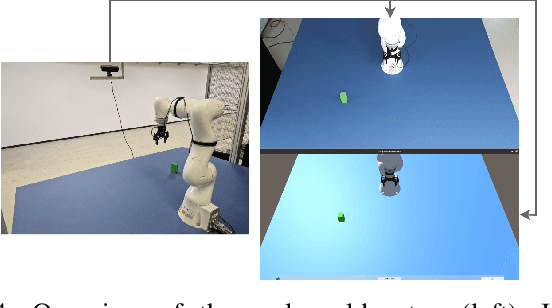
Choosing an appropriate representation of the environment for the underlying decision-making process of the RL agent is not always straightforward. The state representation should be inclusive enough to allow the agent to informatively decide on its actions and compact enough to increase sample efficiency for policy training. Given this outlook, this work examines the effect of various state representations in incentivizing the agent to solve a specific robotic task: antipodal and planar object grasping. A continuum of state representation abstractions is defined, starting from a model-based approach with complete system knowledge, through hand-crafted numerical, to image-based representations with decreasing level of induced task-specific knowledge. We examine the effects of each representation in the ability of the agent to solve the task in simulation and the transferability of the learned policy to the real robot. The results show that RL agents using numerical states can perform on par with non-learning baselines. Furthermore, we find that agents using image-based representations from pre-trained environment embedding vectors perform better than end-to-end trained agents, and hypothesize that task-specific knowledge is necessary for achieving convergence and high success rates in robot control.