 Add to Chrome
 Add to Firefox
 Add to Edge
Scalix: Uncertainty-Aware Scale-Consistent Monocular SLAM
Aug 18, 2026
Cameras are ubiquitous sensors in robotics due to their compact form factor and the perceptual richness captured through visual information. Monocular SLAM enables robots to understand the environment with a minimum setup, however, it inherently suffers from scale ambiguity. A common solution is to provide multi-modal sensor configurations, such as visual-inertial systems, where scale is observable unless the robot navigates under a constant-velocity motion, a common scenario in mobile robotics. With the advent of deep-learning, geometric foundation models have been used to address this problem, but the depths maps are often noisy and scale-inconsistent across frames. In this paper, we propose Scalix, a real-time monocular SLAM framework that achieves metric-scale state estimation by integrating learned depth cues into a probabilistic factor-graph formulation. By augmenting existing monocular depth models with both per-pixel depth uncertainty and per-frame scale uncertainty, Scalix treats scale predictions as independent measurements within its optimization, leading to improved scale consistency through multi-view data associations. Experiments in large-scale outdoor and indoor environments demonstrate state-of-the-art performance on both metric and up-to-scale benchmarks while maintaining real-time operation and generalization.

Uncertainty-Aware Visual-Inertial SLAM with Volumetric Occupancy Mapping
Sep 18, 2024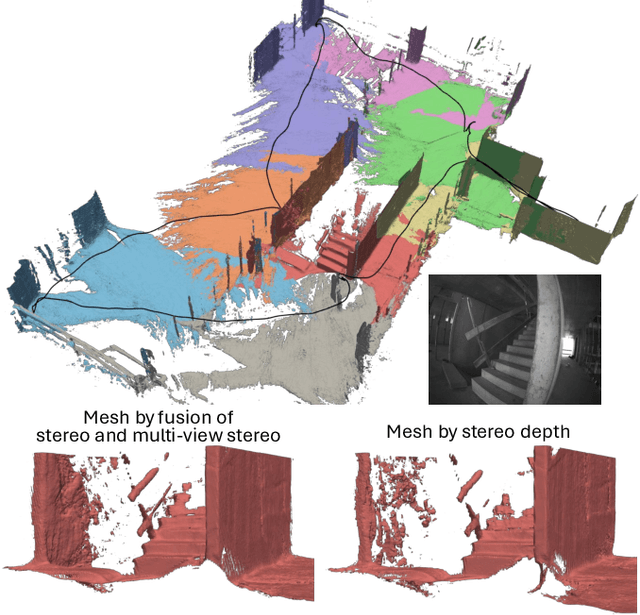
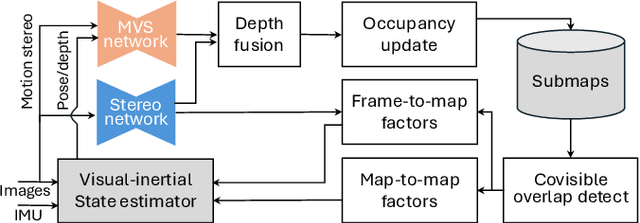
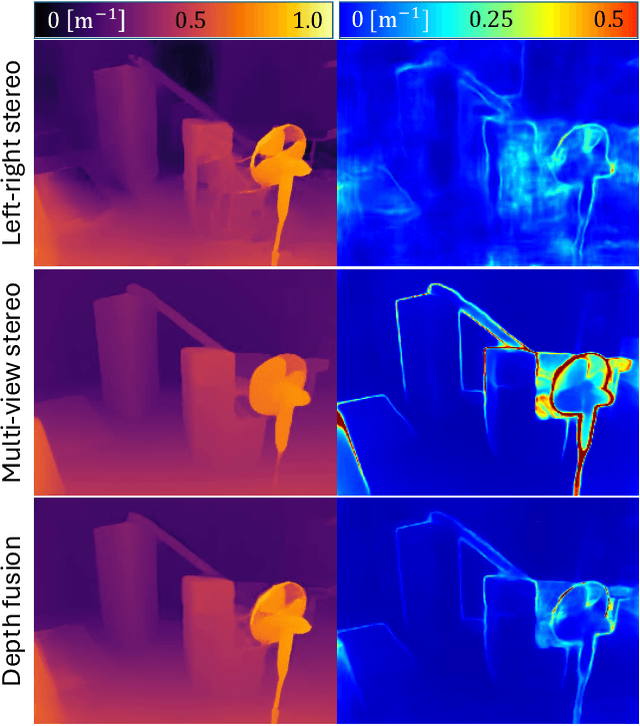
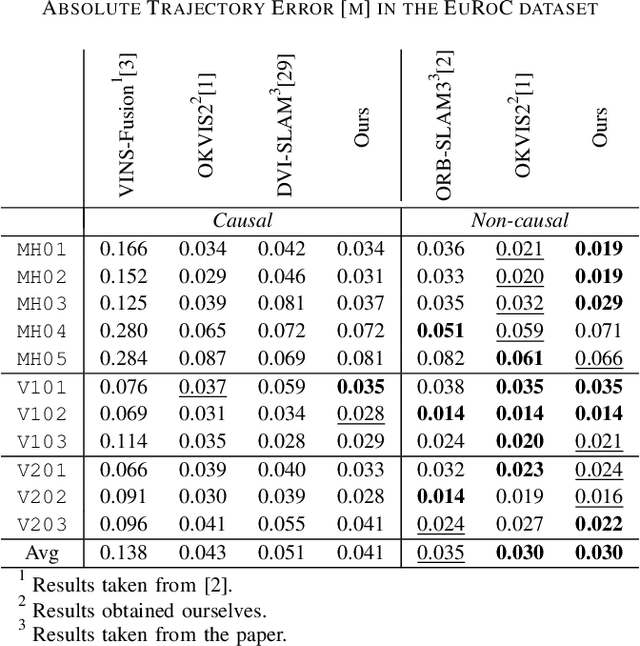
We propose visual-inertial simultaneous localization and mapping that tightly couples sparse reprojection errors, inertial measurement unit pre-integrals, and relative pose factors with dense volumetric occupancy mapping. Hereby depth predictions from a deep neural network are fused in a fully probabilistic manner. Specifically, our method is rigorously uncertainty-aware: first, we use depth and uncertainty predictions from a deep network not only from the robot's stereo rig, but we further probabilistically fuse motion stereo that provides depth information across a range of baselines, therefore drastically increasing mapping accuracy. Next, predicted and fused depth uncertainty propagates not only into occupancy probabilities but also into alignment factors between generated dense submaps that enter the probabilistic nonlinear least squares estimator. This submap representation offers globally consistent geometry at scale. Our method is thoroughly evaluated in two benchmark datasets, resulting in localization and mapping accuracy that exceeds the state of the art, while simultaneously offering volumetric occupancy directly usable for downstream robotic planning and control in real-time.