 Add to Chrome
 Add to Firefox
 Add to Edge
UFAL-CUNI at SemEval-2026 Task 11: An Efficient Modular Neuro-symbolic Method for Syllogistic Reasoning
May 06, 2026
This paper describes our system submitted to SemEval-2026 Task 11: Disentangling Content and Formal Reasoning in Large Language Models. We present an efficient modular neuro-symbolic approach, combining a symbolic prover with small reasoning LLMs (4B parameters). The system consists of an LLM-based parser that translates natural language syllogisms to a first-order logic (FOL) representation, an automated theorem prover, and two optional modules: machine translation for multilingual inputs and a symbolic retrieval component for the identification of relevant premises. The system achieves competitive accuracy and relatively low content effect on most subtasks. Our ablations show that this approach outperforms LLM-based zero-shot baselines in this parameter size range, but also reveal limited multilingual capabilities of small LLMs. Finally, we include a discussion of the task's main ranking metric and analyze its limitations.

Reasoning Gets Harder for LLMs Inside A Dialogue
Mar 20, 2026Large Language Models (LLMs) achieve strong performance on many reasoning benchmarks, yet these evaluations typically focus on isolated tasks that differ from real-world usage in task-oriented dialogue (TOD). In this setting, LLMs must perform reasoning inherently while generating text and adhering to instructions on role, format, and style. This mismatch raises concerns about whether benchmark performance accurately reflects models' reasoning robustness in TOD setting. We investigate how framing reasoning tasks within TOD affects LLM performance by introducing BOULDER, a new dynamic benchmark covering eight travel-related tasks that require arithmetic, spatial, and temporal reasoning with both commonsense and formal aspects. Each problem is presented in both isolated and dialogue-based variants, enabling controlled comparison while mitigating data contamination. Experiments on eight LLMs reveal a substantial and consistent performance gap between isolated and dialogue settings. Through ablations and qualitative analysis, we show that this gap is largely driven by the multi-turn nature of dialogue, with additional effects from role conditioning and tool-use requirements. Our results highlight the need to evaluate LLM reasoning in realistic interactive scenarios.
Strategies for Span Labeling with Large Language Models
Jan 23, 2026Large language models (LLMs) are increasingly used for text analysis tasks, such as named entity recognition or error detection. Unlike encoder-based models, however, generative architectures lack an explicit mechanism to refer to specific parts of their input. This leads to a variety of ad-hoc prompting strategies for span labeling, often with inconsistent results. In this paper, we categorize these strategies into three families: tagging the input text, indexing numerical positions of spans, and matching span content. To address the limitations of content matching, we introduce LogitMatch, a new constrained decoding method that forces the model's output to align with valid input spans. We evaluate all methods across four diverse tasks. We find that while tagging remains a robust baseline, LogitMatch improves upon competitive matching-based methods by eliminating span matching issues and outperforms other strategies in some setups.
LLM Agents Implement an NLG System from Scratch: Building Interpretable Rule-Based RDF-to-Text Generators
Dec 20, 2025We present a novel neurosymbolic framework for RDF-to-text generation, in which the model is "trained" through collaborative interactions among multiple LLM agents rather than traditional backpropagation. The LLM agents produce rule-based Python code for a generator for the given domain, based on RDF triples only, with no in-domain human reference texts. The resulting system is fully interpretable, requires no supervised training data, and generates text nearly instantaneously using only a single CPU. Our experiments on the WebNLG and OpenDialKG data show that outputs produced by our approach reduce hallucination, with only slight fluency penalties compared to finetuned or prompted language models
Real-World Summarization: When Evaluation Reaches Its Limits
Jul 15, 2025We examine evaluation of faithfulness to input data in the context of hotel highlights: brief LLM-generated summaries that capture unique features of accommodations. Through human evaluation campaigns involving categorical error assessment and span-level annotation, we compare traditional metrics, trainable methods, and LLM-as-a-judge approaches. Our findings reveal that simpler metrics like word overlap correlate surprisingly well with human judgments (Spearman correlation rank of 0.63), often outperforming more complex methods when applied to out-of-domain data. We further demonstrate that while LLMs can generate high-quality highlights, they prove unreliable for evaluation as they tend to severely under- or over-annotate. Our analysis of real-world business impacts shows incorrect and non-checkable information pose the greatest risks. We also highlight challenges in crowdsourced evaluations.
Large Language Models as Span Annotators
Apr 11, 2025For high-quality texts, single-score metrics seldom provide actionable feedback. In contrast, span annotation - pointing out issues in the text by annotating their spans - can guide improvements and provide insights. Until recently, span annotation was limited to human annotators or fine-tuned encoder models. In this study, we automate span annotation with large language models (LLMs). We compare expert or skilled crowdworker annotators with open and proprietary LLMs on three tasks: data-to-text generation evaluation, machine translation evaluation, and propaganda detection in human-written texts. In our experiments, we show that LLMs as span annotators are straightforward to implement and notably more cost-efficient than human annotators. The LLMs achieve moderate agreement with skilled human annotators, in some scenarios comparable to the average agreement among the annotators themselves. Qualitative analysis shows that reasoning models outperform their instruction-tuned counterparts and provide more valid explanations for annotations. We release the dataset of more than 40k model and human annotations for further research.
OpeNLGauge: An Explainable Metric for NLG Evaluation with Open-Weights LLMs
Mar 14, 2025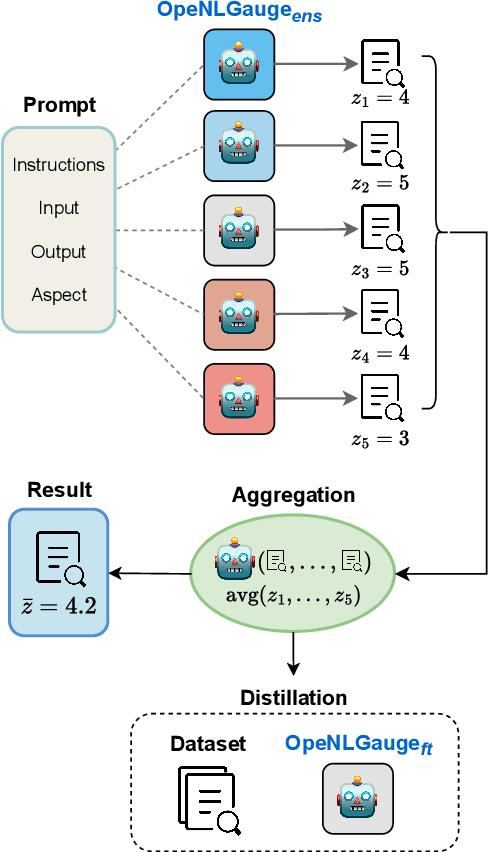
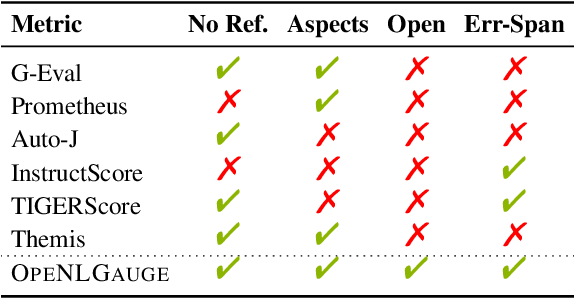
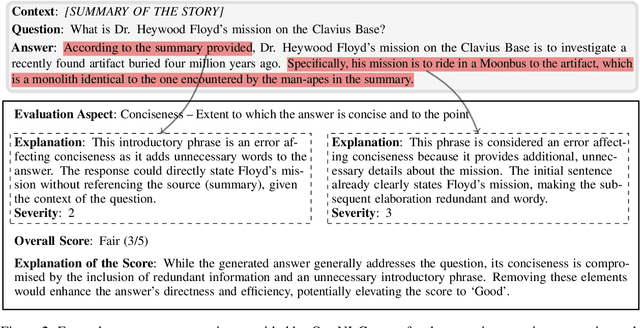
Large Language Models (LLMs) have demonstrated great potential as evaluators of NLG systems, allowing for high-quality, reference-free, and multi-aspect assessments. However, existing LLM-based metrics suffer from two major drawbacks: reliance on proprietary models to generate training data or perform evaluations, and a lack of fine-grained, explanatory feedback. In this paper, we introduce OpeNLGauge, a fully open-source, reference-free NLG evaluation metric that provides accurate explanations based on error spans. OpeNLGauge is available as a two-stage ensemble of larger open-weight LLMs, or as a small fine-tuned evaluation model, with confirmed generalizability to unseen tasks, domains and aspects. Our extensive meta-evaluation shows that OpeNLGauge achieves competitive correlation with human judgments, outperforming state-of-the-art models on certain tasks while maintaining full reproducibility and providing explanations more than twice as accurate.
Automatic Metrics in Natural Language Generation: A Survey of Current Evaluation Practices
Aug 17, 2024
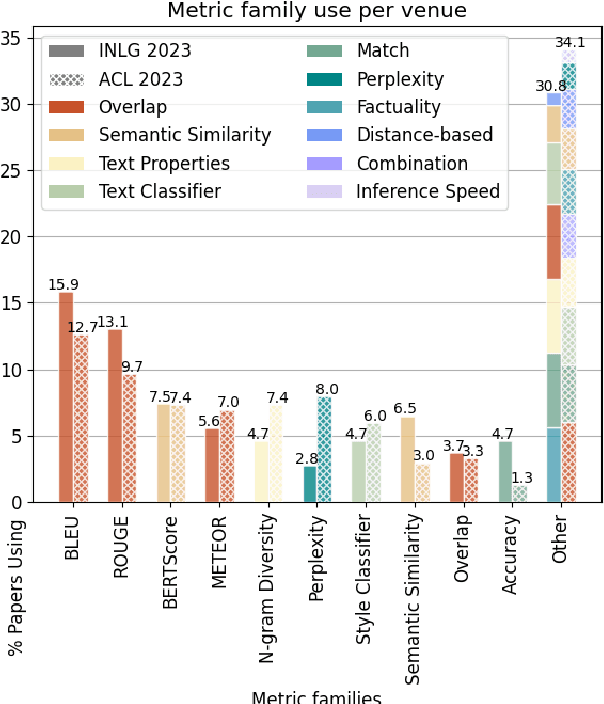


Automatic metrics are extensively used to evaluate natural language processing systems. However, there has been increasing focus on how they are used and reported by practitioners within the field. In this paper, we have conducted a survey on the use of automatic metrics, focusing particularly on natural language generation (NLG) tasks. We inspect which metrics are used as well as why they are chosen and how their use is reported. Our findings from this survey reveal significant shortcomings, including inappropriate metric usage, lack of implementation details and missing correlations with human judgements. We conclude with recommendations that we believe authors should follow to enable more rigour within the field.
Teaching LLMs at Charles University: Assignments and Activities
Jul 29, 2024This paper presents teaching materials, particularly assignments and ideas for classroom activities, from a new course on large language models (LLMs) taught at Charles University. The assignments include experiments with LLM inference for weather report generation and machine translation. The classroom activities include class quizzes, focused research on downstream tasks and datasets, and an interactive "best paper" session aimed at reading and comprehension of research papers.
factgenie: A Framework for Span-based Evaluation of Generated Texts
Jul 25, 2024
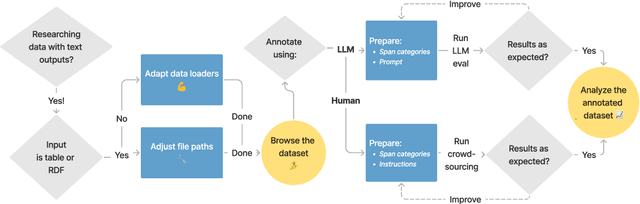
We present factgenie: a framework for annotating and visualizing word spans in textual model outputs. Annotations can capture various span-based phenomena such as semantic inaccuracies or irrelevant text. With factgenie, the annotations can be collected both from human crowdworkers and large language models. Our framework consists of a web interface for data visualization and gathering text annotations, powered by an easily extensible codebase.