 Add to Chrome
 Add to Firefox
 Add to Edge
RAG-HAR+: Towards Cost-Efficient LLM-Based Human Activity Recognition for Edge Deployment
Jul 29, 2026
Human Activity Recognition (HAR) from wearable sensors supports applications in healthcare, rehabilitation, fitness tracking, and smart environments. Yet, existing deep learning approaches require dataset-specific training, large labeled corpora, and repeated adaptation to new sensor settings or activity taxonomies. Retrieval-Augmented Generation for Human Activity Recognition (RAG-HAR) addresses this by framing HAR as a training-free, retrieval-augmented task, in which statistical descriptions of sensor windows are used to retrieve similar labeled examples that guide LLM-based classification. We introduce RAG-HAR+, a retrieval-first and cost-optimized extension that strengthens retrieval while reducing dependence on LLM-based inference. RAG-HAR+ uses an offline Retrieval Designer Agent to design dataset-specific feature groups from a diverse pool of motion descriptors, enabling sensor windows to be compared using features better aligned with dataset-specific activity patterns. During inference, RAG-HAR+ uses majority voting over retrieved neighbors for samples with strong retrieval evidence and defers only uncertain cases to an LLM-based Ambiguity Resolver Agent. Across six HAR benchmarks, RAG-HAR+ maintains competitive or improved performance while reducing LLM usage, token consumption, and inference time. We further extend the RAG-HAR mobile prototype to demonstrate the practical feasibility of retrieval-first, LLM-assisted HAR in mobile sensing scenarios.

DiffPMAE: Diffusion Masked Autoencoders for Point Cloud Reconstruction
Dec 06, 2023
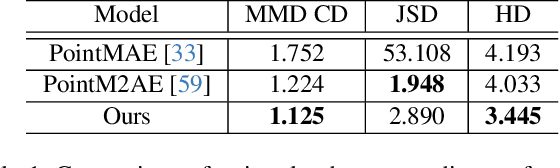

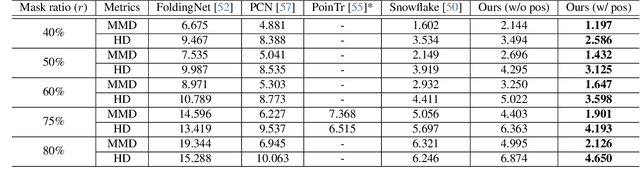
Point cloud streaming is increasingly getting popular, evolving into the norm for interactive service delivery and the future Metaverse. However, the substantial volume of data associated with point clouds presents numerous challenges, particularly in terms of high bandwidth consumption and large storage capacity. Despite various solutions proposed thus far, with a focus on point cloud compression, upsampling, and completion, these reconstruction-related methods continue to fall short in delivering high fidelity point cloud output. As a solution, in DiffPMAE, we propose an effective point cloud reconstruction architecture. Inspired by self-supervised learning concepts, we combine Masked Auto-Encoding and Diffusion Model mechanism to remotely reconstruct point cloud data. By the nature of this reconstruction process, DiffPMAE can be extended to many related downstream tasks including point cloud compression, upsampling and completion. Leveraging ShapeNet-55 and ModelNet datasets with over 60000 objects, we validate the performance of DiffPMAE exceeding many state-of-the-art methods in-terms of auto-encoding and downstream tasks considered.