 Add to Chrome
 Add to Firefox
 Add to Edge
Ambiguous Strategic Classification
Jun 08, 2026
A common assumption in strategic classification is that the classifier is public knowledge. However, it remains unclear whether, and why, a system would choose to commit to full disclosure. We study a setting in which regulation requires the system to disclose some, but not all, of the information. This induces a learning task in which the learner must jointly optimize the classifier and the uncertainty surrounding it. To this end, we adopt from robust mechanism design the notion of ambiguity, which in our setting allows the learner to reveal a set or range of possible classifiers, while privately choosing which of them to ultimately realize. We investigate how ambiguity affects the learning task, develop efficient algorithms for computing best-responses and training, and empirically explore strategic learning and its outcomes in this novel setting and using our approach.

The Role of Causal Features in Strategic Classification for Robustness and Alignment
May 26, 2026In strategic classification, an institution (e.g., a bank) anticipates adaptation from users who change their features to increase utility in a classification task (e.g., loan repayment). Since a key challenge is the distribution shift induced by users, we turn to causal models, which have been shown to bound the worst-case out-of-distribution (OOD) risk, and establish several new results that link causality and strategic classification. First, we show that causal classification leads to optimal classification error after any sufficiently large adaptation, when the noise is bounded in a certain way. Second, when these assumptions do not hold, we show OOD cross-entropy risk of optimal classifiers decomposes into an OOD bias term and a term arising from not using all observable features, allowing us to understand when causal classifiers have an advantage. Finally, we show that the use of causal features can allow alignment of long-term incentives between institutions and users, contrasting with previous work that highlights social costs of such approaches. We validate our theory empirically on synthetic data, finding that our results predict behavior in practice.
Strategic PAC Learnability via Geometric Definability
May 14, 2026Strategic classification studies learning settings in which individuals can modify their features, at a cost, in order to influence the classifier's decision. A central question is how the sample complexity of the induced (strategic) hypothesis class depends on the complexities of the underlying hypothesis class and the cost structure governing feasible manipulations. Prior work has shown that in several natural settings, such as linear classifiers with norm costs, the induced complexity can be controlled. We begin by showing that such guarantees fail in general - even in simple cases: there exist hypothesis classes of VC dimension $1$ on the real line such that, even under the simplest interval neighborhoods, the induced class has infinite VC dimension. Thus, strategic behavior can turn an easy learning problem into a non-learnable one. To overcome this, we introduce structure via a geometric definability assumption: both the hypothesis class and the cost-induced neighborhood relation can be defined by first-order formulas over $\mathbb{R}_{\mathtt{exp}}$. Intuitively, this means that hypotheses and costs can be described using arithmetic operations, exponentiation, logarithms, and comparisons. This captures a broad range of natural classes and cost functions, including $\ell_p$ distances, Wasserstein distance, and information-theoretic divergences. Under this assumption, we prove that learnability is preserved, with sample complexity controlled by the complexity of the defining formulas.
Strategic Classification with Non-Linear Classifiers
May 29, 2025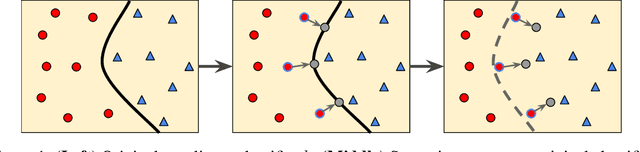

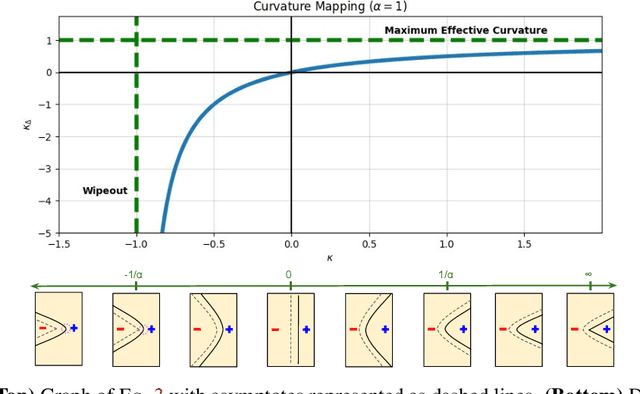
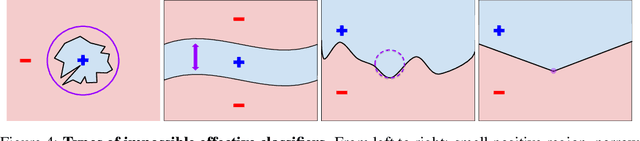
In strategic classification, the standard supervised learning setting is extended to support the notion of strategic user behavior in the form of costly feature manipulations made in response to a classifier. While standard learning supports a broad range of model classes, the study of strategic classification has, so far, been dedicated mostly to linear classifiers. This work aims to expand the horizon by exploring how strategic behavior manifests under non-linear classifiers and what this implies for learning. We take a bottom-up approach showing how non-linearity affects decision boundary points, classifier expressivity, and model classes complexity. A key finding is that universal approximators (e.g., neural nets) are no longer universal once the environment is strategic. We demonstrate empirically how this can create performance gaps even on an unrestricted model class.
Evolutionary Prediction Games
Mar 05, 2025

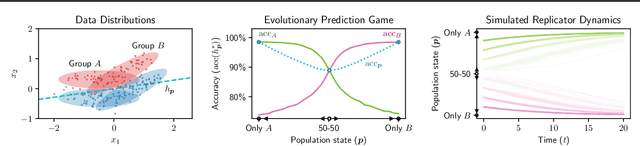
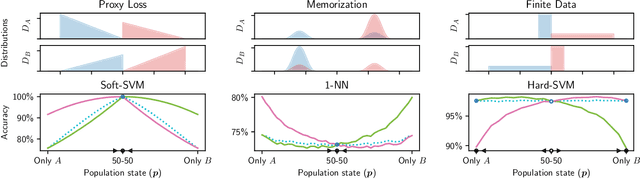
When users decide whether to use a system based on the quality of predictions they receive, learning has the capacity to shape the population of users it serves - for better or worse. This work aims to study the long-term implications of this process through the lens of evolutionary game theory. We introduce and study evolutionary prediction games, designed to capture the role of learning as a driver of natural selection between groups of users, and hence a determinant of evolutionary outcomes. Our main theoretical results show that: (i) in settings with unlimited data and compute, learning tends to reinforce the survival of the fittest, and (ii) in more realistic settings, opportunities for coexistence emerge. We analyze these opportunities in terms of their stability and feasibility, present several mechanisms that can sustain their existence, and empirically demonstrate our findings using real and synthetic data.
Learning Classifiers That Induce Markets
Feb 27, 2025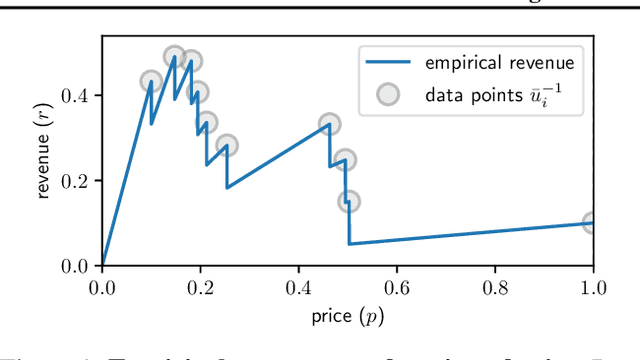


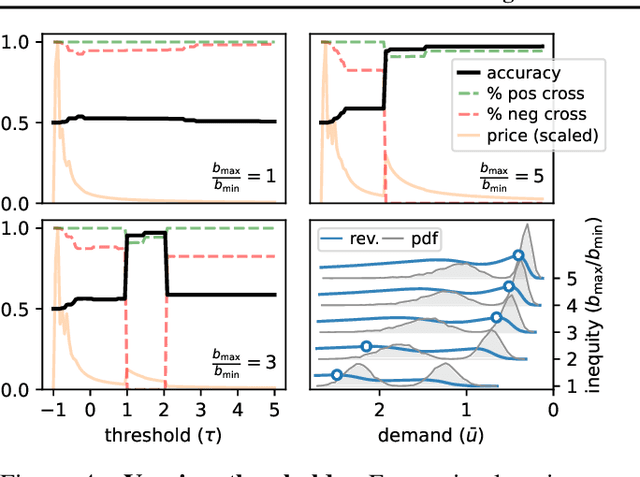
When learning is used to inform decisions about humans, such as for loans, hiring, or admissions, this can incentivize users to strategically modify their features to obtain positive predictions. A key assumption is that modifications are costly, and are governed by a cost function that is exogenous and predetermined. We challenge this assumption, and assert that the deployment of a classifier is what creates costs. Our idea is simple: when users seek positive predictions, this creates demand for important features; and if features are available for purchase, then a market will form, and competition will give rise to prices. We extend the strategic classification framework to support this notion, and study learning in a setting where a classifier can induce a market for features. We present an analysis of the learning task, devise an algorithm for computing market prices, propose a differentiable learning framework, and conduct experiments to explore our novel setting and approach.
A Market for Accuracy: Classification under Competition
Feb 25, 2025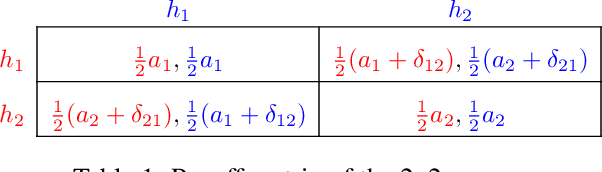
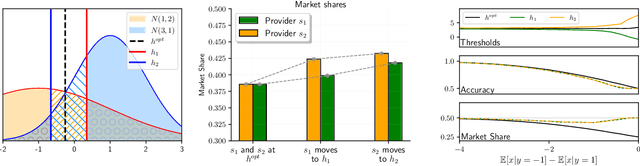

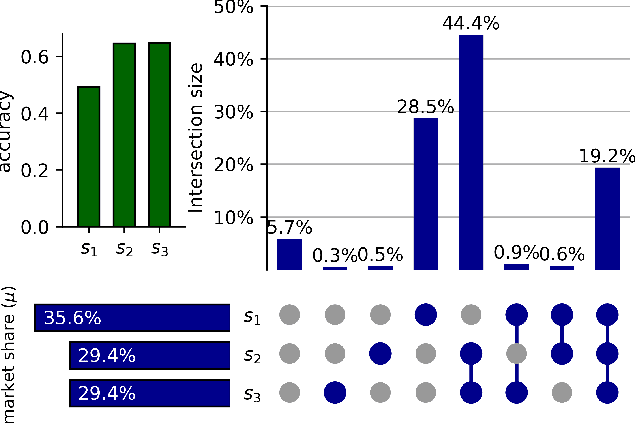
Machine learning models play a key role for service providers looking to gain market share in consumer markets. However, traditional learning approaches do not take into account the existence of additional providers, who compete with each other for consumers. Our work aims to study learning in this market setting, as it affects providers, consumers, and the market itself. We begin by analyzing such markets through the lens of the learning objective, and show that accuracy cannot be the only consideration. We then propose a method for classification under competition, so that a learner can maximize market share in the presence of competitors. We show that our approach benefits the providers as well as the consumers, and find that the timing of market entry and model updates can be crucial. We display the effectiveness of our approach across a range of domains, from simple distributions to noisy datasets, and show that the market as a whole remains stable by converging quickly to an equilibrium.
Machine Learning Should Maximize Welfare, Not (Only) Accuracy
Feb 17, 2025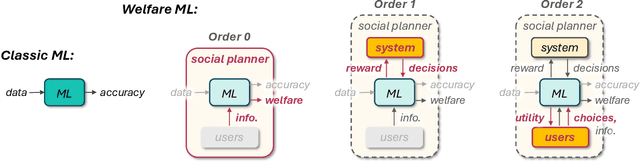
Decades of research in machine learning have given us powerful tools for making accurate predictions. But when used in social settings and on human inputs, better accuracy does not immediately translate to better social outcomes. This may not be surprising given that conventional learning frameworks are not designed to express societal preferences -- let alone promote them. This position paper argues that machine learning is currently missing, and can gain much from incorporating, a proper notion of social welfare. The field of welfare economics asks: how should we allocate limited resources to self-interested agents in a way that maximizes social benefit? We argue that this perspective applies to many modern applications of machine learning in social contexts, and advocate for its adoption. Rather than disposing of prediction, we aim to leverage this forte of machine learning for promoting social welfare. We demonstrate this idea by proposing a conceptual framework that gradually transitions from accuracy maximization (with awareness to welfare) to welfare maximization (via accurate prediction). We detail applications and use-cases for which our framework can be effective, identify technical challenges and practical opportunities, and highlight future avenues worth pursuing.
Adversaries With Incentives: A Strategic Alternative to Adversarial Robustness
Jun 17, 2024Adversarial training aims to defend against *adversaries*: malicious opponents whose sole aim is to harm predictive performance in any way possible - a rather harsh perspective, which we assert results in unnecessarily conservative models. Instead, we propose to model opponents as simply pursuing their own goals, rather than working directly against the classifier. Employing tools from strategic modeling, our approach uses knowledge or beliefs regarding the opponent's possible incentives as inductive bias for learning. Our method of *strategic training* is designed to defend against opponents within an *incentive uncertainty set*: this resorts to adversarial learning when the set is maximal, but offers potential gains when it can be appropriately reduced. We conduct a series of experiments that show how even mild knowledge regarding the adversary's incentives can be useful, and that the degree of potential gains depends on how incentives relate to the structure of the learning task.
Classification Under Strategic Self-Selection
Feb 23, 2024


When users stand to gain from certain predictions, they are prone to act strategically to obtain favorable predictive outcomes. Whereas most works on strategic classification consider user actions that manifest as feature modifications, we study a novel setting in which users decide -- in response to the learned classifier -- whether to at all participate (or not). For learning approaches of increasing strategic awareness, we study the effects of self-selection on learning, and the implications of learning on the composition of the self-selected population. We then propose a differentiable framework for learning under self-selective behavior, which can be optimized effectively. We conclude with experiments on real data and simulated behavior that both complement our analysis and demonstrate the utility of our approach.