 Add to Chrome
 Add to Firefox
 Add to Edge
Ambiguous Strategic Classification
Jun 08, 2026
A common assumption in strategic classification is that the classifier is public knowledge. However, it remains unclear whether, and why, a system would choose to commit to full disclosure. We study a setting in which regulation requires the system to disclose some, but not all, of the information. This induces a learning task in which the learner must jointly optimize the classifier and the uncertainty surrounding it. To this end, we adopt from robust mechanism design the notion of ambiguity, which in our setting allows the learner to reveal a set or range of possible classifiers, while privately choosing which of them to ultimately realize. We investigate how ambiguity affects the learning task, develop efficient algorithms for computing best-responses and training, and empirically explore strategic learning and its outcomes in this novel setting and using our approach.

Learning Classifiers That Induce Markets
Feb 27, 2025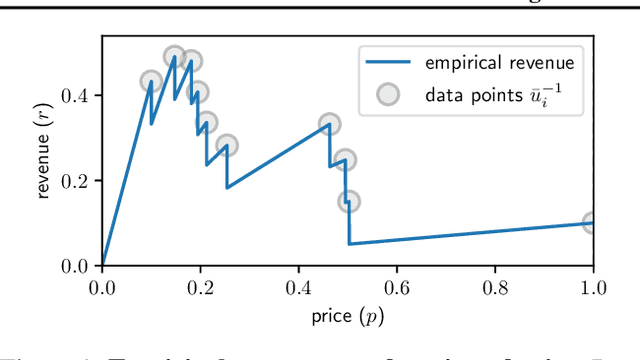


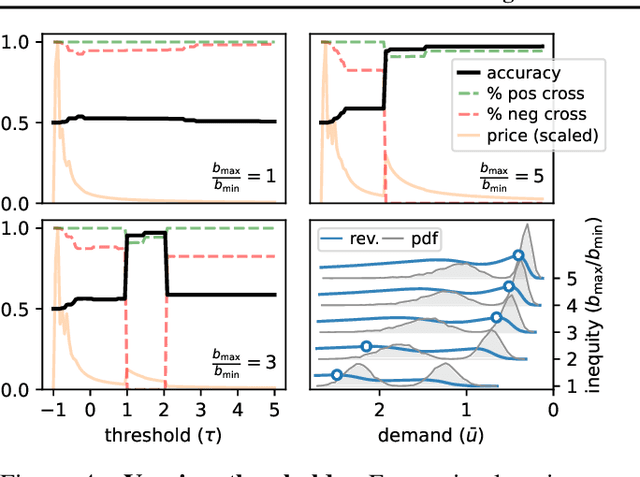
When learning is used to inform decisions about humans, such as for loans, hiring, or admissions, this can incentivize users to strategically modify their features to obtain positive predictions. A key assumption is that modifications are costly, and are governed by a cost function that is exogenous and predetermined. We challenge this assumption, and assert that the deployment of a classifier is what creates costs. Our idea is simple: when users seek positive predictions, this creates demand for important features; and if features are available for purchase, then a market will form, and competition will give rise to prices. We extend the strategic classification framework to support this notion, and study learning in a setting where a classifier can induce a market for features. We present an analysis of the learning task, devise an algorithm for computing market prices, propose a differentiable learning framework, and conduct experiments to explore our novel setting and approach.