 Add to Chrome
 Add to Firefox
 Add to Edge
DeepDTF: Dual-Branch Transformer Fusion for Multi-Omics Anticancer Drug Response Prediction
Mar 25, 2026
Cancer drug response varies widely across tumors due to multi-layer molecular heterogeneity, motivating computational decision support for precision oncology. Despite recent progress in deep CDR models, robust alignment between high-dimensional multi-omics and chemically structured drugs remains challenging due to cross-modal misalignment and limited inductive bias. We present DeepDTF, an end-to-end dual-branch Transformer fusion framework for joint log(IC50) regression and drug sensitivity classification. The cell-line branch uses modality-specific encoders for multi-omics profiles with Transformer blocks to capture long-range dependencies, while the drug branch represents compounds as molecular graphs and encodes them with a GNN-Transformer to integrate local topology with global context. Omics and drug representations are fused by a Transformer-based module that models cross-modal interactions and mitigates feature misalignment. On public pharmacogenomic benchmarks under 5-fold cold-start cell-line evaluation, DeepDTF consistently outperforms strong baselines across omics settings, achieving up to RMSE=1.248, R^2=0.875, and AUC=0.987 with full multi-omics inputs, while reducing classification error (1-ACC) by 9.5%. Beyond accuracy, DeepDTF provides biologically grounded explanations via SHAP-based gene attributions and pathway enrichment with pre-ranked GSEA.

Pre-trained Molecular Language Models with Random Functional Group Masking
Nov 03, 2024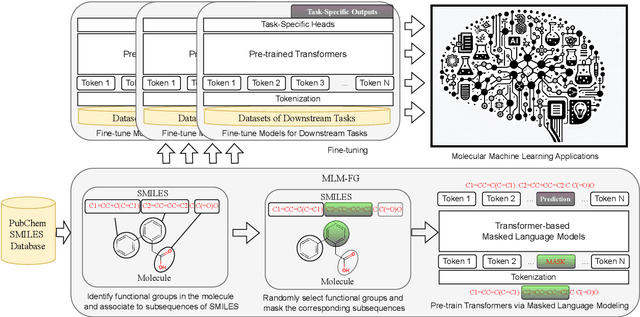


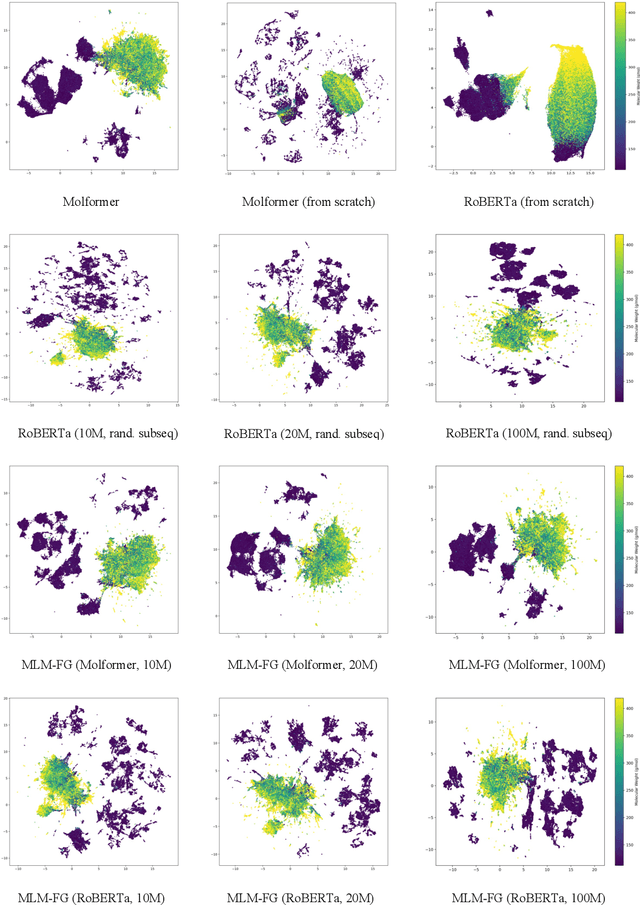
Recent advancements in computational chemistry have leveraged the power of trans-former-based language models, such as MoLFormer, pre-trained using a vast amount of simplified molecular-input line-entry system (SMILES) sequences, to understand and predict molecular properties and activities, a critical step in fields like drug discovery and materials science. To further improve performance, researchers have introduced graph neural networks with graph-based molecular representations, such as GEM, incorporating the topology, geometry, 2D or even 3D structures of molecules into pre-training. While most of molecular graphs in existing studies were automatically converted from SMILES sequences, it is to assume that transformer-based language models might be able to implicitly learn structure-aware representations from SMILES sequences. In this paper, we propose \ours{} -- a SMILES-based \underline{\em M}olecular \underline{\em L}anguage \underline{\em M}odel, which randomly masking SMILES subsequences corresponding to specific molecular \underline{\em F}unctional \underline{\em G}roups to incorporate structure information of atoms during the pre-training phase. This technique aims to compel the model to better infer molecular structures and properties, thus enhancing its predictive capabilities. Extensive experimental evaluations across 11 benchmark classification and regression tasks in the chemical domain demonstrate the robustness and superiority of \ours{}. Our findings reveal that \ours{} outperforms existing pre-training models, either based on SMILES or graphs, in 9 out of the 11 downstream tasks, ranking as a close second in the remaining ones.
Protoformer: Embedding Prototypes for Transformers
Jun 25, 2022Transformers have been widely applied in text classification. Unfortunately, real-world data contain anomalies and noisy labels that cause challenges for state-of-art Transformers. This paper proposes Protoformer, a novel self-learning framework for Transformers that can leverage problematic samples for text classification. Protoformer features a selection mechanism for embedding samples that allows us to efficiently extract and utilize anomalies prototypes and difficult class prototypes. We demonstrated such capabilities on datasets with diverse textual structures (e.g., Twitter, IMDB, ArXiv). We also applied the framework to several models. The results indicate that Protoformer can improve current Transformers in various empirical settings.
* Advances in Knowledge Discovery and Data Mining (PAKDD 2022)