 Add to Chrome
 Add to Firefox
 Add to Edge
KVpop -- Key-Value Cache Compression with Predictive Online Pruning
Jul 06, 2026
Key-value (KV) cache growth is a major bottleneck in autoregressive decoding, as memory and bandwidth scale linearly with context length. Existing KV eviction methods often rely on static heuristics or proxy scores, which poorly track future token utility and cause brittle eviction as relevance shifts. To address this, we introduce KVpop, which learns a fixed-budget KV eviction policy by directly supervising the keep-or-drop decision. The scorer is trained against a novel future-attention target, computed efficiently without materializing dense attention maps. We further introduce a delayed memory-based scorer that, uniquely among learned eviction methods, defers scoring for a fixed number of steps to exploit near-future context. On AIME and HMMT mathematical reasoning, KVpop retains 98% of full-attention performance on Qwen3-4B at 75% KV cache compression and 97% at 88% compression, consistently outperforming established eviction baselines. Qwen3-8B shows even stronger results, reaching near-full teacher performance. These results show that supervising eviction with future-attention signals cuts memory costs while maintaining quality.

On Subquadratic Architectures: From Applications to Principles
Jun 10, 2026Transformers dominate modern sequence modeling, but their quadratic attention incurs substantial computational cost. Subquadratic architectures offer a scalable alternative. However, it remains unclear which designs yield the most effective sequence models. We compare three leading approaches: xLSTM, Mamba-2, and Gated DeltaNet. We evaluate these models on tasks with complex dependencies: (1) code-model pre-training, (2) distillation of code models from large language models, and (3) pre-training of time-series foundation models. Across these settings, xLSTM delivers the strongest overall performance. To explain xLSTM's advantage, we present a unified formulation and analyze the underlying architectural mechanisms, focusing on state tracking and memory dynamics. Our results show that xLSTM enables more flexible and stable memory correction via its gating scheme. We corroborate these findings on controlled synthetic length-generalization tasks. Overall, our findings indicate that xLSTM's gains on complex tasks stem from robust state tracking and accumulation.
Effective Distillation to Hybrid xLSTM Architectures
Mar 16, 2026There have been numerous attempts to distill quadratic attention-based large language models (LLMs) into sub-quadratic linearized architectures. However, despite extensive research, such distilled models often fail to match the performance of their teacher LLMs on various downstream tasks. We set out the goal of lossless distillation, which we define in terms of tolerance-corrected Win-and-Tie rates between student and teacher on sets of tasks. To this end, we introduce an effective distillation pipeline for xLSTM-based students. We propose an additional merging stage, where individually linearized experts are combined into a single model. We show the effectiveness of this pipeline by distilling base and instruction-tuned models from the Llama, Qwen, and Olmo families. In many settings, our xLSTM-based students recover most of the teacher's performance, and even exceed it on some downstream tasks. Our contributions are an important step towards more energy-efficient and cost-effective replacements for transformer-based LLMs.
Bio-xLSTM: Generative modeling, representation and in-context learning of biological and chemical sequences
Nov 06, 2024


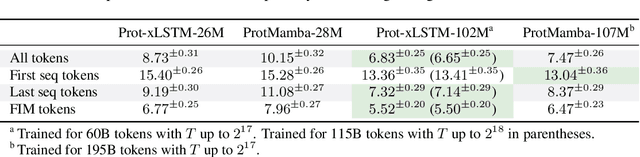
Language models for biological and chemical sequences enable crucial applications such as drug discovery, protein engineering, and precision medicine. Currently, these language models are predominantly based on Transformer architectures. While Transformers have yielded impressive results, their quadratic runtime dependency on the sequence length complicates their use for long genomic sequences and in-context learning on proteins and chemical sequences. Recently, the recurrent xLSTM architecture has been shown to perform favorably compared to Transformers and modern state-space model (SSM) architectures in the natural language domain. Similar to SSMs, xLSTMs have a linear runtime dependency on the sequence length and allow for constant-memory decoding at inference time, which makes them prime candidates for modeling long-range dependencies in biological and chemical sequences. In this work, we tailor xLSTM towards these domains and propose a suite of architectural variants called Bio-xLSTM. Extensive experiments in three large domains, genomics, proteins, and chemistry, were performed to assess xLSTM's ability to model biological and chemical sequences. The results show that models based on Bio-xLSTM a) can serve as proficient generative models for DNA, protein, and chemical sequences, b) learn rich representations for those modalities, and c) can perform in-context learning for proteins and small molecules.