 Add to Chrome
 Add to Firefox
 Add to Edge
VLA Grounder: Language-Conditioning Space Optimization for Black-Box VLA Models
Jul 05, 2026
Vision-Language-Action (VLA) models are commonly treated as end-to-end action policies conditioned on natural-language task descriptions. In practice, however, their behavior often depends sharply on how the instruction is phrased, suggesting that language is not merely a task label but an optimizable conditioning input. We study whether frozen VLA policies can be improved by optimizing language space rather than updating action weights. Our method introduces a language-conditioning space policy that translates a human instruction into a short VLA-grounded command using object appearance, spatial relations, and target-grounding cues. The language-conditioning space policy is initialized with a failure-derived command-space prior and optimized with reinforcement learning from sparse task-completion rewards, while the downstream VLA remains fully frozen. This yields language-conditioning space optimization: RL discovers which VLA-grounded commands best elicit successful behavior from the frozen action policy. Experiments on RL4VLA and VL-Think show that language-conditioning space optimization improves success on instruction-sensitive, symbolic, and multi-object manipulation tasks, demonstrating that language can serve as an optimizable variable for a robot foundation models. Website: https://tttonyalpha.github.io/vla_grounder

Does VLA Even Know the Basics? Measuring Commonsense and World Knowledge Retention in Vision-Language-Action Models
Jun 17, 2026Embodied Vision-Language-Action (VLA) models are typically obtained by fine-tuning powerful pretrained VLMs on robotics data, yet it is unclear how much commonsense and factual knowledge they retain after adaptation. Failures on knowledge-sensitive tasks are ambiguous, conflating missing knowledge with poor generalization of low-level control. We introduce Act2Answer, a lightweight protocol that adapts VLM knowledge benchmarks to VLA evaluation by requiring agents to answer through action. Each question becomes a short tabletop episode where the agent performs a single object-placement action to select among candidate answers, yielding an action-grounded success rate with reduced control confounds. We curate a test suite of such environments across diverse commonsense and world-knowledge categories and introduce layerwise intent probing to localize answer-relevant information across the VLM backbone and action head. In a large-scale study of 7 VLA models and 9 VLM baselines, we systematically rank models across categories, finding that VLAs show solid performance on simple concepts while exhibiting larger gaps on richer semantic categories relative to their source VLMs, that VQA co-training is associated with better knowledge retention, and that answer-relevant signals peak in middle VLA layers but attenuate in upper layers. Act2Answer is available at https://tttonyalpha.github.io/act2answer/.
$μ$VLA: On Recurrent Memory for Partially Observable Manipulation in VLA Models
Jun 10, 2026Vision-language-action (VLA) models predict chunks of future actions from the current observation, an assumption that fails under partial observability, where decisions depend on information no longer visible. Existing memory-augmented VLAs simultaneously introduce recurrence, retrieval, compression modules, auxiliary objectives, hierarchical memory, or task-specific architectural changes, so the contribution of recurrence itself remains entangled with surrounding machinery. We present a controlled isolation study of recurrence in a strong pretrained VLA backbone. Our formulation augments the transformer with a small set of learnable memory tokens carried across timesteps and updated through self-attention, trained end to end with truncated backpropagation through time, with no auxiliary losses and no architectural changes. We instantiate this as $μ$VLA, a family of OpenVLA-OFT variants parameterized by memory width m, TBPTT length K, and the memory update rule (cross-step gradients or a detached EMA), so that recurrence is the only varying factor. On MIKASA-Robo, $μ$VLA improves average success rate on five training tasks from 0.42 to 0.84 at the strongest setting and reaches 0.23 on held-out tasks with the same memory structure versus 0.07 for the memoryless baseline. On tasks requiring different memory structure, performance remains near baseline. On LIBERO, the strongest recurrent variant achieves 96.2% average success, indicating no regression under full observability. We interpret these results as a calibration of the capability envelope of minimal in-backbone recurrence, identifying the regime in which it is sufficient and the regime where additional memory structure is required. Demos and videos can be found in https://avanturist322.github.io/mu-vla/.
Unraveling the Complexity of Memory in RL Agents: an Approach for Classification and Evaluation
Dec 09, 2024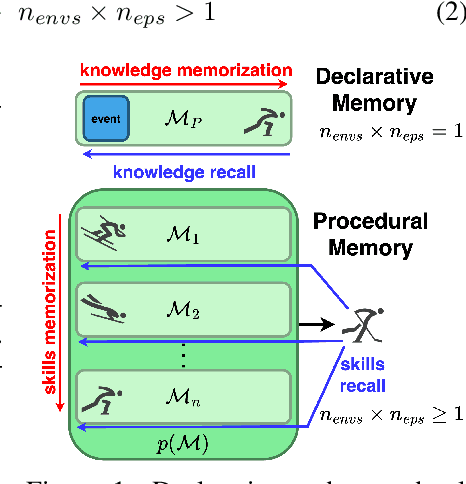
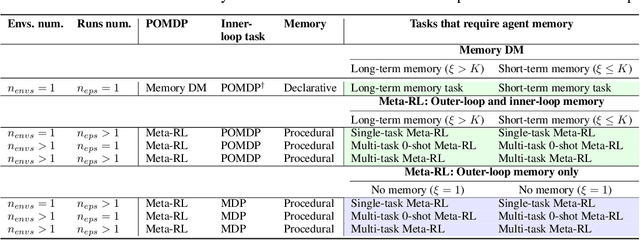
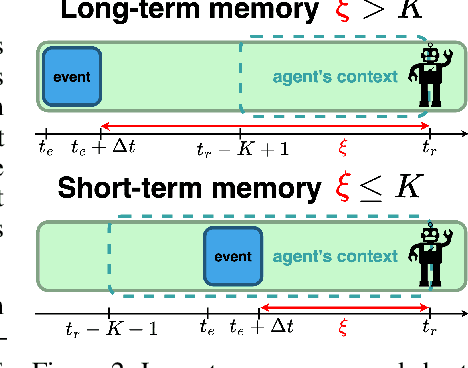
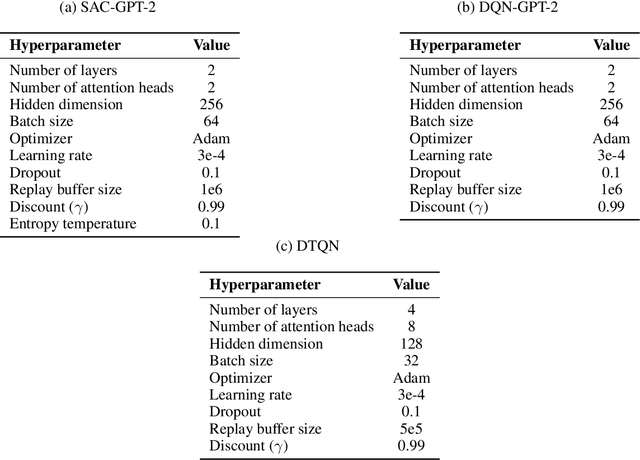
The incorporation of memory into agents is essential for numerous tasks within the domain of Reinforcement Learning (RL). In particular, memory is paramount for tasks that require the utilization of past information, adaptation to novel environments, and improved sample efficiency. However, the term ``memory'' encompasses a wide range of concepts, which, coupled with the lack of a unified methodology for validating an agent's memory, leads to erroneous judgments about agents' memory capabilities and prevents objective comparison with other memory-enhanced agents. This paper aims to streamline the concept of memory in RL by providing practical precise definitions of agent memory types, such as long-term versus short-term memory and declarative versus procedural memory, inspired by cognitive science. Using these definitions, we categorize different classes of agent memory, propose a robust experimental methodology for evaluating the memory capabilities of RL agents, and standardize evaluations. Furthermore, we empirically demonstrate the importance of adhering to the proposed methodology when evaluating different types of agent memory by conducting experiments with different RL agents and what its violation leads to.