 Add to Chrome
 Add to Firefox
 Add to Edge
Remember what you did?: Learning Behavioral Memories for Partially Observable Object Manipulation
Jun 19, 2026
Long horizon, contact-rich manipulation is inherently partially observable. This is as a single visual observation rarely captures a robot's full action context, including prior attempts, interactions, or progress. Consequently, standard visuomotor policies or vision-language-action models are prone to struggle in such tasks due to a lack of memory. To address this, we introduce Compressed Action Memory Policy (CAMP) based on the insight that a robot's own action history serves as a highly informative, self-supervised signal, enabling the policy to learn a robust, compact history representation. In our approach, we train a memory module to maintain a compressed representation of past actions, forcing it to encode a latent behavioral memory of all the robot's past interactions that can then be used to better contextualize future actions. This allows our approach to implicitly track generalized task progress and learn from failed attempts without any additional supervision, or external oversight. We evaluate CAMP across four real-robot setups and two novel simulation benchmarks: Memory-T-Bench and Memory-Manip-Bench. By demonstrating substantial gains over state-of-the-art baselines, CAMP is, to our knowledge, the first policy to demonstrate substantial success on contact-rich partially observable manipulation tasks purely through learned memory.

Robust Surgical Tool Tracking with Pixel-based Probabilities for Projected Geometric Primitives
Mar 08, 2024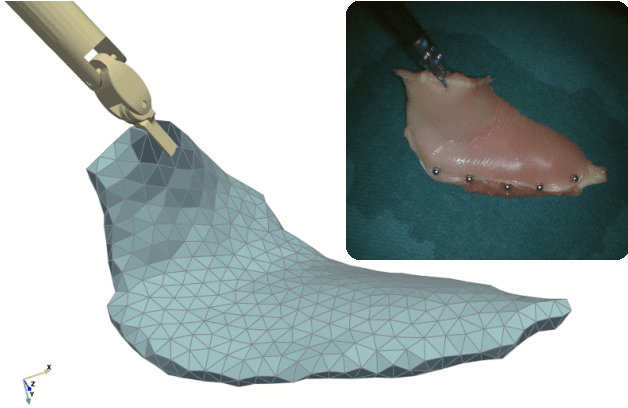
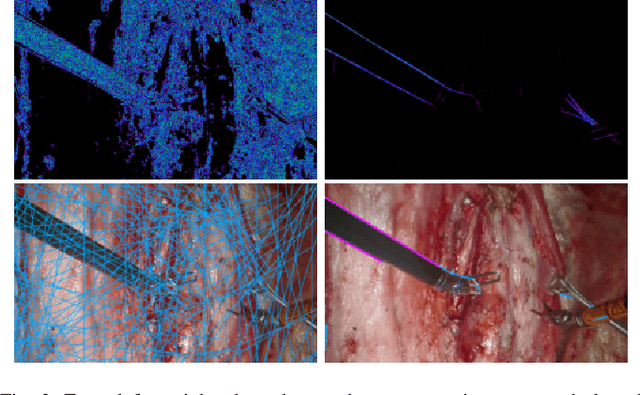
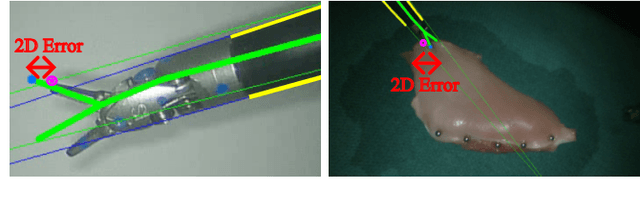
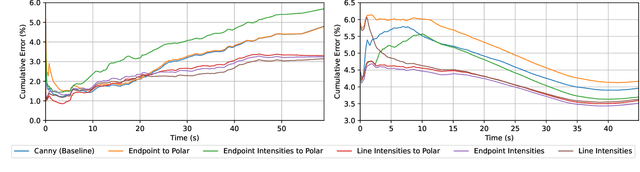
Controlling robotic manipulators via visual feedback requires a known coordinate frame transformation between the robot and the camera. Uncertainties in mechanical systems as well as camera calibration create errors in this coordinate frame transformation. These errors result in poor localization of robotic manipulators and create a significant challenge for applications that rely on precise interactions between manipulators and the environment. In this work, we estimate the camera-to-base transform and joint angle measurement errors for surgical robotic tools using an image based insertion-shaft detection algorithm and probabilistic models. We apply our proposed approach in both a structured environment as well as an unstructured environment and measure to demonstrate the efficacy of our methods.
Finding Biomechanically Safe Trajectories for Robot Manipulation of the Human Body in a Search and Rescue Scenario
Sep 26, 2023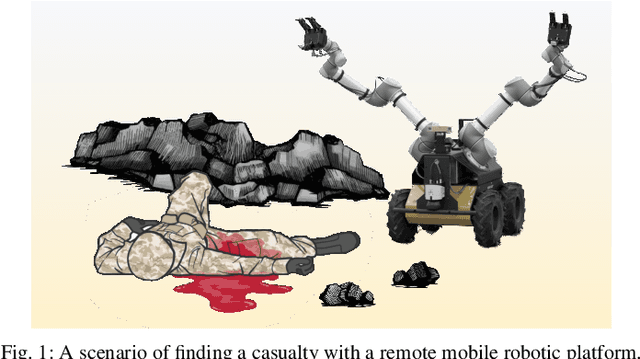
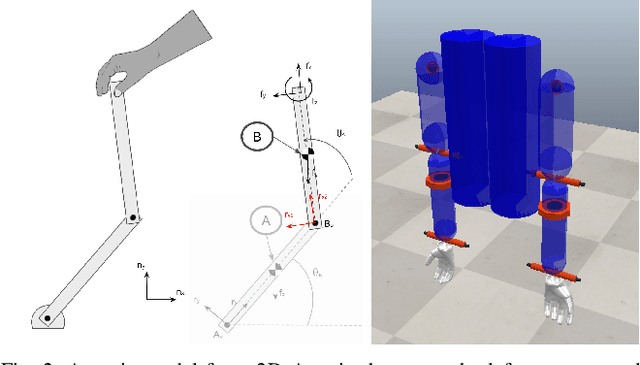
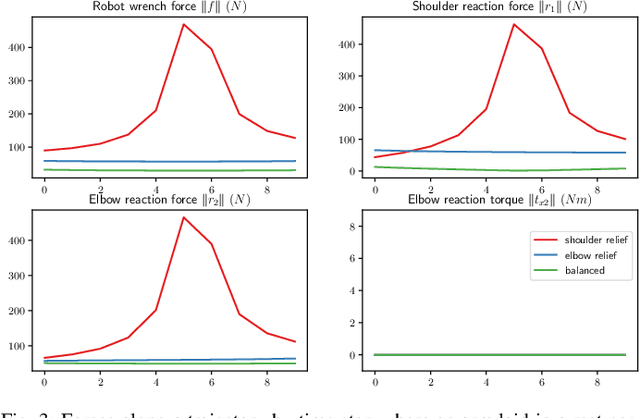
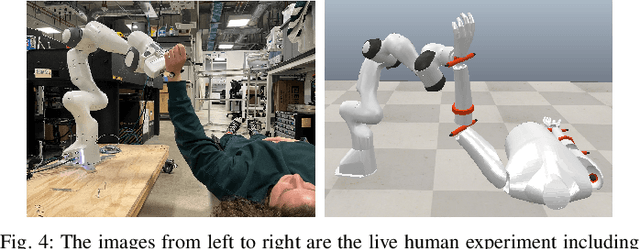
There has been increasing awareness of the difficulties in reaching and extracting people from mass casualty scenarios, such as those arising from natural disasters. While platforms have been designed to consider reaching casualties and even carrying them out of harm's way, the challenge of repositioning a casualty from its found configuration to one suitable for extraction has not been explicitly explored. Furthermore, this planning problem needs to incorporate biomechanical safety considerations for the casualty. Thus, we present a first solution to biomechanically safe trajectory generation for repositioning limbs of unconscious human casualties. We describe biomechanical safety as mathematical constraints, mechanical descriptions of the dynamics for the robot-human coupled system, and the planning and trajectory optimization process that considers this coupled and constrained system. We finally evaluate our approach over several variations of the problem and demonstrate it on a real robot and human subject. This work provides a crucial part of search and rescue that can be used in conjunction with past and present works involving robots and vision systems designed for search and rescue.