 Add to Chrome
 Add to Firefox
 Add to Edge
Remember what you did?: Learning Behavioral Memories for Partially Observable Object Manipulation
Jun 19, 2026
Long horizon, contact-rich manipulation is inherently partially observable. This is as a single visual observation rarely captures a robot's full action context, including prior attempts, interactions, or progress. Consequently, standard visuomotor policies or vision-language-action models are prone to struggle in such tasks due to a lack of memory. To address this, we introduce Compressed Action Memory Policy (CAMP) based on the insight that a robot's own action history serves as a highly informative, self-supervised signal, enabling the policy to learn a robust, compact history representation. In our approach, we train a memory module to maintain a compressed representation of past actions, forcing it to encode a latent behavioral memory of all the robot's past interactions that can then be used to better contextualize future actions. This allows our approach to implicitly track generalized task progress and learn from failed attempts without any additional supervision, or external oversight. We evaluate CAMP across four real-robot setups and two novel simulation benchmarks: Memory-T-Bench and Memory-Manip-Bench. By demonstrating substantial gains over state-of-the-art baselines, CAMP is, to our knowledge, the first policy to demonstrate substantial success on contact-rich partially observable manipulation tasks purely through learned memory.

Multi-Robot Motion Planning from Vision and Language using Heat-Inspired Diffusion
Dec 15, 2025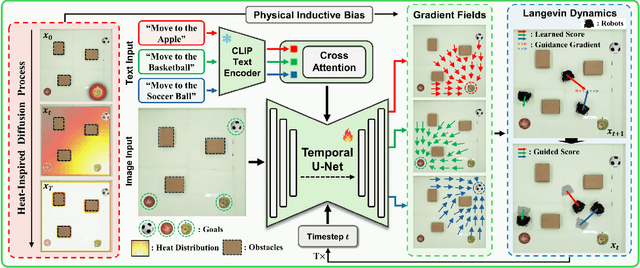
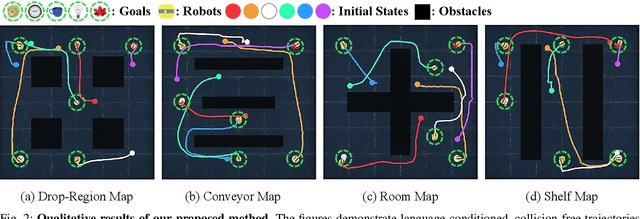
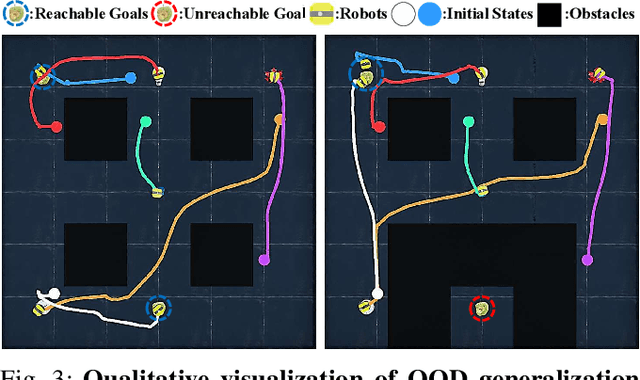
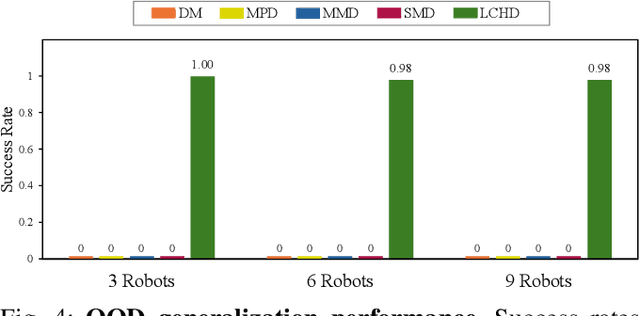
Diffusion models have recently emerged as powerful tools for robot motion planning by capturing the multi-modal distribution of feasible trajectories. However, their extension to multi-robot settings with flexible, language-conditioned task specifications remains limited. Furthermore, current diffusion-based approaches incur high computational cost during inference and struggle with generalization because they require explicit construction of environment representations and lack mechanisms for reasoning about geometric reachability. To address these limitations, we present Language-Conditioned Heat-Inspired Diffusion (LCHD), an end-to-end vision-based framework that generates language-conditioned, collision-free trajectories. LCHD integrates CLIP-based semantic priors with a collision-avoiding diffusion kernel serving as a physical inductive bias that enables the planner to interpret language commands strictly within the reachable workspace. This naturally handles out-of-distribution scenarios -- in terms of reachability -- by guiding robots toward accessible alternatives that match the semantic intent, while eliminating the need for explicit obstacle information at inference time. Extensive evaluations on diverse real-world-inspired maps, along with real-robot experiments, show that LCHD consistently outperforms prior diffusion-based planners in success rate, while reducing planning latency.