 Add to Chrome
 Add to Firefox
 Add to Edge
The FID Lottery: Quantifying Hidden Randomness in Generative-Model Evaluation
Jun 18, 2026
The Frechet Inception Distance (FID) is the de facto arbiter of image generation, yet most papers report just a single number from a single trained model using a single sampling seed. How reproducible is that number if we retrain the model, or merely resample from it? In this paper, we treat FID as a random variable on a two-axis panel of training and generation seeds, and measure its variance directly on several hundred SiT networks trained on class-conditional ImageNet 256x256. We report surprising findings: (a) Retraining the model using the same recipe with a different seed moves FID 3.2x more (in Inception feature space) than redrawing samples from a fixed network. (b) That gap is driven by three factors: random initialisation, data ordering, and the per-step Gaussian noise of the flow-matching loss. (c) Increasing compute or model size barely tightens the spread, holding the FID coefficient of variation (CoV) inside a 1-2% band. (d) Per-cell classifier-free-guidance tuning halves the spread but reshuffles which seeds work best, and a lucky training seed reaches the same FID with up to 2x less compute than an unlucky one. Based on these findings, we recommend a new FID evaluation protocol: evaluate under per-cell optimal guidance, treat any FID gap below the empirically measured ~1.3% CoV as inconclusive, and report an error bar over several training seeds rather than a single FID number.

Surflo: Consistent 3D Surface Flow Model with Global State
Jun 11, 2026Geometry is invariant to viewpoint, which makes any collection of images a redundant encoding of a single 3D state. Existing feed-forward reconstruction models fail to exploit this: per-view methods emit overlapping, unaligned pointmaps that grow linearly with input count, while global-latent methods commit to a fixed, low-resolution output. We introduce Surflo, which compresses a variable number of unposed RGB views into K latent tokens-one global state-and decodes oriented 3D surface points by independently transporting them from noise onto the surface via flow matching. This frees the output from any fixed grid or token budget: the same latent yields from a few thousand to a million points in a single forward pass. To suppress the local inconsistencies inherent to independent per-point decoding, an inference-time guidance term correlates nearby points by injecting a photometric gradient during ODE integration. Surflo matches or surpasses feed-forward baselines on surface metrics, runs an order of magnitude faster than optimization-based methods that require hundreds of views, and is the only feed-forward approach to combine a global latent with arbitrary-resolution decoding.
PoM: A Linear-Time Replacement for Attention with the Polynomial Mixer
Apr 07, 2026This paper introduces the Polynomial Mixer (PoM), a novel token mixing mechanism with linear complexity that serves as a drop-in replacement for self-attention. PoM aggregates input tokens into a compact representation through a learned polynomial function, from which each token retrieves contextual information. We prove that PoM satisfies the contextual mapping property, ensuring that transformers equipped with PoM remain universal sequence-to-sequence approximators. We replace standard self-attention with PoM across five diverse domains: text generation, handwritten text recognition, image generation, 3D modeling, and Earth observation. PoM matches the performance of attention-based models while drastically reducing computational cost when working with long sequences. The code is available at https://github.com/davidpicard/pom.
One View Is Enough! Monocular Training for In-the-Wild Novel View Generation
Mar 24, 2026Monocular novel-view synthesis has long required multi-view image pairs for supervision, limiting training data scale and diversity. We argue it is not necessary: one view is enough. We present OVIE, trained entirely on unpaired internet images. We leverage a monocular depth estimator as a geometric scaffold at training time: we lift a source image into 3D, apply a sampled camera transformation, and project to obtain a pseudo-target view. To handle disocclusions, we introduce a masked training formulation that restricts geometric, perceptual, and textural losses to valid regions, enabling training on 30 million uncurated images. At inference, OVIE is geometry-free, requiring no depth estimator or 3D representation. Trained exclusively on in-the-wild images, OVIE outperforms prior methods in a zero-shot setting, while being 600x faster than the second-best baseline. Code and models are publicly available at https://github.com/AdrienRR/ovie.
MIRO: MultI-Reward cOnditioned pretraining improves T2I quality and efficiency
Oct 29, 2025Current text-to-image generative models are trained on large uncurated datasets to enable diverse generation capabilities. However, this does not align well with user preferences. Recently, reward models have been specifically designed to perform post-hoc selection of generated images and align them to a reward, typically user preference. This discarding of informative data together with the optimizing for a single reward tend to harm diversity, semantic fidelity and efficiency. Instead of this post-processing, we propose to condition the model on multiple reward models during training to let the model learn user preferences directly. We show that this not only dramatically improves the visual quality of the generated images but it also significantly speeds up the training. Our proposed method, called MIRO, achieves state-of-the-art performances on the GenEval compositional benchmark and user-preference scores (PickAScore, ImageReward, HPSv2).
Training-Free Synthetic Data Generation with Dual IP-Adapter Guidance
Sep 26, 2025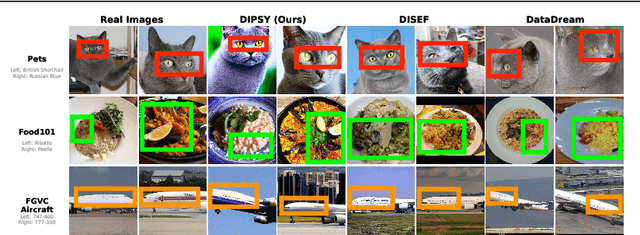

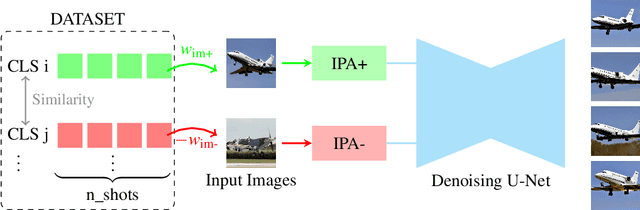

Few-shot image classification remains challenging due to the limited availability of labeled examples. Recent approaches have explored generating synthetic training data using text-to-image diffusion models, but often require extensive model fine-tuning or external information sources. We present a novel training-free approach, called DIPSY, that leverages IP-Adapter for image-to-image translation to generate highly discriminative synthetic images using only the available few-shot examples. DIPSY introduces three key innovations: (1) an extended classifier-free guidance scheme that enables independent control over positive and negative image conditioning; (2) a class similarity-based sampling strategy that identifies effective contrastive examples; and (3) a simple yet effective pipeline that requires no model fine-tuning or external captioning and filtering. Experiments across ten benchmark datasets demonstrate that our approach achieves state-of-the-art or comparable performance, while eliminating the need for generative model adaptation or reliance on external tools for caption generation and image filtering. Our results highlight the effectiveness of leveraging dual image prompting with positive-negative guidance for generating class-discriminative features, particularly for fine-grained classification tasks.
Around the World in 80 Timesteps: A Generative Approach to Global Visual Geolocation
Dec 09, 2024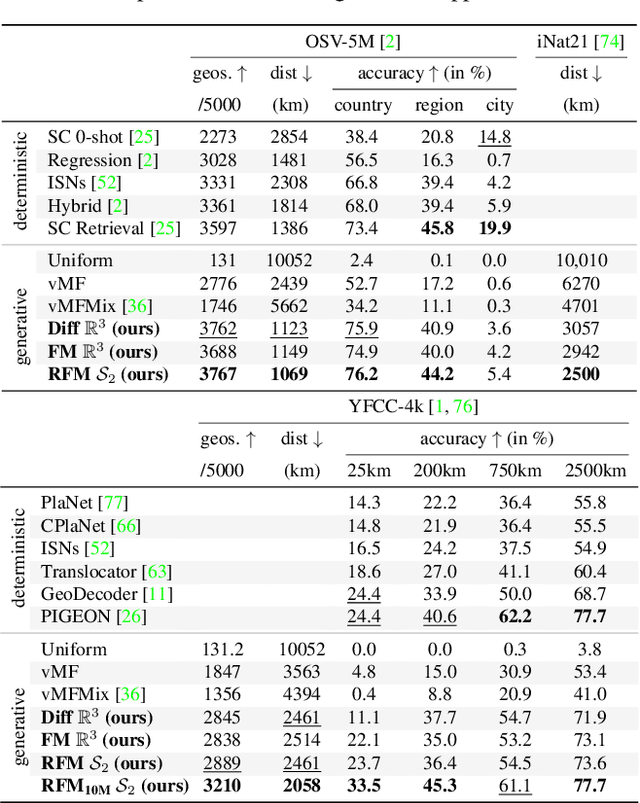
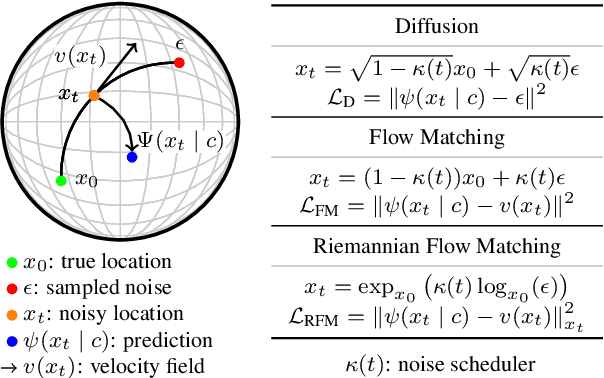
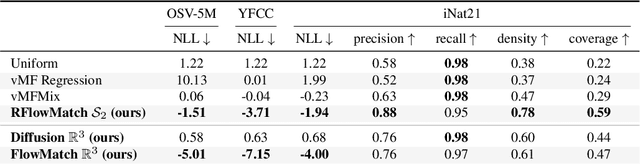
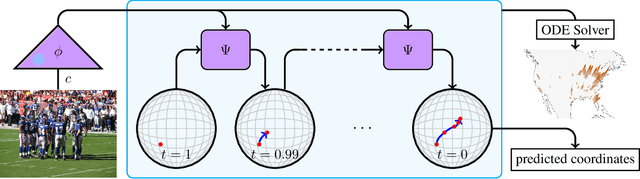
Global visual geolocation predicts where an image was captured on Earth. Since images vary in how precisely they can be localized, this task inherently involves a significant degree of ambiguity. However, existing approaches are deterministic and overlook this aspect. In this paper, we aim to close the gap between traditional geolocalization and modern generative methods. We propose the first generative geolocation approach based on diffusion and Riemannian flow matching, where the denoising process operates directly on the Earth's surface. Our model achieves state-of-the-art performance on three visual geolocation benchmarks: OpenStreetView-5M, YFCC-100M, and iNat21. In addition, we introduce the task of probabilistic visual geolocation, where the model predicts a probability distribution over all possible locations instead of a single point. We introduce new metrics and baselines for this task, demonstrating the advantages of our diffusion-based approach. Codes and models will be made available.
PoM: Efficient Image and Video Generation with the Polynomial Mixer
Nov 19, 2024
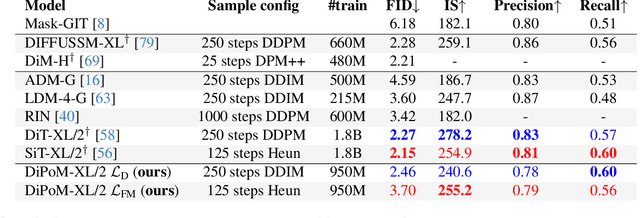

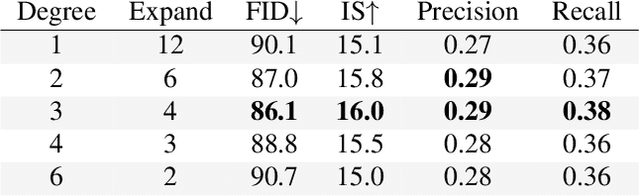
Diffusion models based on Multi-Head Attention (MHA) have become ubiquitous to generate high quality images and videos. However, encoding an image or a video as a sequence of patches results in costly attention patterns, as the requirements both in terms of memory and compute grow quadratically. To alleviate this problem, we propose a drop-in replacement for MHA called the Polynomial Mixer (PoM) that has the benefit of encoding the entire sequence into an explicit state. PoM has a linear complexity with respect to the number of tokens. This explicit state also allows us to generate frames in a sequential fashion, minimizing memory and compute requirement, while still being able to train in parallel. We show the Polynomial Mixer is a universal sequence-to-sequence approximator, just like regular MHA. We adapt several Diffusion Transformers (DiT) for generating images and videos with PoM replacing MHA, and we obtain high quality samples while using less computational resources. The code is available at https://github.com/davidpicard/HoMM.
E.T. the Exceptional Trajectories: Text-to-camera-trajectory generation with character awareness
Jul 01, 2024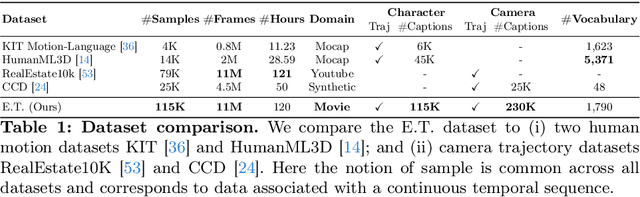
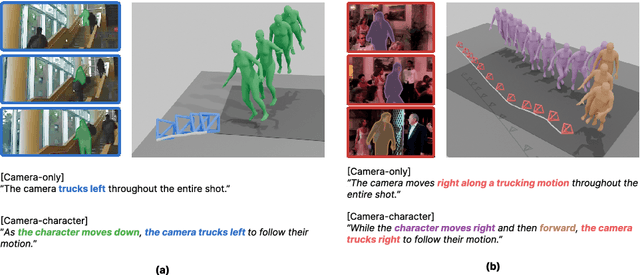
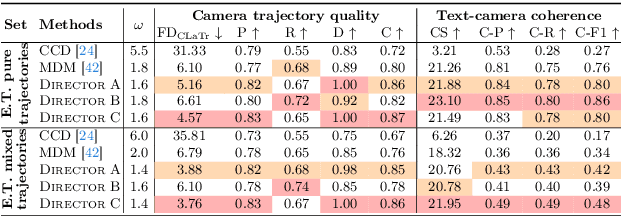
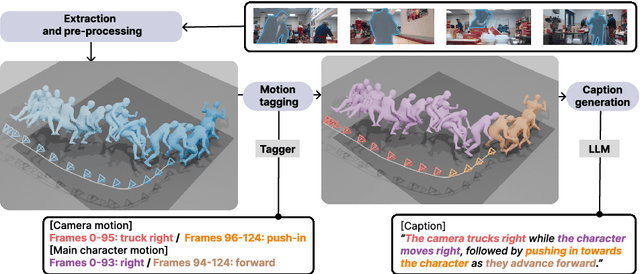
Stories and emotions in movies emerge through the effect of well-thought-out directing decisions, in particular camera placement and movement over time. Crafting compelling camera trajectories remains a complex iterative process, even for skilful artists. To tackle this, in this paper, we propose a dataset called the Exceptional Trajectories (E.T.) with camera trajectories along with character information and textual captions encompassing descriptions of both camera and character. To our knowledge, this is the first dataset of its kind. To show the potential applications of the E.T. dataset, we propose a diffusion-based approach, named DIRECTOR, which generates complex camera trajectories from textual captions that describe the relation and synchronisation between the camera and characters. To ensure robust and accurate evaluations, we train on the E.T. dataset CLaTr, a Contrastive Language-Trajectory embedding for evaluation metrics. We posit that our proposed dataset and method significantly advance the democratization of cinematography, making it more accessible to common users.
Don't drop your samples! Coherence-aware training benefits Conditional diffusion
May 30, 2024
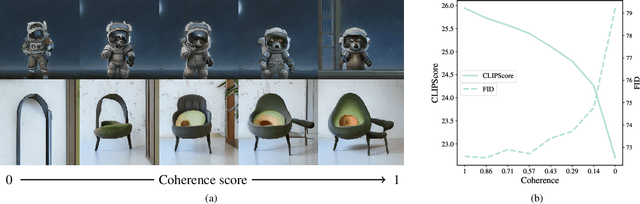
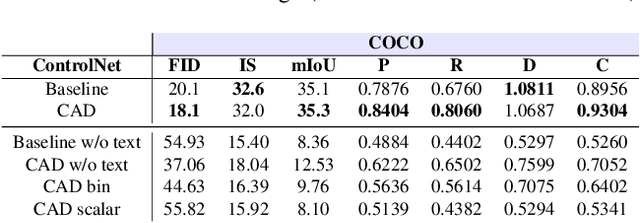
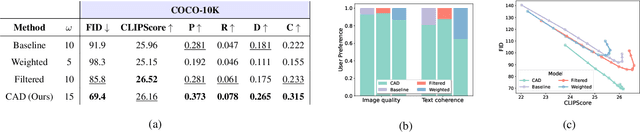
Conditional diffusion models are powerful generative models that can leverage various types of conditional information, such as class labels, segmentation masks, or text captions. However, in many real-world scenarios, conditional information may be noisy or unreliable due to human annotation errors or weak alignment. In this paper, we propose the Coherence-Aware Diffusion (CAD), a novel method that integrates coherence in conditional information into diffusion models, allowing them to learn from noisy annotations without discarding data. We assume that each data point has an associated coherence score that reflects the quality of the conditional information. We then condition the diffusion model on both the conditional information and the coherence score. In this way, the model learns to ignore or discount the conditioning when the coherence is low. We show that CAD is theoretically sound and empirically effective on various conditional generation tasks. Moreover, we show that leveraging coherence generates realistic and diverse samples that respect conditional information better than models trained on cleaned datasets where samples with low coherence have been discarded.