 Add to Chrome
 Add to Firefox
 Add to Edge
Self-conditioned Flow Map Language Models via Fixed-point Flows
Jul 01, 2026
Self-conditioning is a core technique that enhances continuous flow-based language models, where the model learns to denoise generated text by conditioning on its own denoising estimate. While empirically successful, its performance improvements are poorly understood. Moreover, there is growing interest in the use of few-step generators based on flow maps, for which how to leverage self-conditioning is unclear. Here, we show that flow language models with self-conditioning solve a fixed-point iteration that bootstraps the performance of the learned denoiser. We use this viewpoint to formulate fixed-point flows, a two-dimensional class of self-conditioned flows, where the first dimension represents the flow process and the second represents the fixed-point iteration. We show that fixed-point flows define valid flow maps, and show that they can be distilled from self-conditioned flow models by compressing both fixed-point iterations and the flow process, the former with fixed-point distillation and the latter with flow map distillation. Our resulting flow map language model, FMLM$^\star$, outperforms state-of-the-art self-conditioned models and few-step models in one- and few-step generation on OpenWebText. Code is available at https://github.com/Ugness/self-conditioned-fmlm.

Few-Step Boltzmann Generators via Scalable Likelihood Flow Maps
Jun 27, 2026Recent progress in flow-based generative modeling has led to models that output high-quality samples while using only a small number of function evaluations. However, at present, there is a lack of similar advances in estimating the model likelihood. In particular, most existing methods either rely on restrictive architectures that enable exact calculations, or use stochastic approximations such as Hutchinson's trace estimator that introduce substantial variance. In this work, we introduce SCAlable LikeLihood distillation of flOw maPs (SCALLOP). SCALLOP builds on the recently proposed F2D2, a likelihood flow map model that can generate samples and their densities in a small number of function evaluations. While F2D2 uses Hutchinson's estimator during training, we introduce an alternative and more scalable likelihood distillation objective that is Hutchinson-free and admits a vectorized formulation. Empirically, we demonstrate the effectiveness of SCALLOP as a Boltzmann generator in molecular science, and further validate its benefit on image datasets. SCALLOP significantly reduces both training variance and training time while consistently improving performance compared to F2D2, and is competitive with the state-of-the-art while achieving up to 10x inference speedup over the fastest baseline.
Posterior Refinement: Fast Language Generation via Any-Order Flow Maps
Jun 23, 2026Non-autoregressive generation offers a powerful paradigm for iterative refinement, allowing models to recursively critique, erase and regenerate arbitrary subsets of tokens. However, existing non-autoregressive models fail to realize this potential. Masked Diffusion Models (MDMs) suffer from factorization error, causing sample quality to collapse when generating multiple tokens simultaneously. Flow Map Language Models (FMLMs) circumvent this bottleneck via joint sequence transport for excellent few-step generation, but sacrifice the inference-time flexibility of MDMs. We introduce FMLM+, a framework that bridges this gap by equipping FMLM with masking-style noise schedules. While generating the full sequence in a single step, FMLM+ simultaneously scores the global consistency of each token a posteriori. We leverage this to introduce Posterior Refinement, a novel inference-time refinement strategy that enables the model to adaptively self-correct its outputs, matching the performance of discrete baselines with 32x fewer NFEs. Across diverse benchmarks, we demonstrate that FMLM+ with Posterior Refinement improves the speed--quality tradeoff over both MDM and FMLM families, providing a scalable foundation for high-fidelity language modeling.
Reactive Flux Matching: Mechanism Discovery and Adaptive Sampling of Rare Events
Jun 04, 2026Path sampling methods generate ensembles of reactive trajectories connecting metastable states, but extracting mechanistic insight from these data remains nontrivial. We introduce Flux Matching, a framework that learns two complementary objects directly from reactive trajectory data: a current velocity $u(z)$, whose streamlines trace the dominant reaction pathways, and a scalar potential $h(z)$, obtained from a weighted Helmholtz-Hodge decomposition of the reactive current, that serves as a data-driven reaction coordinate. Both minimize quadratic functionals over the reactive path ensemble, analogous to the flow matching loss in generative modeling, and require no knowledge of the underlying dynamics or stationary distribution. Unlike committor-based methods, $u$ and $h$ remain well-defined under projection onto non-Markovian collective variables, and their level sets in turn provide adaptive interfaces for improved sampling with enhanced sampling methods. Flux Matching is validated through the generation of current velocity trajectories and rate constant calculations on molecular systems.
Are we really tilting? The mechanics of reward guidance in flow and diffusion models
Jun 01, 2026Reward guidance algorithms steer a learned generative process toward the reward-tilted measure at inference time. While empirically powerful, these methods are prone to reward hacking: the guided model over-optimizes the reward at the cost of fidelity to the learned distribution. Prior work has attributed this to the complexity of neural reward functions or implicit biases in diffusion training, but its fundamental origins remain poorly understood. We show that reward hacking arises from an approximation made in most practical implementations of reward-guided diffusion -- finite-particle plug-in estimation of the Doob h-function -- even in the simplest non-trivial settings of Gaussian and Gaussian mixture targets with quadratic rewards. In closed form, we isolate two distinct failure modes of the plug-in estimator: it leads to reward hacking within each mode and it cannot select high-reward modes. We propose a closed-form reward damping schedule that corrects the within-mode bias with no additional compute, and clarify the role of best-of-n sampling in compensating for the mode selection failure. Experiments on Gaussian mixture targets, a 2D checkerboard, and FLUX.1 text-to-image generation confirm that our theoretical insights carry over to practical settings.
One-step Language Modeling via Continuous Denoising
Feb 18, 2026Language models based on discrete diffusion have attracted widespread interest for their potential to provide faster generation than autoregressive models. In practice, however, they exhibit a sharp degradation of sample quality in the few-step regime, failing to realize this promise. Here we show that language models leveraging flow-based continuous denoising can outperform discrete diffusion in both quality and speed. By revisiting the fundamentals of flows over discrete modalities, we build a flow-based language model (FLM) that performs Euclidean denoising over one-hot token encodings. We show that the model can be trained by predicting the clean data via a cross entropy objective, where we introduce a simple time reparameterization that greatly improves training stability and generation quality. By distilling FLM into its associated flow map, we obtain a distilled flow map language model (FMLM) capable of few-step generation. On the LM1B and OWT language datasets, FLM attains generation quality matching state-of-the-art discrete diffusion models. With FMLM, our approach outperforms recent few-step language models across the board, with one-step generation exceeding their 8-step quality. Our work calls into question the widely held hypothesis that discrete diffusion processes are necessary for generative modeling over discrete modalities, and paves the way toward accelerated flow-based language modeling at scale. Code is available at https://github.com/david3684/flm.
Sublinear iterations can suffice even for DDPMs
Nov 06, 2025SDE-based methods such as denoising diffusion probabilistic models (DDPMs) have shown remarkable success in real-world sample generation tasks. Prior analyses of DDPMs have been focused on the exponential Euler discretization, showing guarantees that generally depend at least linearly on the dimension or initial Fisher information. Inspired by works in log-concave sampling (Shen and Lee, 2019), we analyze an integrator -- the denoising diffusion randomized midpoint method (DDRaM) -- that leverages an additional randomized midpoint to better approximate the SDE. Using a recently-developed analytic framework called the "shifted composition rule", we show that this algorithm enjoys favorable discretization properties under appropriate smoothness assumptions, with sublinear $\widetilde{O}(\sqrt{d})$ score evaluations needed to ensure convergence. This is the first sublinear complexity bound for pure DDPM sampling -- prior works which obtained such bounds worked instead with ODE-based sampling and had to make modifications to the sampler which deviate from how they are used in practice. We also provide experimental validation of the advantages of our method, showing that it performs well in practice with pre-trained image synthesis models.
Generalised Flow Maps for Few-Step Generative Modelling on Riemannian Manifolds
Oct 24, 2025Geometric data and purpose-built generative models on them have become ubiquitous in high-impact deep learning application domains, ranging from protein backbone generation and computational chemistry to geospatial data. Current geometric generative models remain computationally expensive at inference -- requiring many steps of complex numerical simulation -- as they are derived from dynamical measure transport frameworks such as diffusion and flow-matching on Riemannian manifolds. In this paper, we propose Generalised Flow Maps (GFM), a new class of few-step generative models that generalises the Flow Map framework in Euclidean spaces to arbitrary Riemannian manifolds. We instantiate GFMs with three self-distillation-based training methods: Generalised Lagrangian Flow Maps, Generalised Eulerian Flow Maps, and Generalised Progressive Flow Maps. We theoretically show that GFMs, under specific design decisions, unify and elevate existing Euclidean few-step generative models, such as consistency models, shortcut models, and meanflows, to the Riemannian setting. We benchmark GFMs against other geometric generative models on a suite of geometric datasets, including geospatial data, RNA torsion angles, and hyperbolic manifolds, and achieve state-of-the-art sample quality for single- and few-step evaluations, and superior or competitive log-likelihoods using the implicit probability flow.
BoltzNCE: Learning Likelihoods for Boltzmann Generation with Stochastic Interpolants and Noise Contrastive Estimation
Jul 02, 2025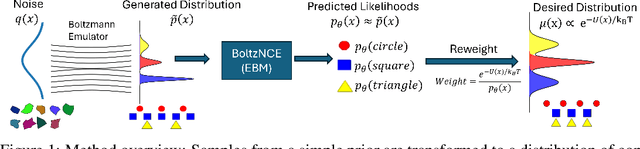

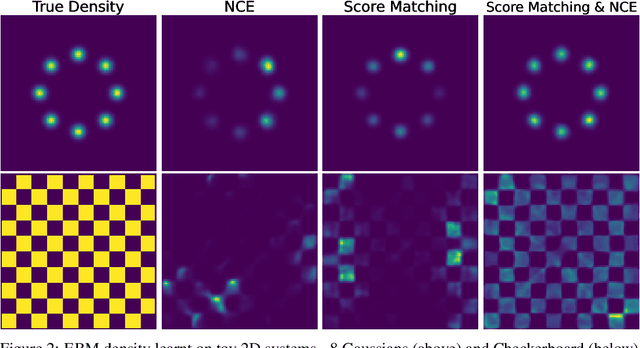
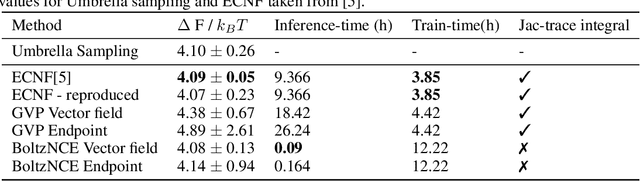
Efficient sampling from the Boltzmann distribution defined by an energy function is a key challenge in modeling physical systems such as molecules. Boltzmann Generators tackle this by leveraging Continuous Normalizing Flows that transform a simple prior into a distribution that can be reweighted to match the Boltzmann distribution using sample likelihoods. However, obtaining likelihoods requires computing costly Jacobians during integration, making it impractical for large molecular systems. To overcome this, we propose learning the likelihood of the generated distribution via an energy-based model trained with noise contrastive estimation and score matching. By using stochastic interpolants to anneal between the prior and generated distributions, we combine both the objective functions to efficiently learn the density function. On the alanine dipeptide system, we demonstrate that our method yields free energy profiles and energy distributions comparable to those obtained with exact likelihoods. Additionally, we show that free energy differences between metastable states can be estimated accurately with orders-of-magnitude speedup.
How to build a consistency model: Learning flow maps via self-distillation
May 24, 2025Building on the framework proposed in Boffi et al. (2024), we present a systematic approach for learning flow maps associated with flow and diffusion models. Flow map-based models, commonly known as consistency models, encompass recent efforts to improve the efficiency of generative models based on solutions to differential equations. By exploiting a relationship between the velocity field underlying a continuous-time flow and the instantaneous rate of change of the flow map, we show how to convert existing distillation schemes into direct training algorithms via self-distillation, eliminating the need for pre-trained models. We empirically evaluate several instantiations of our framework, finding that high-dimensional tasks like image synthesis benefit from objective functions that avoid temporal and spatial derivatives of the flow map, while lower-dimensional tasks can benefit from objectives incorporating higher-order derivatives to capture sharp features.