 Add to Chrome
 Add to Firefox
 Add to Edge
Self-conditioned Flow Map Language Models via Fixed-point Flows
Jul 01, 2026
Self-conditioning is a core technique that enhances continuous flow-based language models, where the model learns to denoise generated text by conditioning on its own denoising estimate. While empirically successful, its performance improvements are poorly understood. Moreover, there is growing interest in the use of few-step generators based on flow maps, for which how to leverage self-conditioning is unclear. Here, we show that flow language models with self-conditioning solve a fixed-point iteration that bootstraps the performance of the learned denoiser. We use this viewpoint to formulate fixed-point flows, a two-dimensional class of self-conditioned flows, where the first dimension represents the flow process and the second represents the fixed-point iteration. We show that fixed-point flows define valid flow maps, and show that they can be distilled from self-conditioned flow models by compressing both fixed-point iterations and the flow process, the former with fixed-point distillation and the latter with flow map distillation. Our resulting flow map language model, FMLM$^\star$, outperforms state-of-the-art self-conditioned models and few-step models in one- and few-step generation on OpenWebText. Code is available at https://github.com/Ugness/self-conditioned-fmlm.

Posterior Refinement: Fast Language Generation via Any-Order Flow Maps
Jun 23, 2026Non-autoregressive generation offers a powerful paradigm for iterative refinement, allowing models to recursively critique, erase and regenerate arbitrary subsets of tokens. However, existing non-autoregressive models fail to realize this potential. Masked Diffusion Models (MDMs) suffer from factorization error, causing sample quality to collapse when generating multiple tokens simultaneously. Flow Map Language Models (FMLMs) circumvent this bottleneck via joint sequence transport for excellent few-step generation, but sacrifice the inference-time flexibility of MDMs. We introduce FMLM+, a framework that bridges this gap by equipping FMLM with masking-style noise schedules. While generating the full sequence in a single step, FMLM+ simultaneously scores the global consistency of each token a posteriori. We leverage this to introduce Posterior Refinement, a novel inference-time refinement strategy that enables the model to adaptively self-correct its outputs, matching the performance of discrete baselines with 32x fewer NFEs. Across diverse benchmarks, we demonstrate that FMLM+ with Posterior Refinement improves the speed--quality tradeoff over both MDM and FMLM families, providing a scalable foundation for high-fidelity language modeling.
Infinite Mask Diffusion for Few-Step Distillation
May 11, 2026Masked Diffusion Models (MDMs) have emerged as a promising alternative to autoregressive models in language modeling, offering the advantages of parallel decoding and bidirectional context processing within a simple yet effective framework. Specifically, their explicit distinction between masked tokens and data underlies their simple framework and effective conditional generation. However, MDMs typically require many sampling iterations due to factorization errors stemming from simultaneous token updates. We observe that a theoretical lower bound of the factorization error exists, which standard MDMs cannot reduce due to their use of a deterministic single-state mask. In this paper, we propose the Infinite Mask Diffusion Model (IMDM), which introduces a stochastic infinite-state mask to mitigate the theoretical bound while directly inheriting the benefits of MDMs, including the compatibility with pre-trained weights. We empirically demonstrate that MDM fails to perform few-step generation even in a simple synthetic task due to the factorization error bound, whereas IMDM can find an efficient solution for the same task. Finally, when equipped with appropriate distillation methods, IMDM surpasses existing few-step distillation methods at small step counts on LM1B and OpenWebText. Code is available at https://Ugness.github.io/official_imdm.
One-step Language Modeling via Continuous Denoising
Feb 18, 2026Language models based on discrete diffusion have attracted widespread interest for their potential to provide faster generation than autoregressive models. In practice, however, they exhibit a sharp degradation of sample quality in the few-step regime, failing to realize this promise. Here we show that language models leveraging flow-based continuous denoising can outperform discrete diffusion in both quality and speed. By revisiting the fundamentals of flows over discrete modalities, we build a flow-based language model (FLM) that performs Euclidean denoising over one-hot token encodings. We show that the model can be trained by predicting the clean data via a cross entropy objective, where we introduce a simple time reparameterization that greatly improves training stability and generation quality. By distilling FLM into its associated flow map, we obtain a distilled flow map language model (FMLM) capable of few-step generation. On the LM1B and OWT language datasets, FLM attains generation quality matching state-of-the-art discrete diffusion models. With FMLM, our approach outperforms recent few-step language models across the board, with one-step generation exceeding their 8-step quality. Our work calls into question the widely held hypothesis that discrete diffusion processes are necessary for generative modeling over discrete modalities, and paves the way toward accelerated flow-based language modeling at scale. Code is available at https://github.com/david3684/flm.
AdaRank: Adaptive Rank Pruning for Enhanced Model Merging
Mar 28, 2025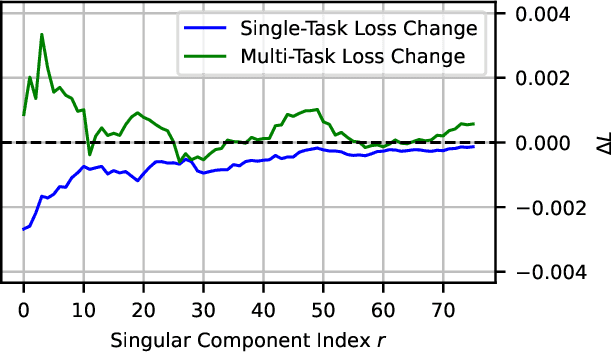
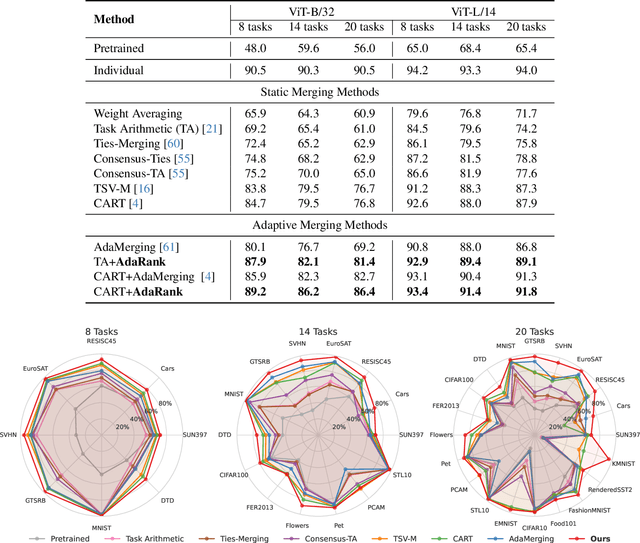
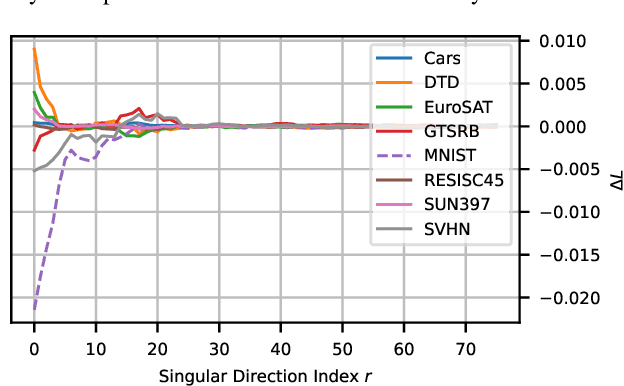
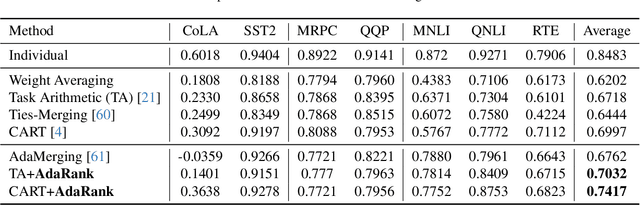
Model merging has emerged as a promising approach for unifying independently fine-tuned models into an integrated framework, significantly enhancing computational efficiency in multi-task learning. Recently, several SVD-based techniques have been introduced to exploit low-rank structures for enhanced merging, but their reliance on such manually designed rank selection often leads to cross-task interference and suboptimal performance. In this paper, we propose AdaRank, a novel model merging framework that adaptively selects the most beneficial singular directions of task vectors to merge multiple models. We empirically show that the dominant singular components of task vectors can cause critical interference with other tasks, and that naive truncation across tasks and layers degrades performance. In contrast, AdaRank dynamically prunes the singular components that cause interference and offers an optimal amount of information to each task vector by learning to prune ranks during test-time via entropy minimization. Our analysis demonstrates that such method mitigates detrimental overlaps among tasks, while empirical results show that AdaRank consistently achieves state-of-the-art performance with various backbones and number of tasks, reducing the performance gap between fine-tuned models to nearly 1%.
Revisiting Weight Averaging for Model Merging
Dec 11, 2024Model merging aims to build a multi-task learner by combining the parameters of individually fine-tuned models without additional training. While a straightforward approach is to average model parameters across tasks, this often results in suboptimal performance due to interference among parameters across tasks. In this paper, we present intriguing results that weight averaging implicitly induces task vectors centered around the weight averaging itself and that applying a low-rank approximation to these centered task vectors significantly improves merging performance. Our analysis shows that centering the task vectors effectively separates core task-specific knowledge and nuisance noise within the fine-tuned parameters into the top and lower singular vectors, respectively, allowing us to reduce inter-task interference through its low-rank approximation. We evaluate our method on eight image classification tasks, demonstrating that it outperforms prior methods by a significant margin, narrowing the performance gap with traditional multi-task learning to within 1-3%