 Add to Chrome
 Add to Firefox
 Add to Edge
Dynamic Tokenization via Reinforcement Patching: End-to-end Training and Zero-shot Transfer
Mar 27, 2026
Efficiently aggregating spatial or temporal horizons to acquire compact representations has become a unifying principle in modern deep learning models, yet learning data-adaptive representations for long-horizon sequence data, especially continuous sequences like time series, remains an open challenge. While fixed-size patching has improved scalability and performance, discovering variable-sized, data-driven patches end-to-end often forces models to rely on soft discretization, specific backbones, or heuristic rules. In this work, we propose Reinforcement Patching (ReinPatch), the first framework to jointly optimize a sequence patching policy and its downstream sequence backbone model using reinforcement learning. By formulating patch boundary placement as a discrete decision process optimized via Group Relative Policy Gradient (GRPG), ReinPatch bypasses the need for continuous relaxations and performs dynamic patching policy optimization in a natural manner. Moreover, our method allows strict enforcement of a desired compression rate, freeing the downstream backbone to scale efficiently, and naturally supports multi-level hierarchical modeling. We evaluate ReinPatch on time-series forecasting datasets, where it demonstrates compelling performance compared to state-of-the-art data-driven patching strategies. Furthermore, our detached design allows the patching module to be extracted as a standalone foundation patcher, providing the community with visual and empirical insights into the segmentation behaviors preferred by a purely performance-driven neural patching strategy.

TimeSqueeze: Dynamic Patching for Efficient Time Series Forecasting
Mar 11, 2026Transformer-based time series foundation models face a fundamental trade-off in choice of tokenization: point-wise embeddings preserve temporal fidelity but scale poorly with sequence length, whereas fixed-length patching improves efficiency by imposing uniform boundaries that may disrupt natural transitions and blur informative local dynamics. In order to address these limitations, we introduce TimeSqueeze, a dynamic patching mechanism that adaptively selects patch boundaries within each sequence based on local signal complexity. TimeSqueeze first applies a lightweight state-space encoder to extract full-resolution point-wise features, then performs content-aware segmentation by allocating short patches to information-dense regions and long patches to smooth or redundant segments. This variable-resolution compression preserves critical temporal structure while substantially reducing the token sequence presented to the Transformer backbone. Specifically for large-scale pretraining, TimeSqueeze attains up to 20x faster convergence and 8x higher data efficiency compared to equivalent point-token baselines. Experiments across long-horizon forecasting benchmarks show that TimeSqueeze consistently outperforms comparable architectures that use either point-wise tokenization or fixed-size patching.
Understanding the Effect of using Semantically Meaningful Tokens for Visual Representation Learning
May 26, 2024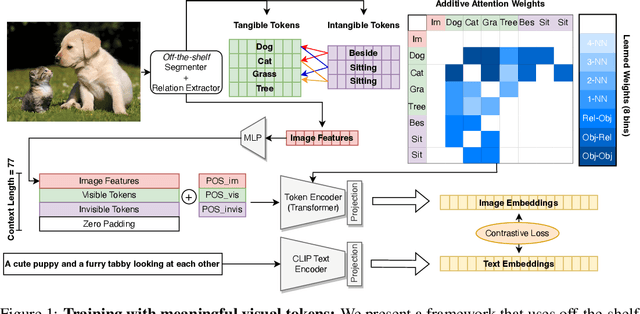
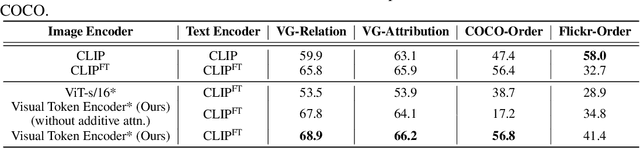
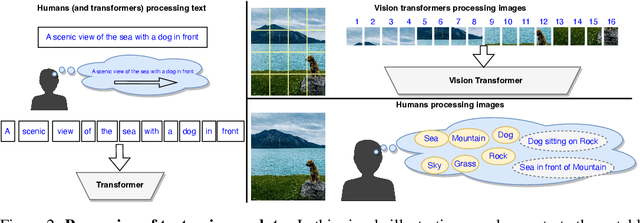
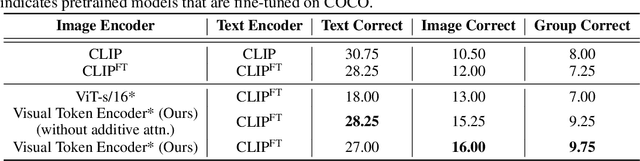
Vision transformers have established a precedent of patchifying images into uniformly-sized chunks before processing. We hypothesize that this design choice may limit models in learning comprehensive and compositional representations from visual data. This paper explores the notion of providing semantically-meaningful visual tokens to transformer encoders within a vision-language pre-training framework. Leveraging off-the-shelf segmentation and scene-graph models, we extract representations of instance segmentation masks (referred to as tangible tokens) and relationships and actions (referred to as intangible tokens). Subsequently, we pre-train a vision-side transformer by incorporating these newly extracted tokens and aligning the resultant embeddings with caption embeddings from a text-side encoder. To capture the structural and semantic relationships among visual tokens, we introduce additive attention weights, which are used to compute self-attention scores. Our experiments on COCO demonstrate notable improvements over ViTs in learned representation quality across text-to-image (+47%) and image-to-text retrieval (+44%) tasks. Furthermore, we showcase the advantages on compositionality benchmarks such as ARO (+18%) and Winoground (+10%).
From Explanation to Action: An End-to-End Human-in-the-loop Framework for Anomaly Reasoning and Management
Apr 06, 2023


Anomalies are often indicators of malfunction or inefficiency in various systems such as manufacturing, healthcare, finance, surveillance, to name a few. While the literature is abundant in effective detection algorithms due to this practical relevance, autonomous anomaly detection is rarely used in real-world scenarios. Especially in high-stakes applications, a human-in-the-loop is often involved in processes beyond detection such as verification and troubleshooting. In this work, we introduce ALARM (for Analyst-in-the-Loop Anomaly Reasoning and Management); an end-to-end framework that supports the anomaly mining cycle comprehensively, from detection to action. Besides unsupervised detection of emerging anomalies, it offers anomaly explanations and an interactive GUI for human-in-the-loop processes -- visual exploration, sense-making, and ultimately action-taking via designing new detection rules -- that help close ``the loop'' as the new rules complement rule-based supervised detection, typical of many deployed systems in practice. We demonstrate \method's efficacy through a series of case studies with fraud analysts from the financial industry.