 Add to Chrome
 Add to Firefox
 Add to Edge
Towards a General Intelligence and Interface for Wearable Health Data
May 21, 2026
While ubiquitous wearable sensors capture a wealth of behavioral and physiological information, effectively transforming these signals into personalized health insights is challenging. Specifically, converting low-level sensor data into representations capable of characterizing higher-level states is difficult due to high phenotypic diversity and variation in individual baseline health, physiology, and lifestyle factors. Moreover, collecting wearable data paired with health outcome annotations is laborious and expensive, and retrospective annotation remains practically unfeasible, contributing to a scarcity of data with high-quality labels. To overcome these limitations, we propose a foundation model for wearable health that is pretrained on more than one trillion minutes of unlabeled sensor signals drawn from a large cohort of five million participants. We demonstrate that the joint scaling of model capacity and pretraining data volume leads to systematic improvements in performance, as evaluated on a diverse set of 35 health prediction tasks, spanning cardiovascular, metabolic, sleep, and mental health, as well as lifestyle choices and demographic factors. We find that this population scale representation unlocks label-efficient few-shot learning and generative capabilities for robust daily metric estimation. To further leverage this learned representation, we deploy a classroom of LLM agents to autonomously search the space of downstream predictive heads built on the model embeddings, showing broad performance improvements that increase with LLM model capacity. Finally, we show how integrating these downstream predictors into a Personal Health Agent can support model responses that are more relevant, contextually aware, and safe, and we validate this via 1,860 ratings from a cohort of clinicians.

Lifestyle-Informed Personalized Blood Biomarker Prediction via Novel Representation Learning
Jul 09, 2024
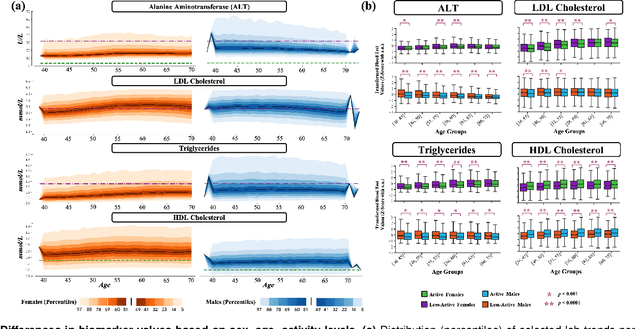
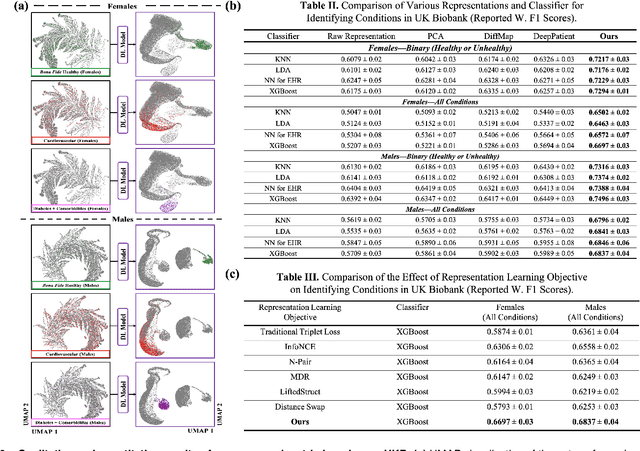
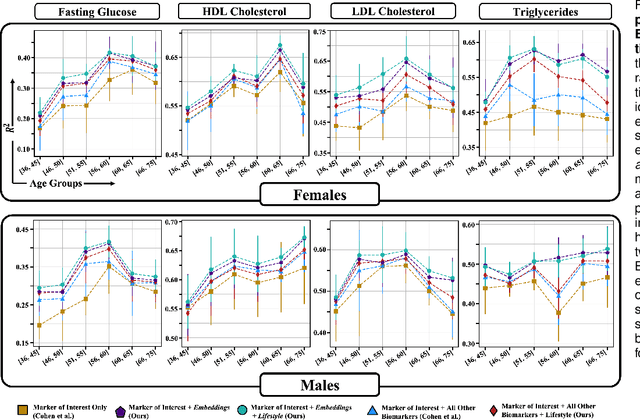
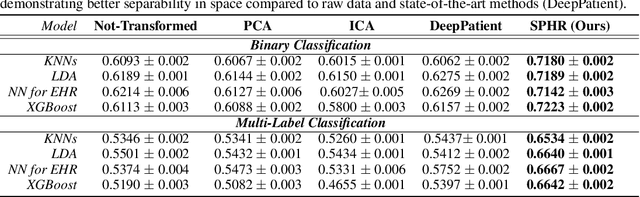
Blood biomarkers are an essential tool for healthcare providers to diagnose, monitor, and treat a wide range of medical conditions. Current reference values and recommended ranges often rely on population-level statistics, which may not adequately account for the influence of inter-individual variability driven by factors such as lifestyle and genetics. In this work, we introduce a novel framework for predicting future blood biomarker values and define personalized references through learned representations from lifestyle data (physical activity and sleep) and blood biomarkers. Our proposed method learns a similarity-based embedding space that captures the complex relationship between biomarkers and lifestyle factors. Using the UK Biobank (257K participants), our results show that our deep-learned embeddings outperform traditional and current state-of-the-art representation learning techniques in predicting clinical diagnosis. Using a subset of UK Biobank of 6440 participants who have follow-up visits, we validate that the inclusion of these embeddings and lifestyle factors directly in blood biomarker models improves the prediction of future lab values from a single lab visit. This personalized modeling approach provides a foundation for developing more accurate risk stratification tools and tailoring preventative care strategies. In clinical settings, this translates to the potential for earlier disease detection, more timely interventions, and ultimately, a shift towards personalized healthcare.
Transforming Wearable Data into Health Insights using Large Language Model Agents
Jun 11, 2024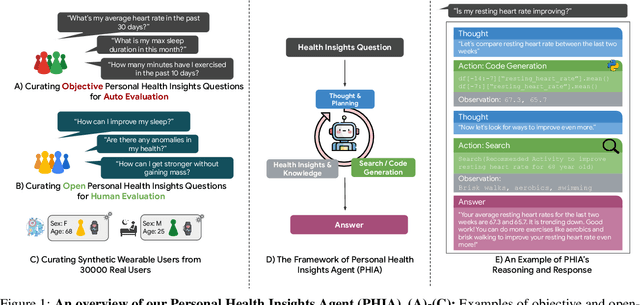

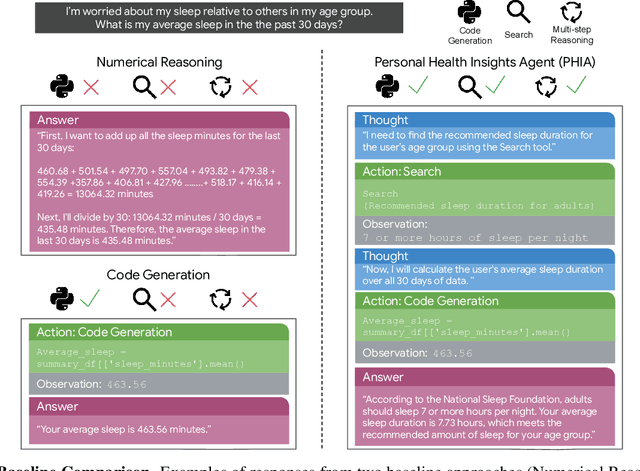
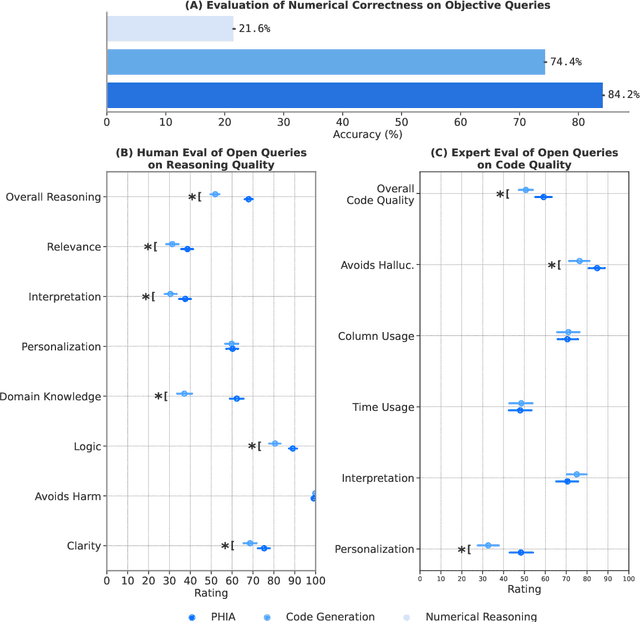
Despite the proliferation of wearable health trackers and the importance of sleep and exercise to health, deriving actionable personalized insights from wearable data remains a challenge because doing so requires non-trivial open-ended analysis of these data. The recent rise of large language model (LLM) agents, which can use tools to reason about and interact with the world, presents a promising opportunity to enable such personalized analysis at scale. Yet, the application of LLM agents in analyzing personal health is still largely untapped. In this paper, we introduce the Personal Health Insights Agent (PHIA), an agent system that leverages state-of-the-art code generation and information retrieval tools to analyze and interpret behavioral health data from wearables. We curate two benchmark question-answering datasets of over 4000 health insights questions. Based on 650 hours of human and expert evaluation we find that PHIA can accurately address over 84% of factual numerical questions and more than 83% of crowd-sourced open-ended questions. This work has implications for advancing behavioral health across the population, potentially enabling individuals to interpret their own wearable data, and paving the way for a new era of accessible, personalized wellness regimens that are informed by data-driven insights.
No Pairs Left Behind: Improving Metric Learning with Regularized Triplet Objective
Oct 18, 2022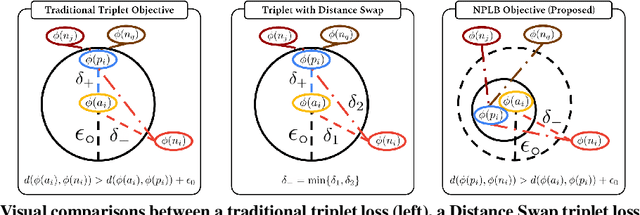

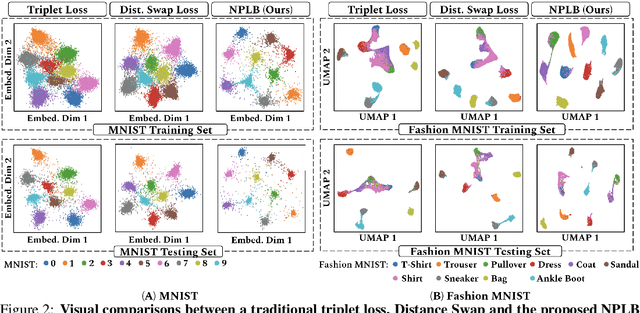
We propose a novel formulation of the triplet objective function that improves metric learning without additional sample mining or overhead costs. Our approach aims to explicitly regularize the distance between the positive and negative samples in a triplet with respect to the anchor-negative distance. As an initial validation, we show that our method (called No Pairs Left Behind [NPLB]) improves upon the traditional and current state-of-the-art triplet objective formulations on standard benchmark datasets. To show the effectiveness and potentials of NPLB on real-world complex data, we evaluate our approach on a large-scale healthcare dataset (UK Biobank), demonstrating that the embeddings learned by our model significantly outperform all other current representations on tested downstream tasks. Additionally, we provide a new model-agnostic single-time health risk definition that, when used in tandem with the learned representations, achieves the most accurate prediction of subjects' future health complications. Our results indicate that NPLB is a simple, yet effective framework for improving existing deep metric learning models, showcasing the potential implications of metric learning in more complex applications, especially in the biological and healthcare domains.